

North Atlantic Treaty
1949 treaty forming the basis of NATO
- 12 min read
- 4 chapters

Related on Lably
Through NATO, Treaty and Multilateralism
Background
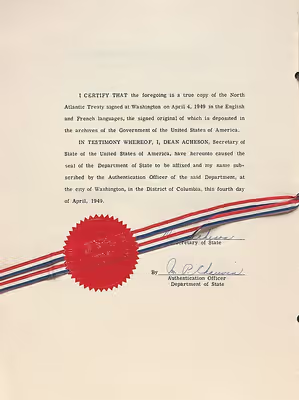
The treaty was signed in Washington, D.C., on 4 April 1949 by a committee which was chaired by US diplomat Theodore Achilles. Earlier secret talks had been held at the Pentagon between 22 March and 1 April 1948, of which Achilles said:
The talks lasted about two weeks and by the time they finished, it had been secretly agreed that there would be a treaty, and I had a draft of one in the bottom drawer of my safe. It was never shown to anyone except Jack [Hickerson]. I wish I had kept it, but when I left the Department in 1950, I dutifully left it in the safe and I have never been able to trace it in the archives. It drew heavily on the Rio Treaty, and a bit of the Brussels Treaty, which had not yet been signed, but of which we were being kept heavily supplied with drafts. The eventual North Atlantic Treaty had the general form, and a good bit of the language of my first draft, but with a number of important differences.
According to Achilles, another important author of the treaty was John D. Hickerson:
More than any human being Jack was responsible for the nature, content, and form of the Treaty...It was a one-man Hickerson treaty.
As a fundamental component of NATO, the North Atlantic Treaty is a product of the US' desire to avoid overextension at the end of World War II, and consequently pursue multilateralism in Europe. It is part of the US' collective defense arrangement with Western European powers, following a long and deliberative process. The treaty was created with an armed attack by the Soviet Union against Western Europe in mind, although the mutual self-defense clause was never invoked during the Cold War.
By signing the North Atlantic Treaty, parties are "determined to safeguard the freedom, common heritage and civilization of the peoples, founded on the principles of democracy, individual liberty and the rule of law."
Sign in to keep reading
3 more chapters are free with a Lably account.
Members
Founding members
The following twelve states signed the treaty and thus became the founding members of NATO. The following leaders signed the agreement as plenipotentiaries of their countries in Washington, D.C., on 4 April 1949:
- Belgium – Prime Minister and Foreign Minister Paul-Henri Spaak and Ambassador Baron Robert Silvercruys
- Canada – Secretary of State for External Affairs Lester B. Pearson and Ambassador H. H. Wrong
- Denmark – Foreign Minister Gustav Rasmussen and Ambassador Henrik Kauffmann
- France – Foreign Minister Robert Schuman and Ambassador Henri Bonnet
- Iceland – Foreign Minister Bjarni Benediktsson and Ambassador Thor Thors
- Italy – Foreign Minister Carlo Sforza and Ambassador Alberto Tarchiani
- Luxembourg – Foreign Minister Joseph Bech and Ambassador Hugues Le Gallais
- Netherlands – Foreign Minister Dirk Stikker and Ambassador Eelco van Kleffens
- Norway – Foreign Minister Halvard M. Lange and Ambassador Wilhelm von Munthe af Morgenstierne
- Portugal – Foreign Minister José Caeiro da Mata and Ambassador Pedro Teotónio Pereira
- United Kingdom – Foreign Secretary Ernest Bevin and Ambassador Oliver Franks
- United States – Secretary of State Dean Acheson
Non-founding members who joined before the dissolution of the Soviet Union
The following four states joined the treaty after the 12 founding states, but before the dissolution of the Soviet Union:
Members who joined after the dissolution of the Soviet Union
The following 16 states joined the treaty after the dissolution of the Soviet Union:
Withdrawal
No state has rescinded its membership, but some dependencies and jurisdictions of member states that had prior NATO mutual defense protection under Article 6 have not requested membership after becoming independent or handed over to non-NATO states, e.g.:
Provisions
Article 1
Article 1 of the treaty states that member parties "settle any international disputes in which they may be involved by peaceful means in such a manner that international peace and security, and justice, are not endangered, and to refrain in their international relations from the threat or use of force in any manner inconsistent with the purposes of the United Nations."
Members seek to promote stability and well-being in the North Atlantic area through preservation of peace and security in accordance with the Charter of the United Nations.
Article 2
Article 2 of the treaty stipulates that "The Parties will contribute toward the further development of peaceful and friendly international relations by strengthening their free institutions, by bringing about a better understanding of the principles upon which these institutions are founded, and by promoting conditions of stability and well-being. They will seek to eliminate conflict in their international economic policies and will encourage economic collaboration between any or all of them." This is sometimes referred to as the Canada Clause after Pearson pushed for its inclusion in the treaty. This included proposals for a trade council, cultural program, technological sharing, and an information program. Of those, only the latter two were passed. Nonetheless, it has been brought up by observers commenting on trade disputes between members.
Article 3
Article 3 of the treaty states that "In order more effectively to achieve the objectives of this Treaty, the Parties, separately and jointly, by means of continuous and effective self-help and mutual aid, will maintain and develop their individual and collective capacity to resist armed attack."
This was interpreted in 2022 as the basis for the target for a 2% GDP expenditure rule, which was established as a loose guideline in 2006. This metric was confirmed again during the 2014 Wales summit.
It has also been used as a core concept for a mandate to strengthen member resilience: the ability to resist and recover from major disasters, failures in infrastructure, or traditional armed attack. This commitment was first accepted during the 2016 Warsaw summit, and further reiterated and clarified due to the COVID-19 pandemic in 2021. In accordance with NATO documents, this has been understood to include seven key areas:
- Continuity of government during a crisis
- Energy and power grid infrastructure resilience
- Immigration control
- Food and water security
- Medical emergencies
- Resilient civil communications
- Effective transportation networks
Article 4
Article 4 is generally considered the starting point for major NATO operations, and therefore is intended for either emergencies or situations of urgency. It officially calls for consultation over military matters when "the territorial integrity, political independence or security of any of the parties is threatened." Upon its invocation, the issue is discussed in the North Atlantic Council, and can formally lead into a joint decision or action (logistic, military, or otherwise) on behalf of the Alliance.
Invocations
It has been invoked nine times as of 19 September 2025.
Threatened invocations
There have also been instances where Article 4 was not formally invoked, but instead threatened. In fact, this was viewed as one of the original intentions for Article 4: as a means to elevate issues and provide member nations a means of deterrence. For example, in November 2021, the Polish foreign ministry—along with Estonia, Lithuania, and Latvia—briefly considered triggering Article 4 due to the Belarusian migrant crisis, but it was not formally requested. On 28 December 2024, Swedish member of parliament and former minister of defense, Peter Hultqvist wanted the government to activate Article 4 in response to the 2024 Baltic Sea submarine cable disruptions and in September 2025, Denmark also considered it after unauthorised drone flights over airports and military bases in the country.
Article 5
The key section of the treaty is Article 5. Its commitment clause defines the casus foederis. It commits each member state to consider an armed attack against one member state, in the areas defined by Article 6, to be an armed attack against them all. Upon such attack, each member state is to assist by taking "such action as [the member state] deems necessary, including the use of armed force, to restore and maintain the security of the North Atlantic area." The article has only been invoked once, but considered in a number of other cases.
Invocations
September 11 attacks
Article 5 has been invoked only once in NATO history, after the September 11 attacks on the United States in 2001. Following the September 11 attacks, the Secretary General of NATO, George Robertson telephoned Colin Powell and said that declaring an Article 5 contingency would be a useful political statement for NATO to make. The United States indicated it had no interest in making such a request itself; however, it would not object to the council taking such action on its own.
Threatened invocations
Article 6
Article 6 states that Article 5 covers only member states' territories in Europe, North America, Turkey, and islands in the Atlantic north of the Tropic of Cancer.
A clarification regarding the territories to which Article 5 applies was issued by Article 2 of the Protocol to the North Atlantic Treaty on the accession of Greece and Turkey signed on 22 October 1951. Subsequent expansions, such as to West Germany in 1955, were treated in the same way. A further clarification was made in a NAC meeting on July 3, 1962 that Algeria (which was explicitly included in the original text as "Algerian departments of France") was no longer included.
In 1954, following India's annexation of Dadra and Nagar Haveli, the Portuguese government was precluded from invoking Article 5 due to Article 6, but it was understood at the time that Article 4 could be invoked.
It was the opinion in August 1965 of the US State Department, the US Defense Department, and the legal division of NATO that an attack on the North Pacific U.S. island state of Hawaii would not trigger the treaty, but an attack on the other 49 would. The Aleutian Islands in the North Pacific are not treated in the same manner by NATO as Hawaii is, since they are politically part of Alaska rather than their own state like Hawaii, and considered geographically part of North America, while Hawaii is not. Similarly, Mediterranean islands like Sicily, Corsica, the Baleares, etc. are considered geographically part of Europe, and therefore under Article 6. However, even though islands like Puerto Rico are considered part of North America, they do not fall under NATO because specifically those islands that are in the Atlantic have to be north of the Tropic of Cancer. The Spanish cities of Ceuta and Melilla on the North African shore are not under NATO protection in spite of Moroccan claims to them. Legal experts have interpreted that other articles could cover the Spanish North African cities but this take has not been tested in practice. This is also why events such as the Balyun airstrikes did not trigger Article 5, as the Turkish troops that were attacked were in Syria, not Turkey. As well as why the 1982 invasion of the Falkland Islands by Argentina did not trigger Article 5, as the Falkland Islands are in the South Atlantic, south of the Tropic of Cancer, and not within the geographic area covered by Article 6.
On 16 April 2003, NATO agreed to take command of the International Security Assistance Force (ISAF) in Afghanistan, which includes troops from 42 countries. The decision came at the request of Germany and the Netherlands, the two states leading ISAF at the time of the agreement, and all nineteen NATO ambassadors approved it unanimously. The handover of control to NATO took place on 11 August, and marked the first time in NATO's history that it took charge of a mission outside of the area delineated by Article 6.
Article 7
Article 7 states that the North Atlantic Treaty shall not be interpreted as affecting in any way the rights and obligations of member countries under the charter of the United Nations, or the primary responsibility of the United Nations Security Council for the maintenance of international peace and security.
Article 8
Article 8 is one of the more rarely referenced provisions of the North Atlantic Treaty. It regulates the relationship between the obligations of the NATO members under the treaty and other obligations of the allied nations (among themselves or with third parties). According to Article 8, members should not have any international commitments in conflict with the treaty, and undertake not to enter into any international "engagement" in conflict with the treaty. The following is a list of such active, intra-NATO military treaties.
Article 9
Establishes the North Atlantic Council, and is the only NATO body that derives its authority directly from the treaty. Its primary objectives as stated in the treaty is the enforcement of Article 3 and Article 5.
The article also empowers the Council to establish subsidiary bodies as necessary and specifically directed it to create a defence committee to recommend measures for implementing Articles 3 and 5.
Article 10
Article 10 dictates the process by which other countries may join NATO, which is by unanimous agreement by current NATO members. Further, new NATO members can only consist of other European nations. In practice, this has turned into a set of action plans which an aspiring nation must follow in order to become a member, including the Membership Action Plan (MAP) mechanism and Intensified Dialogue formula.
Article 11
Article 11 indicated the process of the initial ratification of the treaty. Each signatory nation was required to ratify the treaty through their respective constitutional processes. In order to come into force, the treaty had to be ratified by Belgium, Canada, France, Luxembourg, the Netherlands, the United Kingdom, and the United States.
Article 12
Article 12 states the process by which the treaty may be amended, provided such amendments still affect the North Atlantic area and do not violate the Charter of the United Nations. In practice, this has only been used to clearly delineate which territories are under the purview of NATO.
Article 13
Article 13 delimits the process by which a member leaves NATO, which simply consists of a one-year notice by the member nation to the U.S. government in its role as the treaty depositary, which then promulgates the notice to the other member nations. This has been contemplated by a number of member nations, but so far has not happened aside from withdrawals due to independence of former territories or dependencies (namely, Algeria, Malta, and Cyprus).
Otherwise, the next closest option for a member nation is to instead withdraw from NATO's military command structure, but not from NATO entirely. This happened with France in 1966, which rejoined in 2009; and with Greece in 1974, which rejoined in 1980 after the new Turkish military government ended its objections to Greek re-entry.
Article 14
Article 14 notes the official languages of NATO as English and French, and that the United States government shall promulgate copies of the treaty to the other member nations.
Changes since signing
Three official footnotes have been released to reflect the changes made since the treaty was written:
Regarding Article 6:
- The definition of the territories to which Article 5 applies was revised by Article 2 of the Protocol to the North Atlantic Treaty on the accession of Greece and Turkey signed on 22 October 1951.
Regarding Article 6:
- On 16 January 1963, the North Atlantic Council noted that insofar as the former Algerian Departments of France were concerned, the relevant clauses of this Treaty had become inapplicable as from 3 July 1962.
Regarding Article 11:
- The Treaty came into force on 24 August 1949, after the deposition of the ratifications of all signatory states.
Potential military conflict between NATO members
Full-scale war between two or more NATO members has never occurred, and is not allowed by Article 1. Should conflict occur, there is not a well-established procedure as to what would happen. One argument is that by Article 8, the two members fall under abeyance of the Treaty; or that due to Article 5, NATO allies would thus enter into war against the aggressor party.
There have been several militarised disputes between NATO allies that have threatened this: