


Related on Lably
Through Biodiversity, Animal and Bone
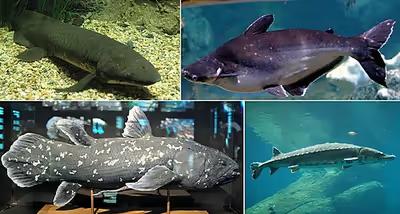
The group is divided into two main clades, the ray-finned fish (Actinopterygii, which makes up the vast majority of extant fish) and the lobe-finned fish (Sarcopterygii, which gave rise to all land vertebrates). The oldest known fossils of bony fish are about 436 million years old from the early Silurian period, which are also transitional fossils showing a tooth pattern that is in between the tooth rows of sharks and true bony fishes. Despite the name, these early basal bony fish had not yet evolved ossification and their skeletons were still mostly cartilaginous, and the main distinguishing feature that set them apart from other fish clades were the development of foregut pouches that eventually evolved into the swim bladders and lungs, respectively.
Osteichthyes is broadly equivalent to Euteleostomi. In paleontology the terms are synonymous. In ichthyology the difference is that Euteleostomi presents a cladistic view which includes the terrestrial tetrapods that evolved from lobe-finned fish. Until recently, the view of most ichthyologists has been that Osteichthyes were paraphyletic and include only fishes. However, since 2013 widely cited ichthyology papers have been published with phylogenetic trees that treat the Osteichthyes as a clade including tetrapods.
Characteristics
Bony fish are characterized by a relatively stable pattern of cranial bones, rooted, medial insertion of mandibular muscle in the lower jaw. The head and pectoral girdles are covered with large dermal bones. The eyeball is supported by a scleral ring of four small bones, but this characteristic has been lost or modified in many modern species. The labyrinth in the inner ear contains large otoliths. The braincase, or neurocranium, is frequently divided into anterior and posterior sections divided by a fissure.
Early bony fish had simple respiratory diverticula (an outpouching on either side of the esophagus) which helped them breathe air in low-oxygen water as a form of supplementary enteral respiration. In ray-finned fish these have evolved into swim bladders, the changing sizes of which help to alter the body's specific density and buoyancy. In elpistostegalians, a crown group of lobe-finned fish that gave rise to the land-dwelling tetrapods, these respiratory diverticula became further specialized for obligated air breathing and evolved into the modern amphibian, reptilian, avian and mammalian lungs. Early bony fish did not have fin spines like most modern fish, but instead had the fleshy paddle-like fins similar to other non-bony clades of fish, although the lobe-finned fish evolved articulated appendicular skeletons within their paired fins, which gave rise to tetrapods' limbs. They also evolved a pair of opercula (gill covers), which can actively draw water across the gills so they can breathe without having to swim.
Bony fish do not have placoid scales like cartilaginous fish, but instead have scales that lie underneath the epidermis and do not penetrate it. The three categories of scales in Osteichthyes are cosmoid scales, ganoid scales, and teleost scales. Teleost scales are then divided into two subgroups which are cycloid scales and ctenoid scales. All of these scales have a base of bone that they all originate from; the main difference is that teleost scales have only one layer of bone. Ganoid scales have lamellar bone, and vascular bone that lies on top of the lamellar bone, then enamel that lies on top of both layers of bone. Cosmoid scales have the same two layers of bone that ganoid scales have except that they have dentin in between the enamel and vascular bone.
Sign in to keep reading
5 more chapters are free with a Lably account.
Classification
Traditionally, Osteichthyes was considered a class, recognised on the presence of a swim bladder, only three pairs of gill arches hidden behind a bony operculum, and a predominantly bony skeleton. Under this classification system, Osteichthyes was considered paraphyletic with regard to land vertebrates, as the common ancestor of all osteichthyans includes tetrapods amongst its descendants. While the largest subclass, Actinopterygii (ray-finned fish), is monophyletic, with the inclusion of the smaller subclass Sarcopterygii, Osteichthyes was regarded as paraphyletic.
This has given way to the current cladistic classification which splits the Osteichthyes into several clades. Under this scheme Osteichthyes is monophyletic, as it includes the tetrapods making it a synonym of the clade Euteleostomi. Most bony fish belong to the ray-finned fish (Actinopterygii).
In ichthyology the difference between Euteleostomi and Osteichthyes is that the former presents a cladistic view, i.e. that the terrestrial tetrapods evolved from lobe-finned fish (Sarcopterygii). Until recently, the view of most ichthyologists has been that Osteichthyes were paraphyletic and include only bony fishes. However, since 2013 widely cited ichthyology papers have been published with phylogenetic trees that treat the Osteichthyes as a clade including tetrapods, making the terms Euteleostomi and Osteichthyes synonymous.
Phylogeny
A phylogeny of living Osteichthyes, including the tetrapods, is shown in the cladogram below. Whole-genome duplication took place in the ancestral Osteichthyes.
Biology
All bony fish possess gills. For the majority this is their sole or main means of respiration. Lungfish and other osteichthyan species are capable of respiration through lungs or vascularized swim bladders. Other species can respire through their skin, intestines, and/or stomach.
Osteichthyes are primitively ectothermic (cold blooded), meaning that their body temperature is dependent on that of the water. But some of the larger marine osteichthyids, such as the opah, swordfish and tuna have independently evolved various levels of endothermy. Bony fish can be any type of heterotroph: numerous species of omnivore, carnivore, herbivore, filter-feeder, detritivore, or hematophage are documented.
Some bony fish are hermaphrodites, and a number of species exhibit parthenogenesis. Fertilization is usually external, but can be internal. Development is usually oviparous (egg-laying) but can be ovoviviparous, or viviparous. Although there is usually no parental care after birth, before birth parents may scatter, hide, guard or brood eggs, with sea horses being notable in that the males undergo a form of "pregnancy", brooding eggs deposited in a ventral pouch by a female.
Examples
The giant sunfish is the heaviest non-tetrapod bony fish in the world. In late 2021, Portuguese fishermen found a dead sunfish near the coast of Faial Island, Azores. At 2,744 kilograms (6,049 lb) in weight, 3.6 metres (12 ft) in height, and 3.5 metres (11 ft) in length, it was the biggest giant sunfish ever captured.
The longest is the king of herrings, a type of oarfish. Other very large bony fish include the Atlantic blue marlin, some specimens of which have been recorded as in excess of 820 kilograms (1,810 lb), the black marlin, some sturgeon species, and the giant and goliath grouper, both of which can exceed 300 kilograms (660 lb) in weight. In contrast, Paedocypris progenetica and the stout infantfish can measure less than 8 millimetres (0.31 in). The beluga sturgeon is the largest species of freshwater bony fish extant today, and Arapaima gigas is among the largest of the freshwater fish. The largest non-tetrapod bony fish ever was Leedsichthys, which dwarfed the beluga sturgeon as well as the ocean sunfish, giant grouper and all the other extant non-tetrapod bony fishes.