


Related on Lably
Through Marine life and Gastrointestinal tract
The Gymnarchidae (the only species being Gymnarchus niloticus, the African knifefish) and the Mormyridae are weakly electric fish able to sense their prey using electric fields.
The mooneyes (Hiodontidae) are often classified here, but may also be placed in a separate order, Hiodontiformes.
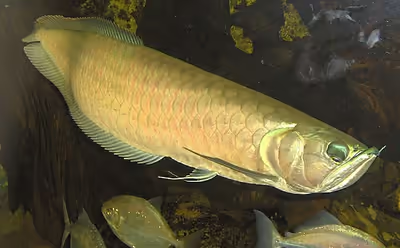
Members of the order are notable for having toothed or bony tongues, and for having the forward part of the gastrointestinal tract pass to the left of the oesophagus and stomach (for all other fish it passes to the right). In other respects, osteoglossiform fishes vary considerably in size and form; the smallest is Pollimyrus castelnaui, at just 2 centimetres (0.79 in) long, while the largest, the arapaima (Arapaima gigas), reaches as much as 2.5 metres (8.2 ft).
Phylogeny
Phylogeny based on the following works:
Sign in to keep reading
One more chapter is free with a Lably account.
Families
Eschmeyer's Catalog of Fishes does not recognise suborders within the order Osteoglossiformes and recognises the following families:
- Family Pantodontidae Peters, 1876 (freshwater butterfly fishes)
- Family Osteoglossidae Bonaparte, 1845 (bonytongues)
- Family Arapaimidae Bonaparte, 1846 (arapaimas)
- Family Notopteridae Bleeker, 1851 (featherfin knifefishes or featherbacks)
- Subfamily Notopterinae Bleeker, 1851 (Asiatic featherbacks)
- Subfamily Xenomystinae Greenwood, 1963 (African knifefishes)
- Family Mormyridae Bonaparte, 1831 (elephantfishes)
- Family Gymnarchidae Bleeker, 1859 (abas)