


Related on Lably
Through Bird, Antarctica and Iceland
Species list in taxonomic sequence
The taxonomy of family Charadriidae is unsettled. At various times the plovers, dotterels, and lapwings of family Charadriidae have been distributed among several subfamilies, with Charadriinae including most of the species. The International Ornithological Congress (IOC) and the Clements taxonomy do not assign species to subfamilies. The South American Classification Committee of the American Ornithological Society (AOS) includes all of the species in Charadriinae. The North American Classification Committee of the AOS and BirdLife International's Handbook of the Birds of the World separate the four members of genus Pluvialis as subfamily Pluvialinae. In the past, the lapwings in the genus Vanellus were widely treated in a further subfamily Vanellinae, but this was subsequently found to leave the Charadriinae paraphyletic, with the genus Anarhynchus, mostly long included within Charadrius, being more closely related to Vanellus than it is to Charadrius, despite the close plumage and structural similarities between Anarhynchus and Charadrius.
The IOC accepts the following 69 species of plovers, dotterels, and lapwings in the family Charadriidae. They are distributed among 11 genera, some of which have only one species. This list is presented according to the IOC taxonomic sequence and can also be sorted alphabetically by common name and binomial.
Sign in to keep reading
3 more chapters are free with a Lably account.
Description
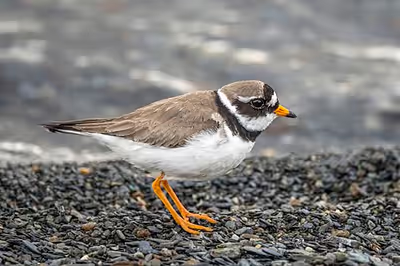
Plovers are found throughout the world, with the exception of the driest parts of the Sahara Desert (where they may occur on migration) and Antarctica, and are small to medium-sized waders ranging from 12–38 cm (4.7–15.0 in) long, characterised by relatively short bills. They hunt by sight, rather than by feel as longer-billed waders like snipe do. They feed mainly on insects, worms or other invertebrates, depending on the habitat, which are obtained by a run-and-pause technique, rather than the steady probing of some other wader groups. Plovers engage in false brooding, a type of distraction display. Examples include pretending to change position or to sit on an imaginary nest site.
Ecology
Many of the tropical and warm-temperate species are resident and individuals may spend their entire lives in a small territory on a single beach, but others, notably the Pluvialis species, and common ringed plover and semipalmated plover in Charadrius, are among the longest-distance migrant landbirds in the world. These breed on the Arctic Ocean coasts, and winter south to southernmost South America, South Africa, and New Zealand, with e.g. grey plovers breeding on the Arctic coast of Siberia migrating 14,000 km to South Africa.
In folklore
The European golden plover spends summers in Iceland, and in Icelandic folklore, the appearance of the first plover in the country means that spring has arrived. The Icelandic media always covers the first plover sighting.