


Related on Lably
Through Chemical formula, Electroplating and Hydrolysis
The moist solid emits small amounts of hydrogen cyanide due to hydrolysis (reaction with water). Hydrogen cyanide is often described as having an odor resembling that of bitter almonds.
The taste of potassium cyanide has been described as acrid and bitter, with a burning sensation similar to lye. However, potassium cyanide kills so rapidly its taste has not been reliably documented. In 2006, an Indian man killed himself using potassium cyanide. In the suicide note he left, the final words written were that potassium cyanide "burns the tongue and tastes acrid".
Production
KCN is produced by treating hydrogen cyanide with an aqueous solution of potassium hydroxide, followed by evaporation of the solution in a vacuum:
- HCN + KOH → KCN + H2O
About 50,000 short tons (45,000,000 kg) of potassium cyanide are produced yearly.
Historical production
Before 1900 and the invention of the Castner process, potassium cyanide was the most important source of alkali metal cyanides. In this historical process, potassium cyanide was produced by decomposing potassium ferrocyanide:
- K4[Fe(CN)6] → 4 KCN + FeC2 + N2
Sign in to keep reading
4 more chapters are free with a Lably account.
Structure
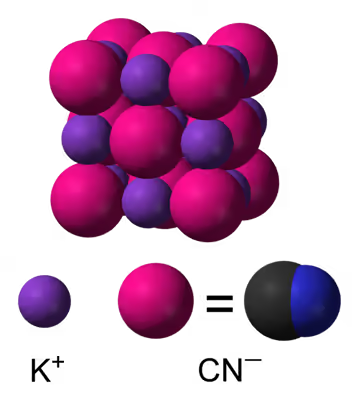
In aqueous solution, KCN is dissociated into hydrated potassium (K+) ions and cyanide (CN−) ions. As a solid, KCN has structure resembling sodium chloride: with each potassium ion surrounded by six cyanide ions, and vice versa. Despite being diatomic, and thus less symmetric than chloride, the cyanide ions rotate so rapidly that their time-averaged shape is spherical. At low temperature and high pressure, this free rotation is hindered, resulting in a less symmetric crystal structure with the cyanide ions arranged in sheets.
Applications
KCN and sodium cyanide (NaCN) are widely used in organic synthesis for the preparation of nitriles and carboxylic acids, particularly in the von Richter reaction. It also finds use for the synthesis of hydantoins, which can be useful synthetic intermediates, when reacted with a carbonyl compound such as an aldehyde or ketone in the presence of ammonium carbonate.
KCN is used as a photographic fixer in the wet plate collodion process. The KCN dissolves silver where it has not been made insoluble by the developer. This reveals and stabilizes the image, making it no longer sensitive to light. Modern wet plate photographers may prefer less toxic fixers, often opting for sodium thiosulfate, but KCN is still used.
In the 19th century, cyanogen soap, a preparation containing potassium cyanide, was used by photographers to remove silver stains from their hands.
Potassium gold cyanide
In gold mining, KCN forms the water-soluble salt potassium gold cyanide (or gold potassium cyanide) and potassium hydroxide from gold metal in the presence of oxygen (usually from the surrounding air) and water:
- 4 Au + 8 KCN + O2 + 2 H2O → 4 K[Au(CN)2] + 4 KOH
Analytical chemistry
In analytical chemistry, potassium cyanide is used as complexing agent for chemical analysis of zinc in water and wastewater. The cyanide group complexes zinc and other heavy metals, which is separated and analyzed in a spectro-photometer.
Toxicity
Potassium cyanide is a potent inhibitor of cellular respiration, acting on mitochondrial cytochrome c oxidase, hence blocking oxidative phosphorylation. Lactic acidosis then occurs as a consequence of anaerobic metabolism. Initially, acute cyanide poisoning causes a red or ruddy complexion in the victim because the tissues are not able to use the oxygen in the blood. The effects of potassium cyanide and sodium cyanide are identical, and symptoms of poisoning typically occur within a few minutes of ingesting the substance: the person loses consciousness, and brain death eventually follows. During this period the victim may suffer convulsions. Death is caused by histotoxic hypoxia/cerebral hypoxia. The expected LD100 dose (human) for potassium cyanide is 200–300 mg while the median lethal dose (LD50) is estimated at 140 mg.
Disposal
Due to toxicity considerations, the disposal of cyanide is subject to stringent regulations. Industrial cyanide effluent is typically destroyed by oxidation using peroxysulfuric acid, hydrogen peroxide, sulfur dioxide/copper salts ("Inco process") or all three ("Combiox Process"). Use of sodium hypochlorite, traditional for laboratory-scale wastes, is impractical on a commercial scale. Hydrolysis at higher temperatures is highly effective, but requires specialized equipment. Lastly, cyanide wastes can be acidified for recovery of hydrogen cyanide.