


Related on Lably
Through Mineral, Atom and Chemical formula
Quartz exists in two forms, the normal α-quartz and the high-temperature β-quartz, both of which are chiral. The transformation from α-quartz to β-quartz takes place abruptly at 573 °C (846 K; 1,063 °F). Since the transformation is accompanied by a significant change in volume, it can easily induce microfracturing of ceramics or rocks passing through this temperature threshold.
There are many different varieties of quartz, several of which are classified as gemstones. Since antiquity, varieties of quartz have been the most commonly used minerals in the making of jewelry and hardstone carvings, especially in Europe and Asia.
Quartz is the mineral defining the value of 7 on the Mohs scale of hardness, a qualitative scratch method for determining the hardness of a material.
Etymology
The word quartz is derived from the German word Quarz, which had the same form in the first half of the 14th century in Middle High German and in East Central German and which came from the Polish dialect term kwardy, which corresponds to the Czech term tvrdý ('hard'). Some sources, however, attribute the word's origin to the Saxon word Querkluftertz, meaning 'cross-vein ore'.
The Ancient Greeks referred to quartz as κρύσταλλος (krustallos) meaning 'crystal', derived from the Ancient Greek κρύος (kruos) meaning 'icy cold', because some philosophers (including Theophrastus) believed the mineral to be a form of supercooled ice. Today, the term rock crystal is sometimes used as an alternative name for transparent, coarsely crystalline quartz.
Sign in to keep reading
10 more chapters are free with a Lably account.
Early studies
Roman naturalist Pliny the Elder believed quartz to be ice, permanently frozen after great lengths of time. He supported this idea by saying that quartz is found near glaciers in the Alps, but not in warm climates. This idea persisted until at least the 17th century.
In the 17th century, Nicolas Steno's study of quartz paved the way for modern crystallography. He discovered that, regardless of a quartz crystal's size or shape, its long prism faces always meet at a perfect 60° angle, thereby establishing the law of constancy of interfacial angles.
Crystal habit and structure
Quartz can form as two distinct polymorphs depending on the temperature and pressure: α-quartz (also called low quartz or normal quartz) and β-quartz (also called quartz-beta or high quartz). α-quartz crystallizes in the trigonal crystal system, while β-quartz has greater symmetry and crystallizes in the hexagonal crystal system. The transition from α-quartz to β-quartz occurs abruptly at 573 °C (1,063 °F; 846 K) at ambient pressure; the transition temperature is greater at higher pressures. β-quartz is unstable at room temperature; therefore, all quartz at room temperature is α-quartz regardless of which polymorph it formed as.
Both polymorphs of quartz can occur in two different space groups depending on the chirality. Above the transition temperature, α-quartz in P3121 (space group 152) becomes β-quartz in P6422 (space group 181), and α-quartz in P3221 (space group 154) becomes β-quartz in P6222 (space group 180).
These space groups are truly chiral (they each belong to the 11 enantiomorphous pairs). Both α-quartz and β-quartz are examples of chiral crystal structures composed of achiral building blocks (SiO4 tetrahedra in the present case). The transformation between α- and β-quartz only involves a comparatively minor rotation of the tetrahedra with respect to one another, without a change in the way they are linked. However, there is a significant change in volume during this transition, and this can result in significant microfracturing in ceramics during firing, in ornamental stone after a fire and in rocks of the Earth's crust exposed to high temperatures, thereby damaging materials containing quartz and degrading their physical and mechanical properties.
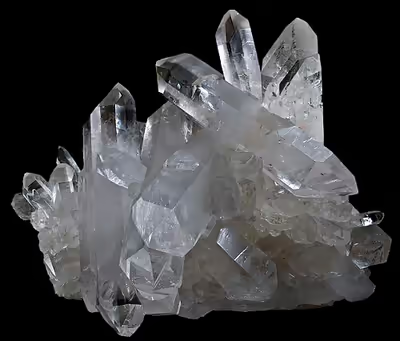
The ideal crystal shape for quartz is a six-sided prism terminating with six-sided pyramid-like rhombohedrons at each end. In nature, quartz crystals are often twinned (with twin right-handed and left-handed quartz crystals), distorted, or so intergrown with adjacent crystals of quartz or other minerals as to only show part of this shape, or to lack obvious crystal faces altogether and appear massive.
Well-formed crystals typically form as a druse (a layer of crystals lining a void), of which quartz geodes are particularly fine examples. The crystals are attached at one end to the enclosing rock, and only one termination pyramid is present. However, doubly terminated crystals do occur where they develop freely without attachment, for instance, within gypsum.
Varieties
Pure quartz, traditionally called rock crystal or clear quartz, is colorless and transparent or translucent. Colored varieties of quartz are common and include citrine, rose quartz, amethyst, smoky quartz, milky quartz, and others. These color differentiations arise from the presence of impurities which change the molecular orbitals, causing some electronic transitions to take place in the visible spectrum, emitting colored light.
Quartz varieties were previously classified into three categories based on the visibility of their individual crystals. Macrocrystalline quartz varieties have individual crystals that are visible to the unaided eye (macroscopic). Microcrystalline quartz varieties are aggregates of tiny crystals that can only be seen through a microscope (microscopic). Cryptocrystalline quartz varieties are aggregates of crystals that are too small to be seen even with an optical microscope (sub-microscopic). Today, the microcrystalline and cryptocrystalline varieties are commonly grouped together and referred to as chalcedony. However, in the scientific literature, chalcedony is a specific form of silica consisting of fine intergrowths of both quartz and its monoclinic polymorph, moganite. Chalcedony is commonly translucent to opaque, while the macrocrystalline varieties of quartz tend to be more transparent. Color is a secondary identifier for the cryptocrystalline varieties and a primary identifier for the macrocrystalline varieties.
Piezoelectricity
Quartz crystals have piezoelectric properties; they develop an electric potential upon the application of mechanical stress. Quartz's piezoelectric properties were discovered by Jacques and Pierre Curie in 1880.
Occurrence
Quartz is the second most abundant mineral or mineral group in the Earth's lithosphere; by mass, the feldspar group comprises 41% of the lithosphere, followed by quartz at 12% and the pyroxene group at 11%. Quartz is a defining constituent of granite and other felsic igneous rocks. It is very common in sedimentary rocks such as sandstone and shale. It is a common constituent of schist, gneiss, quartzite and other metamorphic rocks. Quartz has the lowest potential for weathering in the Goldich dissolution series and consequently it is very common as a residual mineral in stream sediments and residual soils. Generally a high presence of quartz suggests a "mature" rock, since it indicates the rock has been heavily reworked and quartz was the primary mineral that endured heavy weathering.
While the majority of quartz crystallizes from molten magma, quartz also chemically precipitates from hot hydrothermal veins as gangue, sometimes with ore minerals such as gold, silver and copper. Large crystals of quartz are found in magmatic pegmatites. Well-formed crystals may reach several meters in length and weigh hundreds of kilograms.
The largest documented single crystal of quartz was found near Itapore, Goiaz, Brazil; it measured approximately 6.1 m × 1.5 m × 1.5 m (20 ft × 5 ft × 5 ft) and weighed over 39,900 kg (88,000 lb).
Mining
Quartz is extracted from open-pit mines. Miners occasionally use explosives to expose deep pockets of quartz. More frequently, bulldozers and backhoes are used to remove soil and clay and expose quartz veins, which are then worked using hand tools. Care must be taken to avoid sudden temperature changes that may damage the crystals.
Related silica minerals
Tridymite and cristobalite are high-temperature polymorphs of SiO2 that occur in high-silica volcanic rocks. Coesite is a denser polymorph of SiO2 found in some meteorite impact sites and in metamorphic rocks formed at pressures greater than those typical of the Earth's crust. Stishovite is a yet denser and higher-pressure polymorph of SiO2 found in some meteorite impact sites. Moganite is a monoclinic polymorph. Lechatelierite is an amorphous silica glass SiO2 which is formed by lightning strikes in quartz sand.
Safety
As quartz is a form of silica, it is a possible cause for concern in various workplaces. Cutting, grinding, chipping, sanding, drilling, and polishing natural and manufactured stone products can release hazardous levels of very small, crystalline silica dust particles into the air that workers breathe. Crystalline silica of respirable size is a recognized human carcinogen and may lead to other diseases of the lungs such as silicosis and pulmonary fibrosis.
Synthetic and artificial treatments
Not all varieties of quartz are naturally occurring. Some clear quartz crystals can be treated using heat or gamma irradiation to induce color where it would not otherwise have occurred naturally. Susceptibility to such treatments depends on the location from which the quartz was mined. Prasiolite, an olive-colored material, is produced by heat treatment; natural prasiolite has also been observed in Lower Silesia in Poland. Although citrine occurs naturally, the majority is the result of heat-treating amethyst or smoky quartz. Carnelian has been heat-treated to deepen its color since prehistoric times. Because natural quartz is often twinned, synthetic quartz is produced for use in industry. Large, flawless single crystals are synthesized in an autoclave via the hydrothermal process. Like other crystals, quartz may be coated with metal vapors to give it an attractive sheen.
Uses
Quartz is the most common material identified as the mystical substance maban in Australian Aboriginal mythology. It is found regularly in passage tomb cemeteries in Europe in a burial context, such as Newgrange or Carrowmore in Ireland. Quartz was also used in prehistoric Ireland, as well as many other countries, for stone tools; both vein quartz and rock crystal were knapped as part of the lithic technology of prehistoric peoples.
While jade has been the most prized semi-precious stone for carving in East Asia and pre-Columbian America since earliest times, in Europe and the Middle East different varieties of quartz were the most commonly used for the various types of jewelry and hardstone carving, including engraved gems and cameo gems, rock crystal vases, and extravagant vessels. The tradition continued to produce highly valued objects until the mid-19th century, when it largely fell from fashion except in jewelry. Cameo technique exploits the bands of color in onyx and other varieties.
Efforts to synthesize quartz began in the mid-19th century as scientists attempted to create minerals under laboratory conditions that mimicked the conditions in which the minerals formed in nature. German geologist Karl Emil von Schafhäutl (1803–1890) was the first person to synthesize quartz when in 1845 he created microscopic quartz crystals in a pressure cooker. However, the quality and size of the crystals that were produced by these early efforts were poor.
Elemental impurity incorporation strongly influences the ability to process and utilize quartz. Naturally occurring quartz crystals of extremely high purity, necessary for the crucibles and other equipment used for growing perfect large silicon boules to be sliced into silicon wafers in the semiconductor industry, are expensive and rare. These high-purity quartz are defined as containing less than 50 ppm of impurity elements. A major mining location for high-purity quartz is the Spruce Pine Mining District in Spruce Pine, North Carolina, United States. Quartz may also be found in Caldoveiro Peak in Asturias, Spain.
By the 1930s, the electronics industry had become dependent on quartz crystals. The only source of suitable crystals was Brazil; however, World War II disrupted supplies from Brazil, so nations attempted to synthesize quartz on a commercial scale. German mineralogist Richard Nacken (1884–1971) achieved some success during the 1930s and 1940s. After the war, many laboratories attempted to grow large quartz crystals. In the United States, the U.S. Army Signal Corps contracted with Bell Laboratories and with the Brush Development Company of Cleveland, Ohio to synthesize crystals following Nacken's lead. (Prior to World War II, Brush Development produced piezoelectric crystals for record players.) By 1948, Brush Development had grown crystals that were 1.5 inches (3.8 cm) in diameter, the largest at that time. By the 1950s, hydrothermal synthesis techniques were producing synthetic quartz crystals on an industrial scale, and today virtually all the quartz crystal used in the modern electronics industry is synthetic.
An early use of the piezoelectricity of quartz crystals was in phonograph pickups. One of the most common piezoelectric uses of quartz today is as a crystal oscillator. Also called a quartz oscillator or resonator, it was first developed by Walter Guyton Cady in 1921. George Washington Pierce designed and patented quartz crystal oscillators in 1923. The quartz clock is a familiar device using the mineral; it is simply a clock that uses a quartz oscillator as its time reference. Warren Marrison created the first quartz oscillator clock based on the work of Cady and Pierce in 1927. The resonant frequency of a quartz crystal oscillator is changed by mechanically loading it, and this principle is used for very accurate measurements of very small mass changes in the quartz crystal microbalance and in thin-film thickness monitors.
Almost all the industrial demand for quartz crystal (used primarily in electronics) is met with synthetic quartz produced by the hydrothermal process. However, synthetic crystals are less prized for use as gemstones. The popularity of crystal healing has increased the demand for natural quartz crystals, which are now often mined in developing countries using primitive mining methods, sometimes involving child labor.