


Related on Lably
Through Russia, UNESCO and Umayyad Caliphate
Rasht is the largest city on Iran's Caspian Sea coast. Due to being between the coast and the mountains, the local environment is rainy with a humid subtropical climate. It also has a temperate rainforest to its south, in contrast to the rest of Iran, which is mostly arid.
It is a major trade center between Caucasia, Russia, and Iran, using the port of Bandar-e Anzali. Rasht is also a major tourist center with the resort of Masouleh in the adjacent mountains and the beaches of Caspian as some of the major attractions.
Historically, Rasht was a major transport and business center which connected Iran to Russia and the rest of Europe, and because of this it was known as the "Gate of Europe". The city has a history that goes back to the 13th century, but its modern history dates back to the Safavid era during which Rasht was a major center of the silk trade with numerous textile workshops. In 2015, this city joined the network of creative cities of the world as a creative gastronomy city under the supervision of UNESCO.
Some of the famous neighbourhoods of Rasht include Golsar, Safsar, Kordmahaleh and Khamiran.
Etymology
There are multiple views about the origin of the city's name. According to one view, the root of the city's name is the word resh (رش), meaning "very light rain". This is connected with the rainy weather of the area. According to another view, the correct pronunciation of the city's name is Resht, deriving from the root of the verb risidan (ریسیدن) or reshtan (رشتن), both meaning "to spin". This is connected with the importance of silk thread production in the city. The name has also been interpreted as meaning "low, sunken place"; apparently the word originally described a market in the area (rasht bazar) and was later applied to the settlement. Ali-Akbar Dehkhoda cites a tradition according to which the sum of the numerical values of the letters (per Abjad numerals) corresponds to the date of the founding of the city (900 AH, or 1494/95 AD), although the name is mentioned in the 10th-century geography Hudud al-'Alam (albeit as the name of a district, not of a city). Zana Salehrad notes that the name Rasht could be traced to the ancient Gilaki or Caspian languages, where it may have originally meant "fertile plain" or "verdant land". Surrounded by rivers, forests, and rice paddies, the city has always been defined by its rich natural environment. Over time, the name endured, coming to symbolize not just the geography, but the prosperity and vitality of the people who lived there. In this way, Rasht reflects both the bounty of the land and the enduring connection between the city and its lush, life-giving surroundings.
Sign in to keep reading
13 more chapters are free with a Lably account.
History
Timeline
- 682: Rasht was first mentioned in Umayyad historical documents.
- 1669: Stenka Razin, a Cossack warlord, plundered the city.
- 1714: Rasht destroyed by earthquake.
- 1722–1732: Occupation by the Russians due to the Russo-Persian War.
- 1901: A major epidemic plague devastates the city.
- 1917–1920: The Russian and British armed forces fight in the port city of Bandar-e Anzali and Rasht. The British retreat and the Russians occupy the area.
- 1920–1921: The short-lived Gilan Soviet Socialist Republic was established with its capital in Rasht.
- 1937: A revolt, sparked by the desire to collect a "road tax" from the Russians, was suppressed.
- 1974: First university established in Rasht.
Rasht was first mentioned in Umayyad historical documents in 682 CE. It has seen the Sassanid era, the Rashidun conquest, the armies of Peter the Great and later Russian rulers, and British colonialism. The people of Rasht also played a major role in the Constitutional Revolution of Iran.
Rasht has, along with regions around Tabriz and Tehran, one of the earliest industry plants during the last quarter of the 19th century, prominently in fields such as fishing, caviar production, the Caspian sea oil pipeline construction and textiles. During the 20th century, until the mid-70s, Gilan and the Rasht region was the third-ranking industrial city in Iran by number of workers and per capita productivity. It lost its cultural and industrial status to a large extent after the 1970s.
The people of Rasht played a prominent role in instigation and radicalization of the Persian Constitutional Revolution (1905–1907). Rasht is the birthplace of Mīrzā Kūchak Khān, one of the leading figures of the Constitutional Revolution. His own movement in Gilan, which went by the name of Jangalis, represented a pro-modern and social democratic program for reformation of Muslim rituals and traditions. Mirza established the short-lived Persian Socialist Soviet Republic in 1920 after the defeat of the constitutional forces and in coalition with Iranian communists.
The republic had the support of the newly established Russian Red Army. The Soviet Government, after a turn of military and political strategy proposed by Trotsky, withdrew its support and the republic itself was tormented by the inner conflicts between the newly established Iranian Communist Party (1919) and the Jangalis and other factions. The republic was finally defeated by the Iranian army under the command of Reza Shah.
The first national library of Iran was established in Rasht under the Qajar dynasty. Nasim-e-Shomal, the first modern newspaper of Iran after the constitutional revolution, has been initially published in Rasht. First Public Library of Iran was built in Rasht City. First Branch of the First Iranian Bank (Sepah Bank) was located in Rasht City. First branch of 24/7 pharmacy (Karoon pharmacy) was built in Rasht City. First school for girls and first fire station in Iran were also built in Rasht City. The city of Rasht was the center of Gilan and the center of the first province of the country.
During the Qajar period, along with economic development between Iran and Russia, Noghan trade and other products expanded. Thus, Rasht became the gateway to Europe in the 19th century. Grigoriy Melgunov, a Russian orientalist and writer who visited Rasht at the end of 1860, wrote in his published notes that the city at that time had 5463 houses, 1021 shops, 22 mosques, 34 schools and 17 bathhouses, and a population of 27,314. At that time, Rasht's political credibility was such that the Russian, British, and Ottoman governments had consulates in Rasht.
Modern day
Rasht is turning into an industrialized town like most of the Iranian large cities and province capitals. Enjoying the Kadus International Hotel and hundreds of tourist attractions, Rasht receives thousands of foreign tourists annually, mostly from Austria, Germany, Netherlands, France, Australia, Japan and African countries like Senegal and Cameroon as well as countries from Oceania like Micronesia.
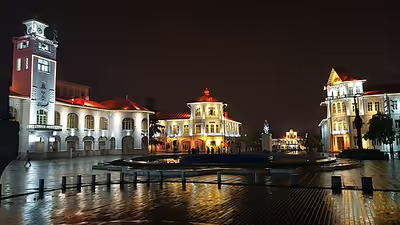
Rasht is known for its famous municipal building, located in the Square of Municipality, which was constructed circa 1900, and has been renovated each year. Due to the high amount of humidity in Rasht which damages and destroys the aged buildings, the native, older architectural texture of Rasht is gradually being replaced with the modern skyscrapers and apartments.
The culture of consumerism is prevalent among the people of Rasht as a cultural and urban center which is historically engaged in close commercial and political ties with the United Kingdom, Russia and France. Due to this background which makes the inhabitants much familiar with the industrial, cultural and political developments of the west, the finance and credit institutions are more willing to open representative offices and bureaus in Rasht and it has made the city a center of various banks and financial organizations.
There are many commercial centers, malls and financial institutions in Rasht including one branch of the Exports Development Bank of Iran which is an international bank dealing with the Iranian exports. The organizers and directors of national Iranian or non-Iranian banks afford to spend considerable amounts of budgets to construct attractive and modern buildings for their offices in Rasht.
Since the Islamic Revolution of 1979 in Iran, there have always been requests on behalf of Russian, Turkish and Azerbaijani banks to open branches in Rasht and that is why the city is endowed as the "gate of Europe" in Iran. The head consulate of the Russian Federation government is located in Rasht and some of the other Caspian region countries are also keen to establish representative headquarters in Rasht alongside their embassies in Tehran.
Some evidences are the University of Gilan which was constructed jointly by the governments of Iran and West Germany about 40 years ago, the building of IRIB representatives in Rasht which was constructed jointly by the Iranian and Belgian engineers.
On January 8 and 9, 2026, during the 2025–2026 Iranian protests, the Iranian government perpetrated the 2026 Rasht massacre in trying to suppress the anti-government protests. According to the HRANA, at least 392 people have been killed in Rasht.
First of Iran
- The first branch of Bank Sepah and first Bank of Iran was established in Rasht in 1925
- The first girls' school in Iran was established in Rasht
- The first day & night pharmacy in Iran was established in Rasht
- The first sanatorium for the elderly and disabled in Iran was established in Rasht
- The first National Library of Iran was established in Rasht in 1920
- The first bus Iran arrived in Rasht
- The first city in which the sewage system was established
- The first city in which the Russian, British, French and Ottoman governments opened their consulates and had political representatives.
- The first silk factory in Iran
- The first national hospital in Iran named Poursina Hospital
- The first classical theater in Iran
Streets and boulevards
- Golsar Street
- Imam Ali Boulevard
- Shahid Chamran Boulevard
- Ayatollah Taleghani Boulevard
- Resalat Street
- Shohaday-e Gomnam Boulevard
- Ostadsara Street
- Esteghamat Street
- Deylaman Boulevard
- Moallem Boulevard
- Imam Khomeini Boulevard
- Valiasr Street
- Enghelab Street
- Azadi Street
- Azadegan Boulevard
- Shahid Ansari Street
- Farhang Street
- Parastar Boulevard
- Bastani Shoaar Street
- Afakhra Street
- Pasdaran Street
- 22 Bahman Boulevard
- Alamolhoda Street
- Saadi Street
- Tohid Street
- Navab Street
- Gilan Boulevard
- Gholipour Boulevard
- Habibzadeh Boulevard
- Ansari Boulevard
- Suleman Darab Boulevard
- Takhti Street
- Bisotun Street
Demographics
Population
The city of Rasht is the most populated city in the north of the country and one of the metropolises of Iran. At the time of the 2006 National Census, the city's population was 551,161 in 159,983 households. The following census in 2011 counted 639,951 people in 204,054 households. The 2016 census measured the population of the city as 679,995 people in 228,142 households.
Language
People of Rasht are mostly Gilaks (98.2%) and they speak Rashti variety of Western Gilaki language.
Climate
Rasht has a humid subtropical climate (Köppen: Cfa, Trewartha: Cf). The climate is one of the wettest in Iran, with warm summers and cool winters, sometimes with snow. The average humidity is above 80%, contrasting heavily with cities in many other parts of Iran. Sunshine hours, averaging roughly 1,700 per year, is lower than in most places in Iran and also compared to most places at this latitude. Rasht is also known as "The City of Rain".
Culture
People of Rasht spend much on arts, food, and clothes. They spend the leisure times going to cinemas, art exhibitions, music concerts and international book fairs that are being held in the city most of times in a year. Also the municipality kicks off sports, cultural or IT-related competitions to involve the youth in healthy and constructive activities. The most beloved competition is the annual blogging competition which awards the top young bloggers each year.
Rasht has played a major role in Iranian history. It was Iran's gateway to Russia and Europe; therefore it was influenced by western architecture. Iran's first public library was built here and it was the first city in Iran where girls were allowed to go to school.
Iranian cities of Isfahan and Rasht were accepted to the UNESCO Creative Cities Network on December 11, 2015. Isfahan is registered because of its creative crafts and folk art; and Rasht because of its unique gastronomy. Rasht embroidery is a handicraft and art specific to the city and Gilan province.
On 4 January 2015, Rasht was selected as the political center of Gilan more than 4,500 years ago. The date 4 January was then included in the official calendar of the country as Rasht Day.
Cuisine
The dominant foods of Rasht people are various types of fish. Mirza Ghassemi, vavishka (a type of haggis), nargesi, baghala ghatogh, and ashpal (roe) are some other popular local dishes. Reshteh khoshkar is a well-known sweet. Zeitoun Parvardeh is a kind of delicacy prepared from olives and pomegranates; it is a popular seasoning in the city.
Rose de Rescht
Rosa 'de Rescht', like many old garden roses, presents an interesting historical background story. This cultivar, originating in Iran, was reported at the end of 19th century in England, but it was then forgotten. It was rediscovered near the Iranian provincial capital of Rascht by Miss Nancy Lindsay in 1945, and was brought back to the United Kingdom, where it was re-introduced around 1950. Today it is shown in the Victorian Class, winning many trophies.
Sports
The people of Rasht are fans of football. Most are fans of Damash Gilan who play in the Azadegan League or Sepidrood Rasht who play in the Persian Tier 2 and 3 League. Damash Gilan is the newer version of former Pegah football club that belonged to the municipality of Rasht, but was purchased later by the mineral water factory of Damash and changed its name and properties to Damash Gilan.
The home stadium of Damash Gilan is Dr. Azodi Stadium which is an old stadium dating back to almost 40 years ago and its capacity is 11,000 people. Sardar Jangal Stadium is the city's second stadium.
Following football, wrestling, judo and weightlifting are the most popular sports of youth in Rasht and that is due to the presence of Iranian wrestlers and weightlifters in the international competitions like Olympics. The two-time olympics Gold medal winner Hossein Rezazadeh is a main inspirer of Rasht youth to try Weightlifting as their professional job. Asghar Ebrahimi who was the squad captain of Iranian weightlifting team at the 2008 Olympics is from Rasht and an example of those youth from Rasht who tried this national field of sport after Hossein Rezazadeh.
Colleges and universities
- University of Gilan
- Gilan university of medical sciences
- Islamic Azad University of Rasht
- Jaber ebn Hayyan Institute of Higher Education
- Payame Noor University
- Institute of Higher Education for Academic Jihad of Rasht
- Guilan Technical & Vocational Training Organization
- Gilan Advanced Skills Training Center
- Rasht Technical and Vocational Institute
- Guilan University of Applied and Scientific Technology
Economy
This city is greatly important based on its geographical situation (locating on the central plain and its large width, fertile lands and soil, being the most important region of the province and Iran in terms of rice cultivation), communicative situation (locating among Tehran–Qazvin-Anzali-Astara roads, in one hand, and the main road from Gilan to Mazandaran and the east of Gilan, on the other hand), political–administrative situation (situating as the capital city of Gilan province) and economic development, towns expansion and industrial factories and the following increase in the agricultural-commercial activities and in the number of science and technology centers.
The most residents of this city are active in service, trading and industrial jobs and paddy is the main activities of the villagers in this region. Rasht has long been one of the most prominent customs cities in Iran. This city used to be the only communication and trade route of Iran to Europe through the Anzali port. From the time of Shah Abbas II until the end of the Qajar rule, the city of Rasht was a large commercial center, and caravans stopped in this city to buy silk and sell their goods from In this way, they were sent to the ports of the Mediterranean Sea.
The presence of the Russian Consulate and then the British Consulate in Rasht caused the economic and social prosperity of this city, and there was a representative of the Ministry of Foreign Affairs or a broker, a Russian consul, a French deputy consul, and a British deputy consul in this city, and apart from The ruler of Rasht, the agent of foreign affairs was also stationed in Rasht on behalf of the central government. During this period, Tomanians Russian Borrowing Bank and Trading House were active in Rasht consecutively.
At the same time, Rasht's foreign trade developed and most Rashtites became millionaires, and Rasht became an aristocratic city during the Qajar period. The city is served by Refah Chain Stores Co., Iran Hyper Star, Isfahan City Center, Shahrvand Chain Stores Inc., Ofoq Kourosh chain store.
Pharmaceutical industry
Rasht has a Faculty of Pharmacy under the auspices of Gilan University of Medical Sciences and several drug production centers, one of which is a center for the production of anti-cancer nano-drugs with 24 pens. Sobhan Daroo Co. is one of the successful pharmaceutical companies in Iran. And with more than 100 production licenses, it is currently the second largest producer in the country in terms of production volume. Sobhan Oncology Pharmaceutical Company is one of the modern and advanced production units of anti-cancer and chemotherapy products in the world.
Health centers and hotels
Hotel
- Kadus Grand Hotel
- Shabestan Hotel
- Ordibehesht Hotel
- Ghadir Hotel
- Pamchal Hotel
- Pourya Hotel
Hospital
- Poursina Hospital
- Golsar Hospital
- Arya Hospital
- Pars Rasht Hospital
- Rasoul Akram Hospital
- Velayat Hospital
- Omid Hospital
- Razi University Hospital
- Qaem Hospital
- Al Zahra Hospital
Transportation
Taxi
In 1947, 50 taxis were purchased from England by the order of Fakhr-ol-dowleh (daughter of Muzaffar al-Din Shah) and imported to Iran. In 1948, the first taxi entered Rasht by crossing the main street of the city due to his interest in Gilan. Rasht Metropolitan Taxi Organization has so far organized more than 9,500 taxis and private cars.
Railway
Rasht is served by Rasht railway station, which is located south of the city near the road to Jirdeh, Shaft. The railway passes through Alborz mountains and then Sefidrood river valley and is connected to Karaj and Qazvin on its way to Tehran. To the north the railway leads to Anzali free trade zone.
International airport
The Rasht International airport is the only airport in the province of Gilan and was established in 1969 with an approximate area of 220 hectares. At first, the airport just handled domestic flights to Tehran and Mashhad, but after it was renamed to Sardar Jangal International airport in 2007, additional routes were established.
The airport is in close affiliation with hundreds of flights by national and international airlines, including Mahan Air, Iran Air, Iran Aseman Airlines, Kish Air and receives more than 2000 flights annually.
Historical and natural attractions
- Iran Hotel
- National Library
- Saravan Forest Park
- Hajj Samad Khan Mosque
- Haj Samiee Mosque
- Badyollah Mosque
- Emamzadeh Hashem
- Imamzadeh Ismail and Abbas
- Mellat Park
- Keshavarz Park
- Meshkat Park
- Towhid Park
- Golshan Mosque
- Kase Forushan Mosque
- Zargaran Mosque
- Abrishamchi House
- Mohtasham Caravanserai
- Ebrahim Pourdavoud Tomb
- Gurab-e Lishavandan
- Imamzadeh Bibi Zeynab
- Tomb Tower Danaye Ali
- Lat Carvansary
- Shahid Beheshti High School
Notable people
- Azar Andami (1926–1984), physician and bacteriologist noted for her development of a cholera vaccine
- Aydin Aghdashloo (1940) painter, graphic artist, and art curator
- Fathollah Khan Akbar (1855–1937) Qajar dynasty prime minister
- Reza Baluchi (born 1972) cyclist, athlete
- Shohreh Bayat (born 1987) international chess arbiter for FIDE, awarded an International Women of Courage Award for being a champion for women’s rights, based in England
- Mahmoud Behzad (1913–2007) biologist
- Mir Abdolrez Daryabeigi (1930–2012) painter
- Hushang Ebtehaj (1928–2022) poet
- Mohsen Forouzan footballer
- Mohammad Bagher Nobakht (born 1950) politician and economist
- Asghar Ebrahimi weightlifter
- Amir Eftekhari (born 1964) footballer
- Esmaeil Elmkhah weightlifter
- Mahmoud Etemadzadeh writer
- Reza Ramezani Gilani Muslim cleric
- Shaya Goldoust (born 1986), Iranian-born Canadian journalist, activist
- Khosrow Golsorkhi (1944–1974) journalist, poet, and communist
- Saeid Hassanipour Karateka
- Hadi Jelveh (1919–2011) associate justice of the Iran Supreme Court
- Asghar Kardoust basketball player
- Alexander Kasimovich Kazembek (1802–1870) Azerbaijani-Russian Orientalist, historian, philologist
- Mirza Kuchik Khan (1880–1921) revolutionary leader
- Mohammad Khatam Iranian air force commander and advisor to the Shah
- Hamideh Kheirabadi (1924–2010) actress
- Farideh Lashai (1944–2013), painter
- Arsen Minasian Armenian founder of the first modern sanatorium in Iran
- Mohammad Moein Linguistics and literature researcher
- Ardeshir Mohasses (1938–2008), illustrator, cartoonist
- Bahman Mohasses (1931–2010) painter, sculptor
- Nasrollah Moghtader Mojdehi professor
- Youcef Nadarkhani (born 1977) Christian pastor sentenced to death for apostasy from Islam
- Habib Nafisi (1908–1984) engineer, educator
- Houchang Nahavandi professor and politician
- Mahmoud Namjoo (1918–1989) weightlifter
- Amnon Netzer (1934–2008) Rasht-born Israeli historian, researcher, professor of Iranian history and culture as well as Persian and Judeo-Persian languages, and journalist.
- Mohammad Nouri, singer
- Ardeshir Ovanessian, Communist leader
- Ebrahim Poordavood academic
- Kazim Rashti, Shaykhi scholar
- Mohammad Rahbari (born 1991) fencer
- Yahya Rahmat-Samii (born 1948), electrical engineer, professor at UCLA
- Dariush Ramezani cartoonist
- Enayatollah Reza historian
- Fazlollah Reza Former Iran's ambassador to UNICEF and former manager of Sharif University
- Anoushiravan Rohani Musician
- Massoumeh Seyhoun (1934–2010) painter
- Sadeq Saba Head of BBC Persian Service
- Majid Samiei Neurosurgeon and the Manager of Hanover Brain and Nerves Treatment institute
- Hossein Sami'i (1876–1953) writer, poet, diplomat, and politician
- Marjane Satrapi (1969–2026) graphic novelist, cartoonist, film director
- Houman Seyyedi (born 1980) actor and director
- Zahra Tabari (born 1958), human rights actiist
- Hadi Tabatabaei footballer
- Susan Taslimi (born 1950) actress
- Mohammad Tolouei writer
- Homayoon Toufighi chess grandmaster
- Babak Zarrin composer
Distance to major cities
Twin towns – sister cities
Rasht is twinned with: