

Reflection nebula
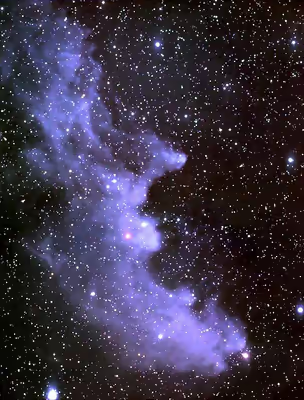
Clouds of interstellar dust which reflect the light of nearby stars
- 2 min read
- 2 chapters

Related on Lably
Through Astronomy, Star and Ionization
Discovery
Analyzing the spectrum of the nebula associated with the star Merope in the Pleiades, Vesto Slipher concluded in 1912 that the source of its light is most likely the star itself, and that the nebula reflects light from the star (and that of the star Alcyone). Calculations by Ejnar Hertzsprung in 1913 lend credence to that hypothesis. Edwin Hubble further distinguished between the emission and reflection nebulae in 1922.
Reflection nebula are usually blue because the scattering is more efficient for blue light than red (this is the same scattering process that gives us blue skies and red sunsets).
Reflection nebulae and emission nebulae are often seen together and are sometimes both referred to as diffuse nebulae.
Some 500 reflection nebulae are known. A blue reflection nebula can also be seen in the same area of the sky as the Trifid Nebula. The supergiant star Antares, which is very red (spectral class M1), is surrounded by a large, yellow reflection nebula.
Reflection nebulae may also be the site of star formation.
Sign in to keep reading
One more chapter is free with a Lably account.
Luminosity law
In 1922, Edwin Hubble published the result of his investigations on bright nebulae. One part of this work is the Hubble luminosity law for reflection nebulae, which makes a relationship between the angular size (R) of the nebula and the apparent magnitude (m) of the associated star:
5 log(R) = −m + k
where k is a constant that depends on the sensitivity of the measurement.