

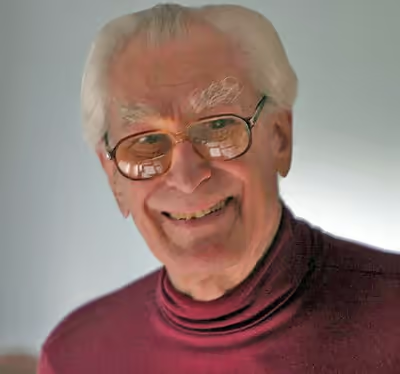
Richard K. Guy
British mathematician (1916–2020)
- 6 min read
- 3 chapters

Related on Lably
Through Mathematics, Geometry and Combinatorics
Biography
Early life
Guy was born 30 September 1916 in Nuneaton, Warwickshire, England, to Adeline Augusta Tanner and William Alexander Charles Guy. Both of his parents were teachers, rising to the rank of headmistress and headmaster, respectively. He attended Warwick School for Boys, the third oldest school in Britain, but was not enthusiastic about most of the curriculum. He was good at sports and excelled in mathematics. At the age of 17 he read Dickson's History of the Theory of Numbers. He said it was better than "the whole works of Shakespeare", solidifying his lifelong interest in mathematics.
In 1935 Guy entered Gonville and Caius College, Cambridge, as a result of winning several scholarships. To win the most important of these he had to travel to Cambridge and write exams for two days. His interest in games began while at Cambridge where he became an avid composer of chess problems. In 1938, he was graduated with a second-class honours degree; he would later state that his failure to get a first may have been related to his obsession with chess. Although his parents strongly advised against it, Guy decided to become a teacher and got a teaching diploma at the University of Birmingham. He met his future wife, Nancy Louise Thirian, through her brother Michael, who was a fellow scholarship winner at Gonville and Caius. He and Louise shared loves of mountain climbing and dancing. They married in December 1940.
War years
In November 1942, Guy received an emergency commission in the Meteorological Branch of the Royal Air Force, with the rank of flight lieutenant. He was posted to Reykjavík, and later to Bermuda, as a meteorologist. He tried to get permission for Louise to join him but was refused. While in Iceland, he did some glacier travel, skiing, and mountain climbing, marking the beginning of another long love affair, this one with snow and ice. When Guy returned to England after the war, he went back to teaching, this time at Stockport Grammar School, but stayed only two years. In 1947 the family moved to London, where he got a job teaching mathematics at Goldsmiths' College.
Later life and death
In 1951 he moved to Singapore, where he taught at the University of Malaya until 1962. He then spent a few years at the Indian Institute of Technology in Delhi, India. While they were in India, he and Louise went mountaineering in the foothills of the Himalayas. Guy moved to Canada in 1965, settling down at the University of Calgary in Alberta, where he obtained a professorship. Although he officially retired in 1982, he still went to the office five days a week to work, even as he passed the age of 100. Along with George Thomas and John Selfridge, Guy taught at Canada/USA Mathcamp during its early years.
In 1991 the University of Calgary awarded him an honorary doctorate. Guy said that they gave him the degree out of embarrassment, although the university stated that "his extensive research efforts and prolific writings in the field of number theory and combinatorics have added much to the underpinnings of game theory and its extensive application to many forms of human activity." Guy and his wife Louise (who died in 2010) remained very committed to mountain hiking and environmentalism even in their later years. In 2014, he donated $100,000 to the Alpine Club of Canada for the training of amateur leaders. In turn, the Alpine Club has honoured them by building the Louise and Richard Guy Hut near the base of Mont des Poilus. They had three children, among them computer scientist and mathematician Michael J. T. Guy.
Guy died on 9 March 2020 at the age of 103.
Sign in to keep reading
2 more chapters are free with a Lably account.
Mathematics
While teaching in Singapore in 1960 Guy met the Hungarian mathematician Paul Erdős. Erdős was noted for posing and solving difficult mathematical problems and shared several of them with Guy. Guy later recalled "I made some progress in each of them. This gave me encouragement, and I began to think of myself as possibly being something of a research mathematician, which I hadn't done before." Eventually he wrote four papers with Erdős, giving him an Erdős number of 1, and solved one of Erdős' problems. Guy was intrigued by unsolved problems and wrote two books devoted to them. Many number theorists got their start trying to solve problems from Guy's book Unsolved problems in number theory.
Guy described himself as an amateur mathematician, although his work was widely respected by professionals. In a career that spans eight decades he wrote or co-authored more than a dozen books and collaborated with some of the most important mathematicians of the twentieth century. Paul Erdős, John H. Conway, Donald Knuth, and Martin Gardner were among his collaborators, as were Elwyn Berlekamp, John L. Selfridge, Kenneth Falconer, Frank Harary, Lee Sallows, Gerhard Ringel, Béla Bollobás, C. B. Lacampagne, Bruce Sagan, and Neil Sloane.
Over the course of his career Guy published more than 100 research papers in mathematics, including four with Erdős.
Guy was influential in the field of recreational mathematics. He collaborated with Berlekamp and Conway on two volumes of Winning Ways, which Martin Gardner described in 1998 as "the greatest contribution to recreational mathematics in this century". Guy was considered briefly as a replacement for Gardner when the latter retired from the Mathematical Games column at Scientific American. Guy conducted extensive research on Conway's Game of Life, and in 1970, discovered the game's glider. Around 1968, Guy discovered a unistable polyhedron with 19 faces; no such construct with fewer faces was found until 2012. As of 2016 Guy still was active in conducting mathematical work. To mark his 100th birthday friends and colleagues organised a celebration of his life and a tribute song and video was released by Gathering 4 Gardner.
Guy was one of the original directors of the Number Theory Foundation and played an active role in supporting their efforts to "foster a spirit of cooperation and goodwill among the family of number theorists" for more than twenty years.
Chess problems
From 1947 to 1951 Guy was the endings editor for British Chess Magazine. He is known for almost 200 endgame studies. Along with Hugh Blandford and John Roycroft, he is one of the inventors of the GBR code (Guy–Blandford–Roycroft code), a system of representing the position of chess pieces on a chessboard. Publications including EG use it to classify endgame types and to index endgame studies.
Solution:
1. Kd1 Ka3
2. Kc1 a5
3. h4 a4
4. h5 Ka2
5. h6 a3
6. h7 Ka1
7. h8=N a2
8. Ng6 fxg6
9. f7 g5
10. f8=N g4
11. Ne6 dxe6
12. d7 e5
13. d8=N e4
14. Nc6 bxc6
15. b7 c5
16. Kd1 Kb2
17. b8=Q+ 1-0