

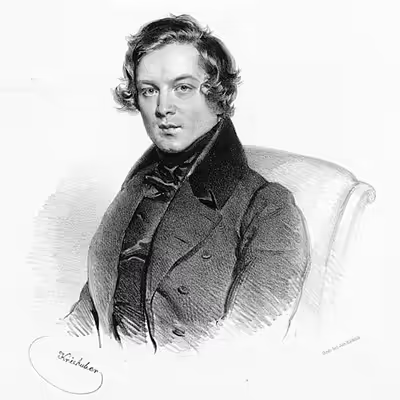
Robert Schumann
German composer, pianist and critic (1810–1856)
- 23 min read
- 4 chapters

Explore on Lably
ToursExplore Lably’s 3D toursSchumann was born in Zwickau, Saxony, to an affluent middle-class family with no musical connections, and was initially unsure whether to pursue a career as a lawyer or to make a living as a pianist-composer. He studied law at the universities of Leipzig and Heidelberg but his main interests were music and Romantic literature. From 1829 he was a student of the piano teacher Friedrich Wieck, but his hopes for a career as a virtuoso pianist were frustrated by a worsening problem with his right hand, and he concentrated on composition. His early works were mainly piano pieces, including the large-scale Carnaval, Davidsbündlertänze (Dances of the League of David), Fantasiestücke (Fantasy Pieces), Kreisleriana and Kinderszenen (Scenes from Childhood) (1834–1838). He was a co-founder of the Neue Zeitschrift für Musik (New Musical Journal) in 1834 and edited it for ten years. In his writing for the journal and in his music he distinguished between two contrasting aspects of his personality, dubbing these alter egos "Florestan" for his impetuous self and "Eusebius" for his gentle poetic side.
Despite the bitter opposition of Wieck, who did not regard his pupil as a suitable husband for her, Schumann married Wieck's daughter Clara in 1840. In the years immediately following their wedding Schumann composed prolifically, writing, first, songs and song‐cycles including Frauenliebe und Leben ("Woman's Love and Life") and Dichterliebe ("Poet's Love"). He turned his attention to orchestral music in 1841, completing the first of his four symphonies. In the following year he concentrated on chamber music, writing three string quartets, a Piano Quintet and a Piano Quartet. During the rest of the 1840s, between bouts of mental and physical ill health, he composed a variety of piano and other pieces and went with his wife on concert tours in Europe. His only opera, Genoveva (1850), was not a success and has seldom been staged since.
Schumann and his family moved to Düsseldorf in 1850 in the hope that his appointment as the city's director of music would provide financial security, but his shyness and mental instability made it difficult for him to work with his orchestra and he had to resign after three years. In 1853 the Schumanns met the twenty-year-old Johannes Brahms, whom Schumann praised in an article in the Neue Zeitschrift für Musik. The following year Schumann's always-precarious mental health deteriorated gravely. He threw himself into the River Rhine but was rescued and taken to a private sanatorium near Bonn, where he lived for more than two years, dying there at the age of 46.
During his lifetime Schumann was recognised for his piano music – often subtly programmatic – and his songs. His other works were less generally admired, and for many years there was a widespread belief that those from his later years lacked the inspiration of his early music. More recently this view has been less prevalent, but it is still his piano works and songs from the 1830s and 1840s on which his reputation is primarily based. He had considerable influence in the nineteenth century and beyond. In the German-speaking world the composers Gustav Mahler, Richard Strauss, Arnold Schoenberg and more recently Wolfgang Rihm have been inspired by his music, as were French composers such as Georges Bizet, Gabriel Fauré, Claude Debussy and Maurice Ravel. Schumann was also a major influence on the Russian school of composers, including Anton Rubinstein and Pyotr Ilyich Tchaikovsky.
Life and career
Childhood
Robert Schumann was born in Zwickau, in the Kingdom of Saxony (today the German state of Saxony), into an affluent middle-class family. On 13 June 1810 the local newspaper, the Zwickauer Wochenblatt (Zwickau Weekly Paper), carried the announcement, "On 8 June to Herr August Schumann, notable citizen and bookseller here, a little son". He was the fifth and last child of August Schumann and his wife, Johanna Christiane. August, not only a bookseller but also a lexicographer, author, and publisher of chivalric romances, made considerable sums from his German translations of writers such as Cervantes, Walter Scott and Lord Byron. Robert, his favourite child, was able to spend many hours exploring the classics of literature in his father's collection. Intermittently, between the ages of three and five-and-a-half, he was placed with foster parents, as his mother had contracted typhus.
At the age of six Schumann went to a private preparatory school, where he remained for four years. When he was seven he began studying general music and piano with the local organist, Johann Gottfried Kuntsch, and for a time he also had cello and flute lessons with one of the municipal musicians, Carl Gottlieb Meissner. Throughout his childhood and youth his love of music and literature ran in tandem, with poems and dramatic works produced alongside small-scale compositions, mainly piano pieces and songs. He was not a musical child prodigy like Wolfgang Amadeus Mozart, Franz Liszt or Felix Mendelssohn, but his talent as a pianist was evident from an early age: in 1850 the Allgemeine musikalische Zeitung (Universal Musical Journal) printed a biographical sketch of Schumann which included an account from contemporary sources that even as a boy he possessed a special talent for portraying feelings and characteristic traits in melody:
Indeed, he could sketch the different dispositions of his intimate friends by certain figures and passages on the piano so exactly and comically that everyone burst into loud laughter at the accuracy of the portrait.
From 1820 Schumann attended the Zwickau Lyceum, the local high school of about two hundred boys, where he remained till the age of eighteen, studying a traditional curriculum. In addition to his studies he read extensively: among his early enthusiasms were Schiller and Jean Paul. According to the musical historian George Hall, Paul remained Schumann's favourite author and exercised a powerful influence on the composer's creativity with his sensibility and vein of fantasy. Musically, Schumann got to know the works of Haydn, Mozart, Beethoven, and of living composers Carl Maria von Weber, with whom August Schumann tried unsuccessfully to arrange for Robert to study. August was not particularly musical but he encouraged his son's interest in music, buying him a Streicher grand piano and organising trips to Leipzig for a performance of Die Zauberflöte (The Magic Flute) and Carlsbad to hear the celebrated pianist Ignaz Moscheles.
University
August Schumann died in 1826; his widow was less enthusiastic about a musical career for her son and persuaded him to study for the law as a profession. After his final examinations at the Lyceum in March 1828 he entered Leipzig University. Accounts differ about his diligence as a law student. According to his roommate Emil Flechsig, he never set foot in a lecture hall, but he himself recorded, "I am industrious and regular, and enjoy my jurisprudence ... and am only now beginning to appreciate its true worth". Nonetheless reading and playing the piano occupied a good deal of his time, and he developed expensive tastes for champagne and cigars. Musically, he discovered the works of Franz Schubert, whose death in November 1828 caused Schumann to cry all night. The leading piano teacher in Leipzig was Friedrich Wieck, who recognised Schumann's talent and accepted him as a pupil.
After a year in Leipzig, Schumann convinced his mother that he should move to the University of Heidelberg which, unlike Leipzig, offered courses in Roman, ecclesiastical and international law (as well as reuniting Schumann with his close friend Eduard Röller who was a student there). After matriculating at the university on 30 July 1829 he travelled in Switzerland and Italy from late August to late October. He was greatly taken with Rossini's operas and the bel canto of the soprano Giuditta Pasta; he wrote to Wieck, "one can have no notion of Italian music without hearing it under Italian skies". Another influence on him was hearing the violin virtuoso Niccolò Paganini play in Frankfurt in April 1830. In the words of one biographer, "The easy-going discipline at Heidelberg University helped the world to lose a bad lawyer and to gain a great musician". Finally deciding in favour of music rather than the law as a career, he wrote to his mother on 30 July 1830 telling her how he saw his future: "My entire life has been a twenty-year struggle between poetry and prose, or call it music and law". He persuaded her to ask Wieck for an objective assessment of his musical potential. Wieck's verdict was that with the necessary hard work Schumann could become a leading pianist within three years. A six-month trial period was agreed.
1830s
Later in 1830 Schumann published his Op. 1, a set of piano variations on a theme based on the name of its supposed dedicatee, Countess Pauline von Abegg (who was almost certainly a product of Schumann's imagination). The notes A-B♭-E-G-G (A-B-E-G-G in German nomenclature, which uses "B" for the note known elsewhere as B♭ and "H" for the note known elsewhere as B[♮]), played in waltz tempo, make up the theme on which the variations are based. The use of a musical cryptogram became a recurrent characteristic of Schumann's later music. In 1831 he began lessons in harmony and counterpoint with Heinrich Dorn, musical director of the Saxon court theatre, and in 1832 he published his Op. 2, Papillons (Butterflies) for piano, a programmatic piece depicting twin brothers – one a poetic dreamer, the other a worldly realist – both in love with the same woman at a masked ball. Schumann had by now come to regard himself as having two distinct sides to his personality and art: he dubbed his introspective, pensive self "Eusebius" and the impetuous and dynamic alter ego "Florestan". Reviewing Chopin's Variations on "Là ci darem la mano" in 1831 he wrote:
Eusebius dropped by one evening, not long ago. He entered quietly, his pale features brightened by that enigmatic smile with which he likes to excite curiosity. Florestan and I were seated at the piano. He, as you know, is one of those rare musical persons who seem to anticipate everything that is new, of the future and extraordinary. ... This time, however, there was a surprise in store even for him. With the words "Hats off, gentlemen, a genius!" Eusebius spread out before us a piece of music.
Schumann's pianistic ambitions were ended by a growing paralysis in at least one finger of his right hand. The early symptoms had come while he was still a student at Heidelberg, and the cause is uncertain. He tried all the treatments then in vogue including allopathy, homeopathy, and electric therapy, but without success. The condition had the advantage of exempting him from compulsory military service – he could not fire a rifle – but by 1832 he recognised that a career as a virtuoso pianist was impossible and he shifted his main focus to composition. He completed further sets of small piano pieces and the first movement of a symphony (it was too thinly orchestrated according to Wieck and was never completed). An additional activity was journalism. From March 1834, along with Wieck and others, he was on the editorial board of a new music magazine, Neue Leipziger Zeitschrift für Musik (New Leipzig Music Magazine), which was reconstituted under his sole editorship in January 1835 as the Neue Zeitschrift für Musik. Hall writes that it took "a thoughtful and progressive line on the new music of the day". Among the contributors were friends and colleagues of Schumann, writing under pen names: he included them in his Davidsbündler (League of David) – a band of fighters for musical truth, named after the Biblical hero who fought against the Philistines – a product of the composer's imagination in which, blurring the boundaries of imagination and reality, he included his musical friends.
During successive months in 1835 Schumann met three musicians whom he regarded with particular respect: Felix Mendelssohn, Chopin and Moscheles. Of these, he was most influenced in his compositions by Mendelssohn, although the latter's restrained classicism is reflected in Schumann's later works rather than in those of the 1830s. Early in 1835 he completed two substantial compositions: Carnaval, Op. 9 and the Symphonic Studies, Op. 13. These works grew out of his romantic relationship with Ernestine von Fricken, a fellow pupil of Wieck. The musical themes of Carnaval derive from the name of her home town, Asch. The Symphonic Studies are based on a melody said to be by Ernestine's father, Baron von Fricken, an amateur flautist. Schumann and Ernestine became secretly engaged, but in the view of the musical scholar Joan Chissell, during 1835 Schumann gradually found that Ernestine's personality was not as interesting to him as he first thought, and this, together with his discovery that she was an illegitimate, impecunious, adopted daughter of Fricken, brought the affair to a gradual end. According to the biographer Alan Walker, Ernestine may have been less than frank with Schumann about her background and he was hurt when he learnt the truth. In a letter in 1837 he acknowledged that learning of Ernestine's poverty weighed heavily on him, fearing that, given his own precarious finances and her lack of independent means, their marriage would condemn him to "work for daily bread like an artisan" (Handwerker).
Schumann felt a growing attraction to Wieck's daughter, the sixteen-year-old Clara. She was her father's star pupil, a piano virtuoso emotionally mature beyond her years, with a developing reputation. According to Chissell, her concerto debut at the Leipzig Gewandhaus on 9 November 1828, with Mendelssohn conducting, "set the seal on all her earlier successes, and there was now no doubting that a great future lay before her as a pianist". Schumann had watched her career approvingly since she was nine, but only now fell in love with her. His feelings were reciprocated: they declared their love to each other in January 1836. Schumann expected that Wieck would welcome the proposed marriage, but he was mistaken: Wieck refused his consent, fearing that Schumann would be unable to provide for his daughter, that she would have to abandon her career, and that she would be legally required to relinquish her inheritance to her husband. It took a series of acrimonious legal actions over the next four years for Schumann to obtain a court ruling that he and Clara were free to marry without her father's consent.
Professionally the later years of the 1830s were marked by an unsuccessful attempt by Schumann to establish himself in Vienna, and a growing friendship with Mendelssohn, who was by then based in Leipzig, conducting the Gewandhaus Orchestra. During this period Schumann wrote many piano works, including Kreisleriana (1837), Davidsbündlertänze (1837), Kinderszenen (Scenes from Childhood, 1838) and Faschingsschwank aus Wien (Carnival Prank from Vienna, 1839). In 1838 Schumann visited Schubert's brother Ferdinand and discovered several manuscripts including that of the Great C major Symphony. Ferdinand allowed him to take a copy away and Schumann arranged for the work's premiere, conducted by Mendelssohn in Leipzig on 21 March 1839. In the Neue Zeitschrift für Musik Schumann wrote enthusiastically about the work and described its "himmlische Länge" – its "heavenly length" – a phrase that has become common currency in later analyses of the symphony.
Schumann and Clara finally married on 12 September 1840, the day before her twenty-first birthday. Hall writes that marriage gave Schumann "the emotional and domestic stability on which his subsequent achievements were founded". Clara made some sacrifices in marrying Schumann: as a pianist of international reputation she was the better-known of the two but her career was continually interrupted by motherhood of their seven children. She inspired Schumann in his composing career, encouraging him to extend his range as a composer beyond solo piano works.
1840s
During 1840 Schumann turned his attention to song, producing more than half his total output of Lieder, including the cycles Myrthen ("Myrtles", a wedding present for Clara), Frauenliebe und Leben ("Woman's Love and Life"), Dichterliebe ("Poet's Love"), and settings of words by Joseph von Eichendorff, Heinrich Heine and others.
In 1841 Schumann focused on orchestral music. On 31 March his First Symphony, The Spring, was premiered by Mendelssohn at a concert in the Gewandhaus at which Clara played Chopin's Second Piano Concerto and some of Schumann's works for solo piano. His next orchestral works were the Overture, Scherzo and Finale, the Phantasie for piano and orchestra (which later became the first movement of the Piano Concerto) and a new symphony (eventually published as the Fourth, in D minor).
Clara gave birth to Marie in September 1841, the first of the Schumanns' seven children to survive.
In 1842 Schumann turned his attention to chamber music. He studied works by Haydn and Mozart, despite an ambivalent attitude to the former, writing: "Today it is impossible to learn anything new from him. He is like a familiar friend of the house whom all greet with pleasure and with esteem, but who has ceased to arouse any particular interest". He was stronger in his praise of Mozart: "Serenity, repose, grace, the characteristics of the antique works of art, are also those of Mozart's school. The Greeks gave to 'The Thunderer' a radiant expression, and radiantly does Mozart launch his lightnings". After his studies Schumann produced three string quartets, a Piano Quintet (premiered in 1843) and a Piano Quartet (premiered in 1844).
In early 1843 there was a setback to Schumann's career: he had a severe and debilitating mental crisis. This was not the first such attack, although it was the worst so far. Hall writes that he had been subject to similar attacks at intervals over a long period, and comments that the condition may have been congenital, affecting August Schumann and Emilie, the composer's sister. Later in the year, Schumann, having recovered, completed a successful secular oratorio, Das Paradies und die Peri (Paradise and the Peri), based on an oriental poem by Thomas Moore. It was premiered at the Gewandhaus on 4 December and repeat performances followed at Dresden on 23 December, Berlin early the following year, and London in June 1856, when Schumann's friend William Sterndale Bennett conducted a performance given by the Philharmonic Society before Queen Victoria and Prince Albert. Although neglected after Schumann's death it remained popular throughout his lifetime and brought his name to international attention. During 1843 Mendelssohn invited him to teach piano and composition at the new Leipzig Conservatory, and Wieck approached him with an offer of reconciliation. Schumann gladly accepted both, although the resumed relationship with his father-in-law remained polite rather than close.
Clara embarked on a concert tour of Russia In 1844; her husband joined her. They met the leading figures of the Russian musical scene, including Mikhail Glinka and Anton Rubinstein and were both immensely impressed by Saint Petersburg and Moscow. The tour was an artistic and financial success but it was arduous, and by the end Schumann was in a poor state both physically and mentally. After the couple returned to Leipzig in late May he sold the Neue Zeitschrift, and in December the family moved to Dresden. Schumann had been passed over for the conductorship of the Leipzig Gewandhaus in succession to Mendelssohn, and he thought that Dresden, with a thriving opera house, might be the place where he could, as he now wished, become an operatic composer. His health remained poor. His doctor in Dresden reported complaints "from insomnia, general weakness, auditory disturbances, tremors, and chills in the feet, to a whole range of phobias".
From the beginning of 1845 Schumann's health began to improve; he and Clara studied counterpoint together and both produced contrapuntal works for the piano. He added a slow movement and finale to the 1841 Phantasie for piano and orchestra, to create his Piano Concerto, Op. 54. The following year he worked on what was to be published as his Second Symphony, Op. 61. Progress on the work was slow, interrupted by further bouts of ill health. When the symphony was complete he began work on his opera, Genoveva, which was not completed until August 1848.
Between 24 November 1846 and 4 February 1847 the Schumanns toured to Vienna, Berlin and other cities. The Viennese leg of the tour was not a success. The performance of Schumann's First Symphony and Piano Concerto at the Musikverein on 1 January 1847 attracted a sparse and unenthusiastic audience, but in Berlin the performance of Das Paradies und die Peri was well received, and the tour gave Schumann the chance to see numerous operatic productions. In the words of Grove's Dictionary of Music and Musicians, "A regular if not always approving member of the audience at performances of works by Donizetti, Rossini, Meyerbeer, Halévy and Flotow, he registered his 'desire to write operas' in his travel diary". The Schumanns suffered several blows during 1847, including the death of their first son, Emil, born the year before, and the deaths of their friends Felix and Fanny Mendelssohn. A second son, Ludwig, and a third, Ferdinand, were born in 1848 and 1849.
1850s
Genoveva, a four-act opera based on the medieval legend of Genevieve of Brabant, was premiered in Leipzig, conducted by the composer, in June 1850. There were two further performances immediately afterwards, but the piece was not the success Schumann had been hoping for. In a 2005 study of the composer, Eric Frederick Jensen attributes this to Schumann's operatic style: "not tuneful and simplistic enough for the majority, not 'progressive' enough for the Wagnerians". Franz Liszt, who was in the first-night audience, revived Genoveva at Weimar in 1855 – the only other production of the opera in Schumann's lifetime. Since then, according to Kobbé's Opera Book, despite occasional revivals Genoveva has remained "far from even the edge of the repertory".
With a large family to support, Schumann sought financial security and with the support of his wife he accepted a post as director of music at Düsseldorf in April 1850. Hall comments that in retrospect it can be seen that Schumann was fundamentally unsuited for the post. In Hall's view, Schumann's diffidence in social situations, allied to mental instability, "ensured that initially warm relations with local musicians gradually deteriorated to the point where his removal became a necessity in 1853". During 1850 Schumann composed two substantial late works – the Third (Rhenish) Symphony and the Cello Concerto. He continued to compose prolifically, and reworked some of his earlier works, including the D minor symphony from 1841, published as his Fourth Symphony (1851), and the 1835 Symphonic Studies (1852).
In 1853 the twenty-year-old Johannes Brahms called on Schumann with a letter of introduction from a mutual friend, the violinist Joseph Joachim. Brahms had recently written the first of his three piano sonatas, and played it to Schumann, who rushed excitedly out of the room and came back leading his wife by the hand, saying "Now, my dear Clara, you will hear such music as you never heard before; and you, young man, play the work from the beginning". Schumann was so impressed that he wrote an article – his last – for the Neue Zeitschrift für Musik titled "Neue Bahnen" (New Paths), extolling Brahms as a musician who was destined "to give expression to his times in ideal fashion".
Hall writes that Brahms proved "a personal tower of strength to Clara during the difficult days ahead": in early 1854 Schumann's health deteriorated drastically. On 27 February he attempted suicide by throwing himself into the River Rhine. He was rescued by fishermen, and at his own request he was admitted to a private sanatorium at Endenich, near Bonn, on 4 March. He remained there for more than two years, gradually deteriorating, with intermittent intervals of lucidity during which he wrote and received letters and sometimes essayed some composition. The director of the sanatorium held that direct contact between patients and relatives was likely to distress all concerned and reduce the chances of recovery. Friends, including Brahms and Joachim, were permitted to visit Schumann, but Clara did not see her husband until nearly two and a half years into his confinement, and only two days before his death. Schumann died at the sanatorium aged 46 on 29 July 1856, the cause of death being recorded as pneumonia.
Sign in to keep reading
3 more chapters are free with a Lably account.
Recordings
All of Schumann's major works and most of the minor ones have been recorded. From the 1920s his music has had a prominent place in the catalogues. In the 1920s Hans Pfitzner recorded the symphonies, and other early recordings were conducted by Georges Enescu and Toscanini. Large-scale performances with modern symphony orchestras have been recorded under conductors including Herbert von Karajan, Wolfgang Sawallisch and Rafael Kubelík, and from the mid-1990s smaller ensembles such as the Orchestre des Champs-Élysées with Philippe Herreweghe and the Orchestre Révolutionnaire et Romantique with John Eliot Gardiner have recorded historically informed readings of Schumann's orchestral music.
The songs featured in the recorded repertoire from the early days of the gramophone, with performances by singers such as Elisabeth Schumann (no relation to the composer), Friedrich Schorr, Alexander Kipnis and Richard Tauber, followed in a later generation by Elisabeth Schwarzkopf and Dietrich Fischer-Dieskau. Although in 1955 the authors of The Record Guide expressed regret that so few of Schumann's songs were available on record, by the early twenty-first century every song was on disc. A complete set was published in 2010 with the songs in chronological order of composition; the pianist Graham Johnson partnered a range of singers including Ian Bostridge, Simon Keenlyside, Felicity Lott, Christopher Maltman, Ann Murray and Christine Schäfer. Pianists for other recordings of Schumann Lieder have included Gerald Moore, Dalton Baldwin, Erik Werba, Jörg Demus, Geoffrey Parsons, and more recently Roger Vignoles, Irwin Gage and Ulrich Eisenlohr.
Schumann's solo piano music has remained core repertoire for pianists; there have been numerous recordings of major works played by performers from Sergei Rachmaninoff, Alfred Cortot, Myra Hess and Walter Gieseking to Alfred Brendel, Vladimir Ashkenazy, Martha Argerich, Stephen Hough, Arcadi Volodos and Lang Lang. The chamber works are also well represented in the recording catalogues. In 2023 Gramophone magazine singled out among recent issues recordings of the Piano Quintet by Leif Ove Andsnes and the Artemis Quartet, String Quartets 1 and 3 by the Zehetmair Quartet and the Piano Trios by Andsnes, Christian Tetzlaff and Tanja Tetzlaff.
Schumann's only opera, Genoveva, has been recorded. A 1996 complete set conducted by Harnoncourt with Ruth Ziesak in the title role followed earlier recordings under Gerd Albrecht and Kurt Masur. Recordings of Das Paradies und die Peri include sets conducted by Gardiner and Rattle. Among the recordings of Szenen aus Goethes Faust is one conducted by Benjamin Britten in 1972, with Fischer-Dieskau as Faust and Elizabeth Harwood as Gretchen.
Legacy
Schumann had considerable influence in the nineteenth century and beyond. Those he influenced included French composers such as Fauré and Messager, who made a joint pilgrimage to his tomb at Bonn in 1879, Bizet, Widor, Debussy and Ravel, along with the developers of symbolism. Cortot maintained that Schumann's Kinderscenen inspired Bizet's Jeux d'enfants (Children's Games, 1871), Chabrier's Pièces pittoresques (1881), Debussy's Children's Corner (1908) and Ravel's Ma mère l'Oye (Mother Goose, 1908).
Elsewhere in Europe, Elgar called Schumann "my ideal", and Grieg's Piano Concerto is heavily influenced by Schumann's. Grieg wrote that Schumann's songs deserved to be recognised as "major contributions to world literature", and Schumann was a major influence on the Russian school of composers, including Anton Rubinstein and Tchaikovsky. Tchaikovsky, though critical of Schumann's orchestration, described him as a "composer of genius" and "the most striking exponent of the music of our time."
Although Brahms said that all he had learned from Schumann was how to play chess, the development of his writing was influenced by Schumann. Other composers in German-speaking countries whose music shows Schumann's influence include Mahler, Richard Strauss and Schoenberg. More recently, Schumann has been an important influence on the music of Wolfgang Rihm, who has incorporated elements of Schumann's music into chamber works (Fremde Szenen I–III, (Foreign Scenes, 1982–1984)) and his opera Jakob Lenz (1977–1978). Other twentieth and twenty-first century composers drawing on Schumann have included Mauricio Kagel, Wilhelm Killmayer, Henri Pousseur, Robin Holloway, and György Ligeti.
During the second half of the nineteenth century there developed what became known as the "War of the Romantics". Schumann's successors including Clara and Brahms, together with their supporters such as Joachim and the music critic Eduard Hanslick, were seen as the proponents of music in the classic German tradition of Beethoven, Mendelssohn and Schumann. They were opposed by the adherents of Liszt and Wagner, including Draeseke, Hans von Bülow (for a time) and in his capacity as a music critic Bernard Shaw, who were in favour of more extreme chromatic harmonies and explicit programmatic content. Wagner declared that the symphony was dead. By the turn of the century critics such as Fuller Maitland and Henry Krehbiel were treating the output of both factions with equal regard.
In 1991 the first volume of a complete edition of Schumann's works was published. A supposedly complete edition had been published between 1879 and 1887, edited by Clara and Brahms, but it was not complete: apart from inadvertent omissions the two editors deliberately suppressed some of Schumann's later music as they believed it had been affected by his declining mental health. In the 1980s the University of Cologne set up a research department with the aim of locating all the composer's manuscripts. This led to the New Schumann Complete Edition which comprises 49 volumes and was completed in 2023.
Schumann's birthplace in Zwickau is preserved as a museum in his honour. It hosts chamber concerts and is the focus of an annual festival commemorating him. The International Robert Schumann Competition for Piano and Voice was launched in Berlin in 1956, and later moved to Zwickau. Among the winners have been the pianists Dezső Ránki, Yves Henry and Éric Le Sage and the singers Siegfried Lorenz, Edith Wiens and Mauro Peter. In 2009 the Royal College of Music in London inaugurated the Joan Chissell Schumann Prize for singers and pianists.
In 2005 the German federal government launched the online Schumann Network in collaboration with cultural institutions in Zwickau, Leipzig, Düsseldorf and Bonn. The site aims to offer the public the most comprehensive coverage of the life and works of Robert and Clara Schumann.