

Santa Marta
District and city in Caribbean Region, Colombia
- 3 min read
- 6 chapters

Related on Lably
Through South America and Mangifera indica
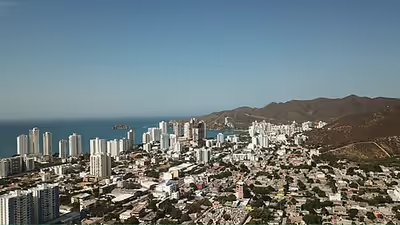
Santa Marta is the capital of Magdalena Department and the fourth-largest urban city of the Caribbean Region of Colombia, after Barranquilla, Cartagena, and Soledad. Founded on July 29, 1525, by the Spanish conqueror Rodrigo de Bastidas, it was one of the first Spanish settlements in Colombia, its oldest surviving city, and second-oldest in South America. This city is situated on a bay by the same name and as such, it is a prime tourist destination in the Caribbean region.
The Universidad del Magdalena is located in Santa Marta. Santa Marta's flag consists of two colors: white and blue. White symbolises peace, in that all are united without restriction. Blue symbolises the sky, the sea, the magic found in the horizon, and the snow-capped Sierra Nevada mountains. The Cathedral Basilica of Santa Marta is one of the oldest structures in the city. Built in the eighteenth century, it held the remains of Bastidas and Bolívar after their deaths.
History
Pre-Columbian times
Before the arrival of Europeans, the South American continent was inhabited by a number of indigenous groups. Due to a combination of tropical weather, significant rainfall, and the destruction and misrepresentation of many records by Spanish conquistadors, our understanding of the peoples of this region is limited.
The Tairona formed mid- to large-size population centers, consisting of stone pathways, terraces, protected waterways, and spaces dedicated to agricultural produce. Their economy was primarily agricultural, cultivating corn, pineapple, yucca, and other local foodstuffs. The Tayrona are considered quite advanced for their time period. Surviving archaeological sites consisted of formed terraces and small scale underground stone channels. They were known to actively collect and process salt, which was a significant trading commodity.
They traded with other indigenous groups along the coast and interior. Archaeological excavations have recovered significant works in pottery, stonework and gold.
Sign in to keep reading
5 more chapters are free with a Lably account.
Simón Bolívar
Simón Bolívar, the liberator of much of South America, spent his last weeks in Santa Marta, and died of tuberculosis in 1830, at the age of 47 at Quinta de San Pedro Alejandrino, Santa Marta. He was buried in the cathedral of Santa Marta, but subsequently his remains were moved to Caracas.
Geography and Climate
Santa Marta is located on Santa Marta Bay of the Caribbean Sea in the province of Magdalena. It is 992 km from Bogotá and 93 km from Barranquilla. It is bordered to the north and west by the Caribbean and to the south by the municipalities of Aracataca and Ciénaga.
Santa Marta experiences a tropical savanna climate (Köppen Aw), bordering on a hot semi-arid climate, with largely uniform temperatures year round. The dry season lasts from December to April, while the wet season lasts from May to November.
Economy
Santa Marta's economy is based primarily on tourism, followed by trade, port activities, fishing and, agriculture. The main agricultural products are: bananas, coffee, mango, citrus cultivars, cocoa and cassava.
Infrastructure
Santa Marta is a major port. Simón Bolívar International Airport (IATA: SMR) is 16 km (10 mi) from the city centre. Historic figure Simón Bolívar died here, a significant event for South America as a whole. His villa known as La Quinta de San Pedro Alejandrino is located just outside the city centre. As the main city centre is located close to the coast, the city itself has had difficulty controlling expansion. Although, technically a separate locality, Rodadero is part of Santa Marta itself.
Notable people
- Antony de Ávila, professional footballer
- Jaime Bateman Cayón, founder and leader of the M19 political movement
- Simón Bolívar, liberator of Gran Colombia, died in Santa Marta
- Julio Bovea, musician
- Sergio Díaz-Granados Guida, IDB Executive Director for Colombia and Peru
- Lalo Ebratt, Reggaeton singer
- Radamel Falcao, professional footballer
- Jesús Ferreira, professional footballer
- Maria Claudia Lacouture, executive director of the Colombo American Chamber of Commerce
- Alejandro Palacio, singer of vallenato music
- Arturo Reyes, football coach
- Aldo Leão Ramírez, professional footballer
- Li Saumet, vocalist of Bomba Estéreo band
- Andrés Solano, professional footballer
- Luis Javier Suárez, professional footballer
- Carlos Valderrama, professional footballer
- Taliana Vargas, actress and model
- Carlos Vives, singer of vallenato music
- Johan Vonlanthen, professional footballer
Media appearances
Santa Marta is the production location of the TV series The White Slave.