


Related on Lably
Through Herbivore
Description
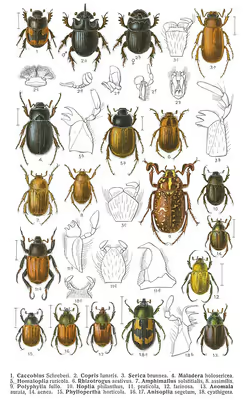
Scarabs are stout-bodied beetles; most are brown or black in colour, but many, generally species that are diurnally active, have bright metallic colours, measuring between 1.5 and 160 mm (0.059 and 6.3 in). The antennae of most species superficially seem to be knobbed (capitated), but the several segments comprising the head of the antenna are, as a rule, lamellate; they extend laterally into plates called lamellae that they usually keep compressed into a ball. Then, when following a scent, such a beetle fans the lamellae out like leaves to sense odours.
Many species are fossorial, with legs adapted for digging. In some groups, males (and sometimes females) have prominent horns on the head and/or pronotum to fight over mates or resources. The largest fossil scarabaeid was Oryctoantiquus borealis with a length of 50 mm (2.0 in).
The C-shaped larvae, called grubs, are pale yellow or white. Most adult beetles are nocturnal, although the flower chafers (Cetoniinae) and many leaf chafers (Rutelinae) are diurnal. The grubs mostly live underground or under debris, so they are not exposed to sunlight. Many scarabs are scavengers that recycle dung, carrion, or decaying plant material. Others, such as the Japanese beetle, are plant-eaters, wreaking havoc on various crops and vegetation.
Some of the well-known beetles from the Scarabaeidae are Japanese beetles, dung beetles, June beetles, rose chafers (Australian, European, and North American), rhinoceros beetles, Hercules beetles, and Goliath beetles.
Several members of this family have structurally coloured shells which act as left-handed circular polarizers; this was the first-discovered example of circular polarization in nature.
Sign in to keep reading
One more chapter is free with a Lably account.
Ancient Egypt
In Ancient Egypt, the dung beetle now known as Scarabaeus sacer (formerly Ateuchus sacer) was revered as sacred. Egyptian amulets representing the sacred scarab beetles were traded throughout the Mediterranean world.