

Cockchafer
Species of scarab beetle
- 14 min read
- 9 chapters

Related on Lably
Through Eastern Europe and Foraging
The cockchafer develops via metamorphosis, in which the beetle undergoes stages of eggs, larvae, pupae and adults.
The mating behaviour is controlled by pheromones. The males usually swarm during the mating season while the females stay put and feed on leaves. The leaves release green leaf volatiles which upon being fed, the cockchafer males can sense and thus locate females for mating. The larvae use both the plant volatiles and CO2 to locate the plant root for food.
This species is an important and nutritious food source for many predators. The adults and larvae feed on plants, and are regarded as agricultural pests of crops such as grasses and fruit trees. Adults have harmful effects for the crop when they aggregate in large groups. The larvae can cause severe damage and kill the plant by gnawing the plant roots.
Etymology
The name cockchafer derives from the late-17th-century usage of cock (in the sense of expressing size or vigour) + chafer which simply means an insect of this type, referring to its propensity for gnawing and damaging plants. The term chafer has its root in Old English ceafor or cefer, of Germanic origin and is related to the Dutch kever, all of which mean gnawer as it relates to the jaw. The term melolontha is derived from the Ancient Greek word mēlolónthē which means cockchafer.
Sign in to keep reading
8 more chapters are free with a Lably account.
Taxonomic history
Melolontha melolontha was first named by Carl Linnaeus as Scarabaeus melolontha in 1758. He described it as hornless and testaceous with a hairy thorax, a bent tail, and a white abdomen. Fabricius in 1775 later named it as Melolontha vulgaris; remarking that its larvae are a root-eater, that it can be preyed on by mice, and that it can foretell autumn diseases. Moll in 1785 named the cockchafer as Scarabaeus majalis and observed that the beetles were brownish-red or multicolored.
In the 19th century, Étienne Mulsant named it as Melolontha albida and differentiated between the male and the female. In 1884, Friedrich Westhoff distinguished numerous subspecies, namely–Melolontha melolontha funesta, M. m. humeralis, M. m. luctuosa, M. m. melanopus, M. m. obscuripes, and M. m. scapularis.
In the 20th century, Georg Pfanneberg named the species Melolontha nigritarsis because the observed specimen caught in May 1903 had completely black tarsi. In 1905, Josef Petz observing a specimen caught the previous year, described a new subspecies which had a sharp deviation at the tip of its pygidium, naming it M. melolontha colpopyga. Karl Wilhelm von Dalla Torre in 1912 named a variation of the species M. redtenbacheri. In 1923, Jarosław Łomnicki found the female to have a blunt pygidium tip which varied from the one observed by Petz, and it also had an acutely posterior pronotum, and flat hairs on its pygidium. He named this M. melolontha amblypyga.
Description
Adults
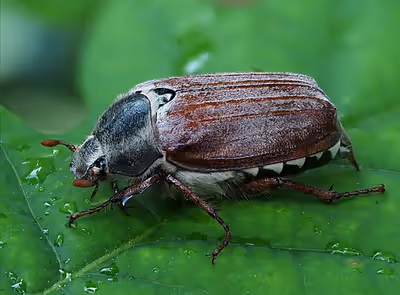
Adults of M. melolontha reach sizes of 25 to 30 mm (1.0 to 1.2 in) in length. They have a dark head with two antennae, each of which has multiple segments. Behind their heads, they have a dark pronotum covered with short hairs. This black coloration distinguishes them from their close relative M. hippocastani, whose pronotum is brown. The top of their bodies has reddish brown elytra and a black abdomen which is partly white on the sides. Male cockchafers have seven flattened leaflike extensions on their antennae, whereas the females have only six. Its antennae are large and fan-like with the male's larger than those of the female's. Genetically, M. melolontha is historically divergent to M. hippocastani as a research study in 2024 showed that melolontha was found to have a higher genetic differentiation than hippocastani (the forest cockchafer).
Larvae
M. melolontha larvae typically have three stages of development over the course of 3–4 years. In the first stage (L1), they are 10–20 mm (0.4–0.8 in) long which then grows to 30–35 mm (1.2–1.4 in) in the second year of development (L2), and reaches 40–46 mm (1.6–1.8 in) in their final year of development (L3) before emerging. In some areas of Eastern Europe, the larvae develop for a fourth year (L4). It has a white body, black at the abdominal extremity which curves into a C-shaped arc, and long, hairy, well-developed legs. It has a large brown head with strong, grabbing mandibles. The larva relies on its olfactory and contact chemosensory senses for underground foraging.
Distribution and habitat
Cockchafers are prevalent across Europe. They are particularly prevalent in temperate regions with suitable soil conditions for larval development. However, they have also been reported in parts of Asia, including Turkey and the Caucasus region. Geographical barriers, climatic conditions, and ecological factors may limit their dispersal, for example M. melolontha does not occur in the mountainous regions of Tyrol because it cannot survive in the Alps' high altitude and low temperature during colder months. Also they do not fly more than 2 to 3 km (1.2 to 1.9 mi) from where they emerge and remain in close proximity of the field or grasslands where they occur.
Life cycle
Adults appear at the end of April or in May and live for about five to seven weeks. After about two to three weeks, the female begins laying eggs, which she buries about 15 to 25 cm (6 to 10 in) deep in the earth. She may do this several times until she has laid between 60 and 80 eggs. Most typically, the female beetle lays its eggs in fields. The preferred food for adults is oak leaves, but they will also feed on conifer needles, for example pine.
The larvae, known as "chafer grubs" or "white grubs", hatch four to six weeks after being laid as eggs. They feed on plant roots, for instance potato roots. The grubs develop in the earth for three to four years, in colder climates even five years, and grow continually to a size of about 4–5 cm (1.6–2.0 in), before they pupate in early autumn and develop into an adult cockchafer in six weeks.
During the winter season, the adult cockchafer overwinters in the earth by staying in its pupal chambers at depths usually between 5 to 40 cm (2 to 16 in) but it can be also found in a depth of 100 cm (40 in). They work their way to the surface only in spring (April–May).
Because of their long development time as larvae, cockchafers appear in a cycle of every three or four years; the years vary from region to region. There is a larger cycle of around 30 years superimposed, in which they occur (or rather, used to occur) in unusually high numbers (10,000s).
Behaviour and ecology
Mating
Males leave the soil when the temperature is favourable in April or May. Sexual dimorphism is observed as male beetles, at dusk, will begin to swarm and locate around groups of trees at forest edges, which ends in darkness. On the other hand, females stay in place and feed on leaves until they reach sexual maturity. Males primarily fly around the branches looking for females to mate with. Mating lasts for several hours. The male beetles seek mates for about 10-20 days. These swarms typically do minimal damage to the trees, but are occasionally harmful in cherry or plum orchards because of their consumption of blossoms. Once the females have matured and mated, they return to the fields to lay their eggs 15 to 25 cm (6 to 10 in) in the soil in a batch of 10 to 38 eggs. The females stay 2 to 4 days on the soil to protect the eggs. Only a third of females will survive this trip, but any survivors will make a second, and occasionally third, swarming trip and return to the field to lay eggs again. Number of days for M. melolontha eggs to mature depends on temperature—5 to 8 days at 27 °C (81 °F) and 23 to 32 days at 32 °C (90 °F).
Green leaf volatiles
Green leaf volatiles (GLVs) have been found to act as a sexual kairomone, that helps M. melolontha adults in mate finding, which is a compound released by plants that attracts the cockchafer. This enhances the attractiveness of toluquinone, a sex pheromone in scarab beetles which is released by the female to attract the male beetles. Only male melolontha are attracted to GLVs particularly (Z)-3-hexen-1-ol, (E)-2-hexen-1-ol and 1-hexanol, using its release to identify leaves that female beetles are feeding on. Female melolontha are not attracted to any of the GLV compounds. M. melolontha males are more sensitive to lower GLV concentrations, possibly due to the anatomical differences between male and female antennae. Due to this phenomenon, sexual dimorphism can be observed in flight behaviour. This makes the melolontha beetle the first reported insect of needing both the sex pheromone and plant volatiles for mating. During swarming behaviour, males will hover around the foliage while females remain on twigs and branches to feed. Males then use GLVs to identify which leaves have females that they can mate with. GLVs are being investigated as a possible pest control technique to attract males and prevent mating.
Pest
Though adults can damage some fruit trees, M. melolontha larvae are the primary agricultural pests. Larvae hatch from their eggs 4–6 weeks after being laid and develop into adults over the course of 3–4 years. Immediately after hatching, larvae will gnaw on small roots. While having only three larval stages, the larvae will continue feeding on roots, particularly grasses, cereals, and other crops, only pausing to burrow deep into the soil for winter hibernation.
In their first stage, M. melolontha larvae depend on soluble compounds such as sugar, amino acids, and isoflavonoids which are released by plant roots in rhizosphere. Hence it gets attracted by the CO2 released by respiring plant roots and soil microorganisms. Above a larval density of 1,000/m2 (93/sq ft), the damage to soil by melolontha larvae is noticeable. In their second stage, larvae will cause the most damage to crops such as strawberry. In their third stage, larvae do less but still cause severe damage to crops. They most prominently use structures on their antennae called pore plates (or lamellae) to smell. These have a thin layer of cells over sensory units consisting of dendrite bundles. Larvae can identify CO2 and plant volatiles. They push their heads into the walls of their burrows and probe with their antennae, likely to taste the soil with bristle-like sensilla. The cockchafer larvae can also gnaw the plant roots for 30 cm (12 in) each day, which quickly kills the plant.
Ecological impact
Environmental factors such as prevailing soil temperature, humidity, and plant type have a considerable impact on the existence and behaviour of cockchafers in wooded environments. It indicates that cockchafer populations are strongly influenced by climatic conditions, with warmer soil temperatures and higher humidity level favouring the growth of larvae in upper soil layers and accelerate its overwintering period but a fall in humidity decreases the number of larvae with desiccation seen in them. Additionally, specific vegetation types, including deciduous trees and shrubs, provide suitable habitats for cockchafers, facilitating their survival and reproduction within forest stands.
Intestinal components and microbiome
The gut enzymes and microbiota of M. melolontha larvae allow them to exploit a variety of ecological niches which include low energy foods, rotting organic matter and freshly growing roots in the soil. There are two major compartments in the melolontha larvae's intestinal tract. The first is a tubular midgut that secretes hydrolytic enzymes for macromolecule breakdown, and the second is a bulbous hindgut used for fermentation. In most individuals of M. melolontha, the bacterial diversity in the midgut was shown to be comparatively reduced than the same in diet, indicating lysis of the bacteria.
In its midgut, M. melolontha has enzymes which have been found to deactivate toxins by separating the latter from sugar, which is found in dandelion plants. Trypsin-like enzymes from the midgut of M. melolontha have been found to break down certain bacterial toxins and inactivate them. Cysteine and Aspartyl Proteinase are enzymes also forming a part of the midgut juice in cockchafers, and help it to digest Cry8C toxin (or B. t. japonensis, a subspecies of Bacillus thuringiensis). The hindgut in melolontha has a low concentration of glucose caused by high fermentation or low hydrolysis of recalcitrant residues such as cellulose. Acetate is a major product of this fermentation, which is caused by the bacteria found in hindgut.
Some research on the M. melolontha microbiome has been focused on increasing the entomopathogenic properties of nematodes so that the latter can be used as a pest control due to their symbiotic nature. Bacteria such as Xenorhabdus nematophila are transported by nematodes and released into the insect's midgut. The bacteria will release lytic enzymes and other antimicrobial substances to decrease competition from the beetle's native microbiome. This creates an optimal environment for nematode development. Bacterial species in the midgut of M. melolontha such as Pseudomonas chlororaphis have been found to fight back, acting as antagonists to entomopathogenic bacteria. These bacteria have been identified differentially in different larval stages, with P. chlororaphis usually being found in the third and final larval stage.
History of control as a pest
In the Late Middle Ages, one notable event took place in which cockchafers were collected and killed because they couldn't withdraw from a town into a specially designated area in France. In the pre-industrial revolution, the main mechanism to control cockchafer population was to control and kill adult beetles in large numbers. Later on, their population grew substantially as one estimate counted more than 20 million individuals in a forest area of 18 km2 (6.9 square miles).
In the 19th century, cockchafers were reportedly consumed in different parts of Europe. It was consumed raw, sugared, candied, or in soup which tasted similar to crab soup. While the soup was eaten back then, the reports of the soup being widely popular were found to be a myth. In Sweden, the peasants determined the severity of upcoming winter by judging the body coloration of the cockchafer larva (or grub). Therefore, they call it Bemärkelse-mask—prognostic worm.
Modern agriculture has resulted in the rise of chemical pesticides and an increase of farming land which together led to a decrease in Cockchafer populations, especially in Europe in the 1970s although recent years suggest otherwise. Along with a decrease in output of chemical products for soil treatment in Europe, the use of aerial treatment for pest control was banned by the EU in favor of agriculturally sustainable methods to control cockchafers. The control methods, which are now a common standard, are light traps, Azadirachtin, soil tilling, pre-cropping, sex pheromones, and more recently entomopathogens.
Interaction with other species
Diet
Cockchafer feeds on deciduous plant and fruit tree leaves, including oaks, maple, sweet chestnut, beech, plum, and walnut trees. Meanwhile, the cockchafer larvae feed on the roots of field plants such as grains, grasses, trees, beet roots, and a large part of crop rootlets.
Predators
The European mole is a natural predator of cockchafers. Moles are known to feed on cockchafer larvae. They can detect them using their keen sense of smell and specialised digging behaviour. This predation can help regulate cockchafer populations in mole-inhabited areas.
M. melolontha adults are predated by ground beetles (Carabidae) and ants (Formicidae). Larvae are predated by click beetles (Elateridae) while underground. Starlings, crows, and gulls also predate M. melolontha larvae, often after a field has been plowed.
Parasites
Dexia rustica is a parasitic fly that uses M. melolontha larvae as its host. D. rustica eggs hatch underground and search for hibernating cockchafer larvae. Their presence will ultimately kill the beetle larvae in spring when the fly hibernates. About 30 to 35 cm (0.98 to 1.15 ft) below the ground, over 10 percent of the grubs (or larvae) can be parasitised by one to six D. rustica.
Relationship with humans
Children since antiquity have played with cockchafers. In ancient Greece, boys caught the insect, tied a linen thread to its feet and set it free, amusing themselves to watch it fly in spirals. English boys in Victorian times played a very similar game by sticking a pin through one of its wings. Nikola Tesla recalls that as a child he made one of his first inventions, an engine made by harnessing four cockchafers in this fashion.
In arts and culture, cockchafers appear in the fairy tales "Thumbelina" by Hans Christian Andersen and "Princess Rosette" by Madame d'Aulnoy. The cockchafer is featured in a German children's song called Maikäfer flieg!. It is tuned to 'Schlaf, Kindlein, schlaf', and is similar to the English "Ladybird, Ladybird":
Maikäfer, flieg,
Dein Vater ist im Kriege,
Dein Mutter ist in Pommerland,
Pommerland ist abgebrannt!
Maikäfer, flieg!
Translation:
Maybug, fly
Your father is at war,
Your mother is in Pomerania,
Pomerania is burnt down!
Maybug, fly!
The verse dates back to the Thirty Years' War in the first half of the 17th century, in which Pomerania was pillaged and suffered heavily. It appeared in other German songs and folk stories, for example Max and Moritz. In Germany, it was commonly seen during the opening years of World War II, particularly during the Battle of France.
According to one source, the dumbledore in Thomas Hardy's 1899 poem An August Midnight is a cockchafer. However, in his novel The Mayor of Casterbridge, Hardy uses the dialect word dumbledore to mean a bumble bee. Also in the United Kingdom, there have been four Royal Navy ships named HMS Cockchafer.
Decorative trims of women's dresses between the 1750s and 1780s, were known as sourcils de hanneton, meaning 'cockchafer eyebrows'. This referred to the beetles fan-like antennae that resembled the decorative trim made with knotted silk floss. As a foodstuff, until the mid-1900s, Cockchafer soup, made with cockchafers, used to be popular in France and Germany.