


Related on Lably
Through Chemical formula, Solid and Ligand
Structure and chemistry
Silver azide can be prepared by treating an aqueous solution of silver nitrate with sodium azide. The silver azide precipitates as a white solid, leaving sodium nitrate in solution.
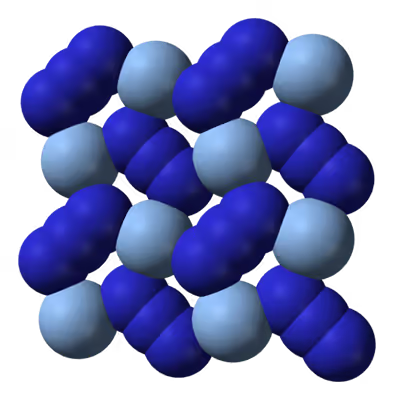
X-ray crystallography shows that AgN3 is a coordination polymer with square planar Ag+ coordinated by four azide ligands. Correspondingly, each end of each azide ligand is connected to a pair of Ag+ centers. The structure consists of two-dimensional AgN3 layers stacked one on top of the other, with weaker Ag–N bonds between layers. The coordination of Ag+ can alternatively be described as highly distorted 4 + 2 octahedral, the two more distant nitrogen atoms being part of the layers above and below.
In its most characteristic reaction, the solid decomposes explosively, releasing nitrogen gas:
- 2 AgN3(s) → 3 N2(g) + 2 Ag(s)
The first step in this decomposition is the production of free electrons and azide radicals; thus the reaction rate is increased by the addition of semiconducting oxides. Pure silver azide explodes at 340 °C, but the presence of impurities lowers this down to 270 °C. This reaction has a lower activation energy and initial delay than the corresponding decomposition of lead azide.
Sign in to keep reading
One more chapter is free with a Lably account.
Safety
AgN3, like most heavy metal azides, is a dangerous primary explosive. Decomposition can be triggered by exposure to ultraviolet light or by impact. Ceric ammonium nitrate [NH4]2[Ce(NO3)6] is used as an oxidising agent to destroy AgN3 in spills.