


Related on Lably
Through Chemical formula, Salt (chemistry) and Hygroscopy
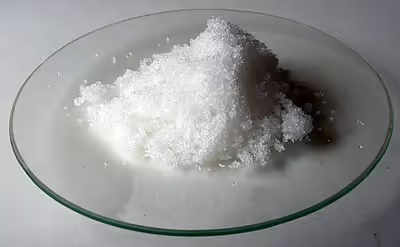
Sodium nitrate is a white deliquescent solid very soluble in water. It is a readily available source of the nitrate anion (NO3−), which is useful in several reactions carried out on industrial scales for the production of fertilizers, pyrotechnics, smoke bombs and other explosives, glass and pottery enamels, food preservatives (esp. meats), and solid rocket propellant. It has been mined extensively for these purposes.
History
An early scientific account of the South American deposits was published in 1821 by the Peruvian mineralogist Mariano Eduardo de Rivero y Ustáriz, who analyzed a sample from the Tarapacá district, then part of Peru. The specimen had been supplied by Pedro Fuentes and was held in the Paris laboratory of the mineralogist René Just Haüy. Rivero concluded that the mineral could be used for industrial purposes like glassmaking, fertilizer, and gunpowder, although commercial work did not begin until 1831.
The first shipment of saltpeter to Europe arrived in England from Peru in 1820 or 1825, right after that country's independence from Spain, but did not find any buyers and was dumped at sea to avoid customs tolls. With time, however, the mining of South American saltpeter became a profitable business (in 1859, England alone consumed 47,000 metric tons). Chile fought the War of the Pacific (1879–1884) against the allies Peru and Bolivia and took over their richest deposits of saltpeter. In 1919, Ralph Walter Graystone Wyckoff determined its crystal structure using X-ray crystallography.
Sign in to keep reading
4 more chapters are free with a Lably account.
Occurrence
The largest accumulations of naturally occurring sodium nitrate are found in Chile and Peru, where nitrate salts are bound within mineral deposits called caliche ore. Nitrates accumulate on land through marine-fog precipitation and sea-spray oxidation/desiccation followed by gravitational settling of airborne NaNO3, KNO3, NaCl, Na2SO4, and I, in the hot-dry desert atmosphere. El Niño/La Niña extreme aridity/torrential rain cycles favor nitrates accumulation through both aridity and water solution/remobilization/transportation onto slopes and into basins; capillary solution movement forms layers of nitrates; pure nitrate forms rare veins. For more than a century, the world supply of the compound was mined almost exclusively from the Atacama desert in northern Chile until, at the turn of the 20th century, German chemists Fritz Haber and Carl Bosch developed a process for producing ammonia from the atmosphere on an industrial scale (see Haber process). With the onset of World War I, Germany began converting ammonia from this process into a synthetic Chilean saltpeter, which was as practical as the natural compound in production of gunpowder and other munitions. By the 1940s, this conversion process resulted in a dramatic decline in demand for sodium nitrate procured from natural sources.
Chile still has the largest reserves of caliche, with active mines in such locations as Valdivia, María Elena and Pampa Blanca, and there it used to be called white gold. Sodium nitrate, potassium nitrate, sodium sulfate and iodine are all obtained by the processing of caliche. The former Chilean saltpeter mining communities of Humberstone and Santa Laura were declared UNESCO World Heritage sites in 2005.
Synthesis
Sodium nitrate is also synthesized industrially by neutralizing nitric acid with sodium carbonate or sodium bicarbonate:
- 2 HNO3 + Na2CO3 → 2 NaNO3 + H2O + CO2
- HNO3 + NaHCO3 → NaNO3 + H2O + CO2
or also by neutralizing it with sodium hydroxide (however, this reaction is very exothermic):
- HNO3 + NaOH → NaNO3 + H2O
or by mixing stoichiometric amounts of ammonium nitrate and sodium hydroxide, sodium bicarbonate or sodium carbonate:
- NH4NO3 + NaOH → NaNO3 + NH4OH
- NH4NO3 + NaHCO3 → NaNO3 + NH4HCO3
- 2NH4NO3 + Na2CO3 → 2NaNO3 + (NH4)2CO3
Uses
Most sodium nitrate is used in fertilizers, where it supplies a water-soluble form of nitrogen. Its use, which is mainly outside of high-income countries, is attractive since it does not alter the pH of the soil. Another major use is as a complement to ammonium nitrate in explosives. Molten sodium nitrate and its solutions with potassium nitrate have good thermal stability (up to 600 °C) and high heat capacities. These properties are suitable for thermally annealing metals and for storing thermal energy in solar applications.
Food
Sodium nitrate is also a food additive used as a preservative and color fixative in cured meats and poultry; it is listed under its INS number 251 or E number E251. It is approved for use in the EU, US and Australia and New Zealand. Sodium nitrate should not be confused with sodium nitrite, which is also a common food additive and preservative used, for example, in deli meats.
Thermal storage
Sodium nitrate has also been investigated as a phase-change material for thermal energy recovery, owing to its relatively high melting enthalpy of 178 J/g. Examples of the applications of sodium nitrate used for thermal energy storage include solar thermal power technologies and direct steam generating parabolic troughs.
Steel coating
Sodium nitrate is used in a steel coating process in which it forms a surface of magnetite layer.
Health concerns
Studies have shown a link between increased levels of nitrates and increased deaths from certain diseases including Alzheimer's disease, diabetes mellitus, stomach cancer, and Parkinson's disease: possibly through the damaging effect of nitrosamines on DNA; however, little has been done to control for other possible causes in the epidemiological results. Nitrosamines, formed in cured meats containing sodium nitrate and nitrite, have been linked to gastric cancer and esophageal cancer. Sodium nitrate and nitrite are associated with a higher risk of colorectal cancer.
Nitrates are key intermediates and effectors in the primary vasculature signaling which is necessary for all mammals to survive.