


Related on Lably
Through Geology, Rock (geology) and Fault (geology)
Geometry of slickensides
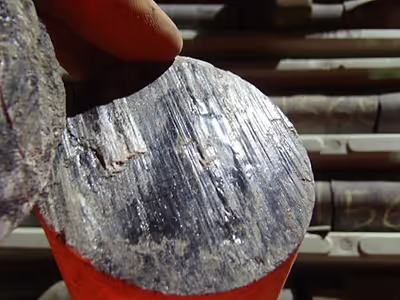
A slickenside can occur as a single surface at a fault between two hard surfaces. Alternatively, the gouge between the fault surfaces may contain many anastamosing slip surfaces that host slickensides. These slip surfaces are on the order of 100 micrometers thick, and the size of the grains that constitute the surface are ultra-fine (0.01–1 micrometers in diameter). These grains are unlike typical grains of fault rock in that they have irregular grain boundaries and few crystal lattice defects (termed dislocations).
Slickensides have conspicuous shapes that can be used to determine the direction of movement along the fault. Straight slickenlines indicate linear-translational fault motion. They are parallel to the direction of fault motion and serve as a kinematic indicator. Curved slickenlines have recently been studied for their potential to preserve the direction of earthquake rupture propagation.
Surface roughness
Slickenside formation results in unique roughness on a slip surface. Fault surface roughness (or topography) is characterized by the aspect ratio of asperity height to scale of observation, and this roughness is a key parameter in the study of fault slip. In general, a fault surface appears rougher at smaller scales (i.e., rough and bumpy at approximately millimetre scales and smaller, and increasingly smooth with larger fields of view). This smoothing with larger observation scales is more pronounced in the slip-parallel direction than the slip-perpendicular direction and is commonly a result of slickenside formation.
Sign in to keep reading
3 more chapters are free with a Lably account.
Mechanisms to create slickensides
The unique geometry of a slickenside can be created in a variety of ways, but the precise mechanisms that create them is not well understood. The grinding between two rocks produces granular material, and there is a change in the behaviour of wear material when the particle size is reduced to nanometers. When the particle size is reduced so dramatically that the surface becomes shiny, it can be characterized as a fault mirror.
A fault mirror may also be the result of fluid being present at the fault surface during slip. Once slip has stopped, this fluid solidifies as a silica gel, which appears shiny and hosts slickenlines.
Asperity plowing
An asperity on a fault surface is a bump or point with higher relief than the area around it. The asperity, when pressed into the opposing rock surface and then moved, digs into the opposing rock, forming troughs, grooves, and scratches. Asperity plowing is thus a result of permanent deformation in the brittle regime at a small scale.
Debris streaking
When an asperity plows into the opposing rock, it wears itself and the opposing rock down and produces fine debris. This debris, or wear product, accumulates both in front of and behind the asperity in a long, elongated shape. If the asperity is relatively hard, the debris will accumulate in front of the asperity. If the asperity is relatively soft, the debris will trail behind. This debris hardens over time and is preserved as a form of slickenline.
Erosional sheltering
Some rocks may contain particles that are harder than the rest of the rock. When these rocks are worn, the harder particles will resist wear more than the softer rock, the rock on the lee side of the hard particle will be protected from wear. This creates a tail that starts abruptly as a crag where the hard particle was located and is elongated parallel to the direction of movement down-slip from the particle.
Fibre growth
The fault plane may be coated by mineral fibres that grew during the fault movement, known as slickenfibres. Due to irregularities in the fault plane, exposed slickenfibres typically have a stepped appearance that can be used to determine the sense of movement across the fault.
Slickenfibres are secondary minerals that make up the slickensides rather than the rock itself. Slickenfibres form in areas where the rock slowly creep past one another rather than sliding suddenly as a result of an earthquake. Unlike slickenlines, which give two possibilities for slip direction, slickenfibres preserve the true slip direction.
Implications
Slickensides provide useful insight into earthquake processes. Calcite slickenfibres have recently been used to constrain the depth of aseismic creep in the Zagros Mountains as well as the orientation of stress acting on the fault. It has also been suggested that when multiple slickenfibre or slickensteps orientations are present, it can indicate that the ongoing shear is not strain softening so slip does not have a constant direction.
In addition to the direction of slip, slickenlines have also been used to constrain the timing of fault slip. They also preserve any complexity in the geometry of the earthquake rupture.
Other types of slickensides
Slickensides in soils
In pedology, the study of soils in their natural environments, a slickenside is a surface of the cracks produced in soils containing a high proportion of swelling clays. Slickensides are a type of cutan. In the Australian Soil Classification, slickensides, along with lenticular structural aggregates, are an indicator of a vertisol.
Slickensides on the Moon
On the Moon, a boulder with slickensides, discovered in a debris-strewn small crater at Station 9 near Rima Hadley, was photographed during a moonwalk by the crew of Apollo 15.