

Brittle–ductile transition zone
Strongest part of the Earth's crust
- 2 min read
- 3 chapters

Related on Lably
Through Lithosphere, Earthquake and Heat transfer
Depth of the Transition Zone
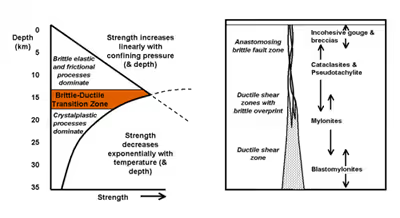
The transition zone occurs at the depth in the Earth's lithosphere where the downward-increasing brittle strength equals the upward-increasing ductile strength, giving a characteristic "saw-tooth" crustal strength profile. The transition zone is, therefore, the strongest part of the crust and the depth at which most shallow earthquakes occur. Its depth depends on both strain rate and temperature gradient; it is shallower for slow deformation and/or high heat flow and deeper for fast deformation and/or low heat flow. Crustal composition and age also affect the depth: it is shallower (~10–20 km) in warm, young crust and deeper (~20–30 km) in cool, old crust.
Sign in to keep reading
2 more chapters are free with a Lably account.
Changes in Physical Properties
The transition zone also marks a shift in the electrical conductivity of the crust. The upper region of the Earth's crust, which is about 10–15 km thick, is highly conductive due to electronic-conducting structures which are commonly distributed throughout this region. In contrast, the lower region of the crust is highly resistive and its electrical conductivity is determined by physical factors such as depth and temperature. Although the transition zone generally marks a shift from brittle rock to ductile rock, exceptions exist in certain conditions. If stress is applied rapidly, rock below the transition zone may fracture. Above the transition zone, the rock may deform ductilely if pore fluids are present and stress is applied gradually.
Examples exposed on land
Sections of fault zones once active in the transition zone, and now exposed at the surface, typically have a complex overprinting of brittle and ductile rock types. Cataclasites or pseudotachylite breccias with mylonite clasts are common, as are ductilely deformed cataclasites and pseudotachylites. These sections become exposed in geologically active regions where the transition zone is located the seismic zone, where most shallow earthquakes occur. A major example of this phenomenon is the Salzach-Ennstal-Mariazell-Puchberg (SEMP) fault system in the Austrian Alps. Along this fault line, researchers have directly observed changes in structure and strength profiles in transition zone.