


Related on Lably
Through Sodium, Oxygen and Water of crystallization
Preparation
Sodium dichromate is generated on a large scale from ores containing chromium(III) oxides. The ore is fused with a base, typically sodium carbonate, at around 1000 °C in the presence of air (source of oxygen):
- 2 Cr2O3 + 4 Na2CO3 + 3 O2 → 4 Na2CrO4 + 4 CO2
This step solubilizes the chromium and allows it to be extracted into hot water. At this stage, other components of the ore such as aluminium and iron compounds, are poorly soluble. Acidification of the resulting aqueous extract with sulfuric acid or carbon dioxide affords the dichromate:
- 2 Na2CrO4 + 2 CO2 + H2O → Na2Cr2O7 + 2 NaHCO3
- 2 Na2CrO4 + H2SO4 → Na2Cr2O7 + Na2SO4 + H2O
The dichromate is isolated as the dihydrate by crystallization. In this way, many millions of kilograms of sodium dichromate are produced annually.
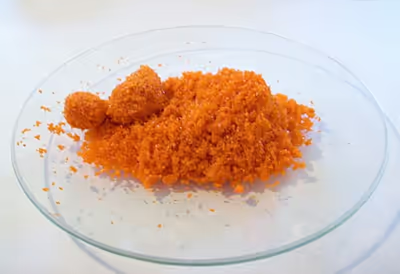
Since chromium(VI) is toxic, especially as the dust, such factories are subject to stringent regulations. For example, effluent from such refineries is treated with reducing agents to return any chromium(VI) to chromium(III), which is less threatening to the environment. A variety of hydrates of this salt are known, ranging from the decahydrate below 19.5 °C (CAS# 13517-17-4 ) as well as hexa-, tetra-, and dihydrates. Above 62 °C, these salts lose water spontaneously to give the anhydrous material. It is crystallised around 30 to 35 degrees C
Sign in to keep reading
2 more chapters are free with a Lably account.
Reactions
Dichromate and chromate salts are oxidizing agents. For the tanning of leather, sodium dichromate is first reduced with sulfur dioxide. For hexavalent chrome plating, chromate is converted to the so-called chromic acid (essentially chromium trioxide) by sulfuric acid.
Organic chemistry
Sodium dichromate is an oxidising agent in organic chemistry. It is a member of a large collection of chromium-based oxidants. Oxidations are often conducted in the presence of sulfuric acid, which favors the formation of chromium trioxide, which is the active oxidation reagent. It is milder and more selective than potassium permanganate. It is often used interchangeably with potassium dichromate. Relative to the potassium salt, the main advantage of sodium dichromate is its greater solubility in water and polar solvents like acetic acid.
Generally, the use of chromate-base reagents has declined owing to environmental concerns (see Hexavalent chromium).
Especially in the presence of acids such as sulfuric acid, it is well known to oxidize alcohols. It converts primary alcohols into aldehydes:
- 3 R2CHOH + Cr2O2−7 + 2 H+ → 3 R2C=O + Cr2O3 + 4 H2O
Under more forcing conditions, into carboxylic acids. In contrast, potassium permanganate tends to give carboxylic acids as the sole products. Secondary alcohols are converted into ketones. Tertiary alcohols are not oxidized.
Oxidations by dichromate are accompanied by a color change from yellow-orange for Cr(VI) to green for Cr(III). The color change, a colorimetric test, exhibited can be used as a test to distinguish aldehydes from ketones. Aldehydes are oxidized further, whereas ketones resist oxidation by dichromate salts.
Sodium dichromate oxidizes benzylic and allylic C-H bonds to carbonyl derivatives. this compound For example, 2,4,6-trinitrotoluene is oxidized to the corresponding carboxylic acid. Similarly, 2,3-dimethylnaphthalene is oxidized by Na2Cr2O7 to 2,3-naphthalenedicarboxylic acid.
Sodium dichromate can be used in fluorene to fluorenone conversion.
Safety
Like all hexavalent chromium compounds, sodium dichromate is carcinogenic. The compound is also corrosive and exposure may produce severe eye damage or blindness. Human exposure further encompasses impaired fertility, heritable genetic damage and harm to unborn children.