

Somali plate
Minor tectonic plate including the east coast of Africa and the adjoining seabed
- 2 min read
- 2 chapters

Related on Lably
Through Indian plate, Indian Ocean and Year
Geology
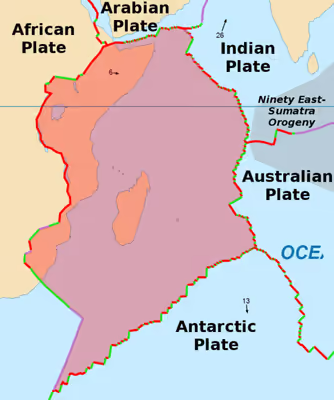
The Arabian plate diverges to the north forming the Gulf of Aden. The Indian plate, Australian plate, and Antarctic plate all diverge from the Somali plate forming the eastern Indian Ocean. The Somali-Indian boundary spreading ridge is known as the Carlsberg Ridge. The Somali-Australian boundary spreading ridge is known as the Central Indian Ridge. The Somali-Antarctic boundary spreading ridge is known as the Southwest Indian Ridge. The western boundary with the African plate is diverging to form the East African Rift, which stretches south from the triple junction in the Afar depression. The southern boundary with the Nubian–African plate is a diffuse plate boundary with the Lwandle plate. The Seychelles and the Mascarene Plateau are located northeast of the Madagascar.
A kinematic model of the Nubian-Somali plates based on DORIS and GPS reports an opening rate of the East African Rift of 4.7–6.7 mm/yr. A more recent synthesis from 2015 states that the most comprehensive geodetic study indicates a "slow clockwise rotation" of the Somali plate relative to the African-Nubian plate and indicates an opening rate that increases northward to about 6 mm/yr in the Afar depression.
Sign in to keep reading
One more chapter is free with a Lably account.
Tectonic history
From 1.4–1.2 Ga the Kibaran orogeny fused the Tanzanian and Congo cratons. From 1000 to 600 Ma the super-continent Gondwana was formed and the Pan-African orogeny sutured the Tanzanian and Kalahari cratons. The rifting of Gondwana occurred from 190 Ma to 47 Ma separating Madagascar from the eastern coast of Africa and placing the Seychelles/Mascarene Plateau northeast of Madagascar. The rifting of the Red Sea started around 30 million years ago and the first rifting occurred in the northern West African Rift System around 20 million years ago.