


Related on Lably
Through Organic compound, Steroid hormone and Bacteria
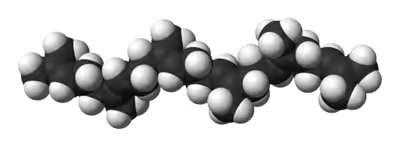
Most plants, fungi, and animals produce squalene as a biochemical precursor in sterol biosynthesis, including cholesterol and steroid hormones in the human body. It is also an intermediate in the biosynthesis of hopanoids in many bacteria. In humans, an estimated 12% of bodily squalene is found in sebum.
Squalene is an ingredient in topical products used for skin lubrication, and in some vaccine adjuvants.
History
Squalene was discovered in 1906 by Mitsumaru Tsujimoto, a Japanese researcher in oil and fats. He discovered a certain unsaponifiable fraction of kuroko-zame in a deep sea shark, measuring its formula as C10H18. Previously, the only substantial unsaponifiable fraction in animal oil was cholesterol.
He later in 1916 used fractional vacuum distillation on liver oil of various species of deep sea sharks, finding its formula was actually C30H50. It was especially concentrated in liver oil of the Squalidae, leading to the name squalene.
In 1931, Karrer and Helfenstein synthesized squalene from farnesyl bromide, thus determining its structure.
Sign in to keep reading
4 more chapters are free with a Lably account.
Role in triterpenoid synthesis
Squalene is a biochemical precursor to both steroids and hopanoids. For sterols, the squalene conversion begins with oxidation (via squalene monooxygenase) of one of its terminal double bonds, resulting in 2,3-oxidosqualene. It then undergoes an enzyme-catalysed cyclisation to produce lanosterol, which can be elaborated into other steroids such as cholesterol and ergosterol in a multistep process by the removal of three methyl groups, the reduction of one double bond by NADPH and the migration of the other double bond. In many plants, this is then converted into stigmasterol, while in many fungi, it is the precursor to ergosterol.
The biosynthetic pathway is found in many bacteria, and most eukaryotes, though has not been found in Archaea.
Production
Biosynthesis
Squalene is biosynthesised by coupling two molecules of farnesyl pyrophosphate. The condensation requires NADPH and the enzyme squalene synthase.
Click on genes, proteins and metabolites below to link to respective articles.
Uses
As an adjuvant in vaccines
Immunologic adjuvants are substances, administered in conjunction with a vaccine, that stimulate the immune system and increase the response to the vaccine. Squalene is not itself an adjuvant, but it has been used in conjunction with surfactants in certain adjuvant formulations.
An adjuvant using squalene is Seqirus' proprietary MF59, which is added to influenza vaccines to help stimulate the human body's immune response through production of CD4 memory cells. It is the first oil-in-water influenza vaccine adjuvant to be commercialised in combination with a seasonal influenza virus vaccine. It was developed in the 1990s by researchers at Ciba-Geigy and Chiron; both companies were subsequently acquired by Novartis. The Influenza vaccine business of Novartis was later acquired by CSL Bering and created the company Seqirus. It is present in the form of an emulsion and is added to make the vaccine more immunogenic. However, the mechanism of action remains unknown. MF59 is capable of switching on a number of genes that partially overlap with those activated by other adjuvants. How these changes are triggered is unclear; to date, no receptors responding to MF59 have been identified. One possibility is that MF59 affects the cell behaviour by changing the lipid metabolism, namely by inducing accumulation of neutral lipids within the target cells. An influenza vaccine called FLUAD which used MF59 as an adjuvant was approved for use in the US in people 65 years of age and older, beginning with the 2016–2017 flu season.
A 2009 meta-analysis assessed data from 64 clinical trials of influenza vaccines with the squalene-containing adjuvant MF59 and compared them to the effects of vaccines with no adjuvant. The analysis reported that the adjuvated vaccines were associated with slightly lower risks of chronic diseases, but that neither type of vaccines altered the rate of autoimmune diseases; the authors concluded that their data "supports the good safety profile associated with MF59-adjuvated influenza vaccines and suggests there may be a clinical benefit over non-MF59-containing vaccines".
Safety
Toxicology studies indicate that in the concentrations used in cosmetics, squalene has low acute toxicity, and is not a significant contact allergen or irritant.
The World Health Organization and the US Department of Defense have both published extensive reports that emphasise that squalene is naturally occurring, even in oils of human fingerprints. The WHO goes further to explain that squalene has been present in over 22 million flu vaccines given to patients in Europe since 1997 without significant vaccine-related adverse events.
Controversies
There have been attempts to link squalene to Gulf War syndrome, but these have been debunked, and it was later revealed that squalene was not an ingredient of the vaccines in question.