

Surfactant
Substance that lowers surface tension
- 14 min read
- 4 chapters
- 4 labs on Lably

Learn it on Lably
Surfactants are among the most widespread and commercially important chemicals. Private households as well as many industries use them in large quantities as detergents and cleaning agents, but also as emulsifiers, wetting agents, foaming agents, antistatic additives, and dispersants.
Surfactants occur naturally in traditional plant-based detergents, e.g. horse chestnuts or soap nuts; they can also be found in the secretions of some caterpillars. Some of the most commonly used anionic surfactants, linear alkylbenzene sulfates (LAS), are produced from petroleum products. However, surfactants are increasingly produced in whole or in part from renewable biomass, like sugar, fatty alcohol from vegetable oils, by-products of biofuel production, and other biogenic material.
Classification
Surfactants are compounds with hydrophilic "heads" and hydrophobic "tails." The "heads" of surfactants are polar and may or may not carry an electrical charge. The "tails" of most surfactants are fairly similar, often consisting of a hydrocarbon chain (linear or branched) and may comprise aromatic units. Most commonly, surfactants are classified according to the polarity of their head group: A non-ionic surfactant has no charged groups in its head. The head of an ionic surfactant carries a net positive, or negative, charge. If the charge is negative, the surfactant is more specifically called anionic; if the charge is positive, it is called cationic. If a surfactant contains a head with two oppositely charged groups, it is termed zwitterionic, or amphoteric.
However, surfactants may also be classified based on chemical structure or based on their properties / their application.
Classification according to charge / polarity
Anionic: sulfate, sulfonate, and phosphate, carboxylate derivatives
Anionic surfactants contain anionic functional groups at their head, such as sulfate, sulfonate, phosphate, and carboxylates. Prominent alkyl sulfates include ammonium lauryl sulfate, sodium lauryl sulfate (sodium dodecyl sulfate, SLS, or SDS), and the related alkyl-ether sulfates sodium laureth sulfate (sodium lauryl ether sulfate or SLES), and sodium myreth sulfate.
Others include:
- Alkylbenzene sulfonates
- Docusate (dioctyl sodium sulfosuccinate)
- Perfluorooctanesulfonate (PFOS)
- Perfluorobutanesulfonate
- Alkyl-aryl ether phosphates
- Alkyl ether phosphates
Carboxylates are the most common surfactants and comprise the carboxylate salts (soaps), such as sodium stearate. More specialized species include sodium lauroyl sarcosinate and carboxylate-based fluorosurfactants such as perfluorononanoate, perfluorooctanoate (PFOA or PFO).
Cationic head groups
Cationic surfactants are extensively described in this review.
pH-dependent primary, secondary, or tertiary amines; primary and secondary amines become positively charged at pH < 10: octenidine dihydrochloride.
Permanently charged quaternary ammonium salts: cetrimonium bromide (CTAB), cetylpyridinium chloride (CPC), benzalkonium chloride (BAC), benzethonium chloride (BZT), dimethyldioctadecylammonium chloride, and dioctadecyldimethylammonium bromide (DODAB).
Zwitterionic surfactants
Zwitterionic (ampholytic) surfactants have both cationic and anionic centers attached to the same molecule. The cationic part is based on primary, secondary, or tertiary amines or quaternary ammonium cations. The anionic part can be more variable and include sulfonates, as in the sultaines CHAPS (3-[(3-cholamidopropyl)dimethylammonio]-1-propanesulfonate) and cocamidopropyl hydroxysultaine. Betaines such as cocamidopropyl betaine have a carboxylate with the ammonium. The most common biological zwitterionic surfactants have a phosphate anion with an amine or ammonium, such as the phospholipids phosphatidylserine, phosphatidylethanolamine, phosphatidylcholine, and sphingomyelins.
Lauryldimethylamine oxide and myristamine oxide are two commonly used zwitterionic surfactants of the tertiary amine oxides structural type.
Non-ionic
Non-ionic surfactants have covalently bonded oxygen-containing hydrophilic groups, which are bonded to hydrophobic parent structures. The water-solubility of the oxygen groups is the result of hydrogen bonding. Hydrogen bonding decreases with increasing temperature, and the water solubility of non-ionic surfactants therefore decreases with increasing temperature.
Non-ionic surfactants are less sensitive to water hardness than anionic surfactants, and they foam less strongly. The differences between the individual types of non-ionic surfactants are slight, and the choice is primarily governed having regard to the costs of special properties (e.g., effectiveness and efficiency, toxicity, dermatological compatibility, biodegradability) or permission for use in food.
Ethoxylates
Many important surfactants include a polyether chain terminating in a highly polar anionic group. The polyether groups often comprise ethoxylated (polyethylene oxide-like) sequences inserted to increase the hydrophilic character of a surfactant. Polypropylene oxides conversely, may be inserted to increase the lipophilic character of a surfactant, see also poloxamers.
Fatty alcohol ethoxylates
- Narrow-range ethoxylate
- Octaethylene glycol monododecyl ether
- Pentaethylene glycol monododecyl ether
Alkylphenol ethoxylates (APEs or APEOs)
- Nonoxynols
- Triton X-100
Fatty acid ethoxylates
Fatty acid ethoxylates are a class of very versatile surfactants, which combine in a single molecule the characteristic of a weakly anionic, pH-responsive head group with the presence of stabilizing and temperature responsive ethyleneoxide units.
Special ethoxylated fatty esters and oils
Ethoxylated amines and/or fatty acid amides
- Polyethoxylated tallow amine
- Cocamide monoethanolamine
- Cocamide diethanolamine
Fatty acid esters of polyhydroxy compounds
Fatty acid esters of glycerol
- Glycerol monostearate
- Glycerol monolaurate
Fatty acid esters of sorbitol
Spans:
- Sorbitan monolaurate
- Sorbitan monostearate
- Sorbitan tristearate
Tweens:
- Tween 20
- Tween 40
- Tween 60
- Tween 80
Fatty acid esters of sucrose
Alkyl polyglucosides
Alkyl polyglycosides (APGs) are a class of non-ionic surfactants made from a sugar (like glucose) and a fatty alcohol. They are produced from renewable resources, possess a high biodegradability and mildness. For these reasons, they are widely used in detergents, cosmetics, and other applications.
- Decyl glucoside
- Lauryl glucoside
- Octyl glucoside
Classification according to chemical structure
Most surfactants comprise "tails" based on saturated or unsaturated hydrocarbons. Fluorosurfactants have fluorocarbon chains. Siloxane surfactants have siloxane chains.
Surfactant molecules have either one tail or two; those with two tails are said to be double-chained.
Amino acid-based surfactants are surfactants derived from an amino acid. Their properties vary and can be either anionic, cationic, or zwitterionic, depending on the amino acid used and which part of the amino acid is condensed with the alkyl/aryl chain.
Gemini surfactants consist of two surfactant molecules linked together at or near their head groups. Compared to monomeric surfactants, they have much lower critical micelle concentrations.
Classification according to properties / application
Sign in to keep reading
3 more chapters are free with a Lably account.
Composition and structure
Surfactants are (usually organic) compounds that are amphiphilic, which means that this molecule each contains a hydrophilic "water-seeking" group (the head), and a hydrophobic "water-avoiding" group (the tail). As a result, a surfactant contains both a water-soluble component and a water-insoluble component. Surfactants diffuse in water and get adsorbed at interfaces between air and water, or at the interface between oil and water in the case where water is mixed with oil. The water-insoluble hydrophobic group may extend out of the bulk water phase into a non-water phase such as air or oil phase, while the water-soluble head group remains bound in the water phase.
The hydrophobic tail may be either lipophilic ("oil-seeking") or lipophobic ("oil-avoiding") depending on its chemistry. Hydrocarbon groups are usually lipophilic, for use in soaps and detergents, while fluorocarbon groups are lipophobic, for use in repelling stains or reducing surface tension.
World production of surfactants is estimated at 15 million tons per year, of which about half are soaps. Other surfactants produced on a particularly large scale are linear alkylbenzene sulfonates (1.7 million tons/y), lignin sulfonates (600,000 tons/y), fatty alcohol ethoxylates (700,000 tons/y), and alkylphenol ethoxylates (500,000 tons/y).
Structure of surfactant phases in water
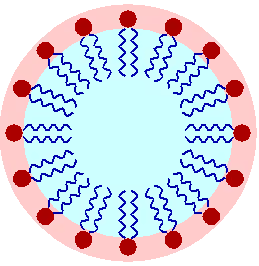
In the bulk aqueous phase, surfactants form aggregates, such as micelles, where the hydrophobic tails form the core of the aggregate and the hydrophilic heads are in contact with the surrounding liquid. Other types of aggregates can also be formed, such as spherical or cylindrical micelles or lipid bilayers. The shape of the aggregates depends on the chemical structure of the surfactants, namely the balance in size between the hydrophilic head and hydrophobic tail. A measure of this is the hydrophilic-lipophilic balance (HLB). Surfactants reduce the surface tension of water by adsorbing at the liquid-air interface. The relation that links the surface tension and the surface excess is known as the Gibbs isotherm.
Dynamics of surfactants at interfaces
The dynamics of surfactant adsorption is of great importance for practical applications such as in foaming, emulsifying or coating processes, where bubbles or drops are rapidly generated and need to be stabilized. The dynamics of absorption depend on the diffusion coefficient of the surfactant. As the interface is created, the adsorption is limited by the diffusion of the surfactant to the interface. In some cases, there can exist an energetic barrier to adsorption or desorption of the surfactant. If such a barrier limits the adsorption rate, the dynamics are said to be ‘kinetically limited'. Such energy barriers can be due to steric or electrostatic repulsions. The surface rheology of surfactant layers, including the elasticity and viscosity of the layer, play an important role in the stability of foams and emulsions.
Characterization of interfaces and surfactant layers
Interfacial and surface tension can be characterized by classical methods such as the -pendant or spinning drop method. Dynamic surface tensions, i.e. surface tension as a function of time, can be obtained by the maximum bubble pressure apparatus
The structure of surfactant layers can be studied by ellipsometry or X-ray reflectivity.
Surface rheology can be characterized by the oscillating drop method or shear surface rheometers such as double-cone, double-ring or magnetic rod shear surface rheometer.
Applications
Surfactants are widely used due to their ability to modify surface and interfacial properties, making them relevant in processes involving the interaction of hydrophobic and hydrophilic substances. Their amphiphilic nature—containing both hydrophilic and hydrophobic parts—enables them to bridge these otherwise immiscible components, thereby facilitating mixing and enhancing the efficiency of various physical and chemical transformations. This makes surfactants useful in numerous fields where control over interfacial interactions is relevant.
Surfactants play an important role as cleaning, wetting, dispersing, emulsifying, foaming and anti-foaming agents in many practical applications and products, including detergents, fabric softeners, motor oils, emulsions, soaps, paints, adhesives, inks, anti-fogs, ski waxes, snowboard wax, in flotation, washing and enzymatic processes, and laxatives.
Food industry
Certain surfactants are used as emulsifiers or foaming agents in food. Examples can be found in the List of food additives.
The alkalization (saponification) of cocoa fat in drinking cocoa powder serves to reduce the surface tension of the milk and to enable faster wetting or suspension of the semi-fat cocoa powder.
Personal care and homecare
Surfactants are used in detergents, washing-up liquids, shampoos, shower gels, and similar products to increase the “solubility” of fat and dirt particles that adhere to laundry or the body in water.
Fabric softeners can consist of cationic surfactants that prevent laundry from becoming stiff when dry.
Pharmaceuticals and cosmetics
Emulsifiers are essential for producing water-in-oil emulsions, e.g. for skin creams. They are also necessary for a wide range of suspensions to maintain liquid drug formulations.
Plant protection products
Plant protection products contain surfactants to improve wetting (spreading) on plants. The most common wetting agent is ethoxylated tallow amine. Trisiloxanes or polyoxyethylated fatty alcohols are also used. Agrochemical formulations that use surfactants include herbicides (some), insecticides, biocides (sanitizers).
Medicine
Surfactants act to cause the displacement of air from the matrix of cotton pads and bandages so that medicinal solutions can be absorbed for application to various body areas. They also act to displace dirt and debris by the use of detergents in the washing of wounds and via the application of medicinal lotions and sprays to surface of skin and mucous membranes. Surfactants enhance remediation via soil washing, bioremediation, and phytoremediation.
Many spermicides contain surfactants (such as nonoxynol-9).
Biochemistry
In solution, detergents help solubilize a variety of chemical species by dissociating aggregates and unfolding proteins. Popular surfactants in the biochemistry laboratory are sodium lauryl sulfate (SDS) and cetyl trimethylammonium bromide (CTAB). Detergents are key reagents to extract protein by lysis of the cells and tissues: they disorganize the membrane's lipid bilayer (SDS, Triton X-100, X-114, CHAPS, DOC, and NP-40), and solubilize proteins. Milder detergents such as octyl thioglucoside, octyl glucoside or dodecyl maltoside are used to solubilize membrane proteins such as enzymes and receptors without denaturing them. Non-solubilized material is harvested by centrifugation or other means. For electrophoresis, for example, proteins are classically treated with SDS to denature the native tertiary and quaternary structures, allowing the separation of proteins according to their molecular weight.
Detergents have also been used to decellularise organs. This process maintains a matrix of proteins that preserves the structure of the organ and often the microvascular network. The process has been successfully used to prepare organs such as the liver and heart for transplant in rats. Pulmonary surfactants are also naturally secreted by type II cells of the lung alveoli in mammals.
Technology
Antistatic agents
Ionic surfactants also function as external antistatic agents to prevent electrostatic charging of plastic surfaces (ESD protection). Both anionic and cationic surfactants are used for this purpose[9].
Textile finishing
Perfluorinated surfactants, such as fluorotelomer alcohols (FTOH), are used as coating agents for textiles, carpets, and construction products to impart or enhance water and grease repellency. As members of the PFC group, however, they are subject to criticism because they are persistent and practically non-degradable in nature.
Cooling lubricants
Surfactants are employed in water-mixed cooling lubricants (water-in-oil emulsions) to provide effective cooling and lubrication during metal cutting operations.
Printer ink
Surfactants regulate the consistency of ink in inkjet printers. An insufficient amount of surfactants results in clumping of the color pigments, whereas an excessive amount renders the ink overly fluid during printing.
Paper recycling
In paper recycling, surfactants facilitate the detachment of ink particles from paper fibers (deinking) and assist in transporting the ink to the surface.
Oil and mining industry
Alkali surfactant polymers are used to mobilize oil in oil wells. Surfactants also play a key role in froth flotation processes for separating copper and other minerals from ores.
Fire fighting
Surfactants are used in firefighting (to make "wet water" that more quickly soaks into flammable materials) and pipelines (liquid drag reducing agents).
"Wet water" provides the advantage of allowing the extinguishing water to penetrate burning materials such as wood or fabric more effectively, thereby enhancing its cooling capacity. Additionally, extinguishing water mixed with surface-active agents can be sprayed over greater distances at the same pumping capacity due to their flow-improving properties. Special foaming agents (Aqueous Film Forming Foam, AFFF) for combating liquid fires contain perfluorinated surfactants that form a gas-tight liquid film between the burning material and the foam. This simultaneously imparts superior sliding properties to the foam blanket, thereby enabling the effective extinguishment of larger liquid fires.
Surfactants in droplet-based microfluidics
Surfactants play an important role in droplet-based microfluidics in the stabilization of the droplets, and the prevention of the fusion of droplets during incubation.
Human body and nature
The human body produces diverse surfactants. Pulmonary surfactant is produced in the lungs in order to facilitate breathing by increasing total lung capacity, and lung compliance. In respiratory distress syndrome or RDS, surfactant replacement therapy helps patients have normal respiration by using pharmaceutical forms of the surfactants. One example of a pharmaceutical pulmonary surfactant is Survanta (beractant) or its generic form Beraksurf, produced by Abbvie and Tekzima respectively. Bile salts, a surfactant produced in the liver, play an important role in digestion.
Certain caterpillars (of the moth species Spodoptera exigua, South East Asia) spit a surfactant-containing secretion at predators. This deters attacking ants, allowing the caterpillars to escape. The surfactants in the caterpillars' oral secretions reduce its surface tension. Instead of rolling off the ants' water-repellent skin like normal water, the secretion soaks the attackers. The affected ants then clean themselves, which gives the caterpillar enough time to escape.
Safety and environmental risks
Most anionic and non-ionic surfactants are non-toxic, having LD50 comparable to table salt. The toxicity of quaternary ammonium compounds, which are antibacterial and antifungal, varies. Dialkyldimethylammonium chlorides (DDAC, DSDMAC) used as fabric softeners have high LD50 (5 g/kg) and are essentially non-toxic, while the disinfectant alkylbenzyldimethylammonium chloride has an LD50 of 0.35 g/kg. Prolonged exposure to surfactants can irritate and damage the skin because surfactants disrupt the lipid membrane that protects skin and other cells. Skin irritancy generally increases in the series non-ionic, amphoteric, anionic, cationic surfactants.
Surfactants are routinely deposited in numerous ways on land and into water systems, whether as part of an intended process or as industrial and household waste.
Anionic surfactants can be found in soils as the result of sewage sludge application, wastewater irrigation, and remediation processes. Relatively high concentrations of surfactants together with multimetals can represent an environmental risk. At low concentrations, surfactant application is unlikely to have a significant effect on trace metal mobility.
In the case of the Deepwater Horizon oil spill, unprecedented amounts of Corexit were sprayed directly into the ocean at the leak and on the sea-water's surface. The apparent theory was that the surfactants isolate droplets of oil, making it easier for petroleum-consuming microbes to digest the oil. The active ingredient in Corexit is dioctyl sodium sulfosuccinate (DOSS), sorbitan monooleate (Span 80), and polyoxyethylenated sorbitan monooleate (Tween-80).
Biodegradation
Because of the volume of surfactants released into the environment, for example laundry detergents in waters, their biodegradation is of great interest. Attracting much attention is the non-biodegradability and extreme persistence of fluorosurfactant, e.g. perfluorooctanoic acid (PFOA). Strategies to enhance degradation include ozone treatment and biodegradation. Two major surfactants, linear alkylbenzene sulfonates (LAS) and the alkyl phenol ethoxylates (APE) break down under aerobic conditions found in sewage treatment plants and in soil to nonylphenol, which is thought to be an endocrine disruptor. Interest in biodegradable surfactants has led to much interest in "biosurfactants" such as those derived from amino acids. Biobased surfactants can offer improved biodegradation. However, whether surfactants damage the cells of fish or cause foam mountains on bodies of water depends primarily on their chemical structure and not on whether the carbon originally used came from fossil sources, carbon dioxide or biomass.