


Related on Lably
Through Lipid, Alcohol (chemistry) and Brain
Phospholipids are essential components of neuronal membranes and play a critical role in maintaining brain structure and function. They are involved in the formation of the blood–brain barrier and support neurotransmitter activity, including the synthesis of acetylcholine.
Research indicates that phospholipid levels in the brain decline with age, with studies showing up to a 20% reduction by age 80, potentially impacting memory, focus, and cognitive performance. Dietary supplementation with phospholipids derived from the milk fat globule membrane (MFGM) has been shown in clinical trials to support memory, mood, and stress resilience in both children and adults.
Multiple randomized controlled trials have demonstrated that daily intake of 300–600 mg of MFGM phospholipids can significantly reduce perceived stress and improve cognitive performance under pressure.
Phospholipids are a key component of all cell membranes. They can form lipid bilayers because of their amphiphilic characteristic. In eukaryotes, cell membranes also contain another class of lipid, sterol, interspersed among the phospholipids. The combination provides fluidity in two dimensions combined with mechanical strength against rupture. Purified phospholipids are produced commercially and have found applications in nanotechnology and materials science.
The first phospholipid identified in 1847 as such in biological tissues was lecithin, or phosphatidylcholine, in the egg yolk of chickens by the French chemist and pharmacist Theodore Nicolas Gobley.
Phospholipids in biological membranes
Arrangement
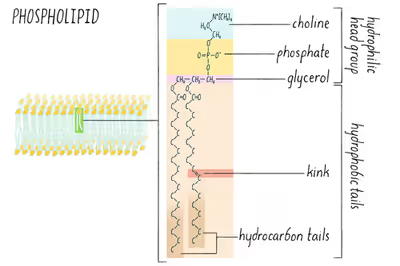
The phospholipids are amphiphilic. The hydrophilic end usually contains a negatively charged phosphate group, and the hydrophobic end usually consists of two "tails" that are long fatty acid residues.
In aqueous solutions, phospholipids are driven by hydrophobic interactions, which result in the fatty acid tails aggregating to minimize interactions with the water molecules. The result is often a phospholipid bilayer: a membrane that consists of two layers of oppositely oriented phospholipid molecules, with their heads exposed to the liquid on both sides, and with the tails directed into the membrane. That is the dominant structural motif of the membranes of all cells and of some other biological structures, such as vesicles or virus coatings.
In biological membranes, the phospholipids often occur with other molecules (e.g., proteins, glycolipids, sterols) in a bilayer such as a cell membrane. Lipid bilayers occur when hydrophobic tails line up against one another, forming a membrane of hydrophilic heads on both sides facing the water.
Dynamics
These specific properties allow phospholipids to play an important role in the cell membrane. Their movement can be described by the fluid mosaic model, which describes the membrane as a mosaic of lipid molecules that act as a solvent for all the substances and proteins within it, so proteins and lipid molecules are then free to diffuse laterally through the lipid matrix and migrate over the membrane. Sterols contribute to membrane fluidity by hindering the packing together of phospholipids. However, this model has now been superseded, as through the study of lipid polymorphism it is now known that the behaviour of lipids under physiological (and other) conditions is not simple.
Sign in to keep reading
9 more chapters are free with a Lably account.
Main phospholipids
Diacylglyceride structures
- See: Glycerophospholipid
- Phosphatidic acid (phosphatidate) (PA)
- Phosphatidylethanolamine (cephalin) (PE)
- Phosphatidylcholine (lecithin) (PC)
- Phosphatidylserine (PS)
- Phosphoinositides:
- Phosphatidylinositol (PI)
- Phosphatidylinositol 3-phosphate (PI3P)
- Phosphatidylinositol 4-phosphate (PI4P)
- Phosphatidylinositol 5-phosphate (PI5P)
- Phosphatidylinositol 4,5-bisphosphate (PIP2)
- Phosphatidylinositol (3,4,5)-trisphosphate (PIP3)
Phosphosphingolipids
- See Sphingolipid
- Ceramide phosphorylcholine (Sphingomyelin) (SPH)
- Ceramide phosphorylethanolamine (Sphingomyelin) (Cer-PE)
- Ceramide phosphoryllipid
Applications
Phospholipids have been widely used to prepare liposomal, ethosomal and other nanoformulations of topical, oral and parenteral drugs for differing reasons like improved bio-availability, reduced toxicity and increased permeability across membranes. Liposomes are often composed of phosphatidylcholine-enriched phospholipids and may also contain mixed phospholipid chains with surfactant properties. The ethosomal formulation of ketoconazole using phospholipids is a promising option for transdermal delivery in fungal infections. Advances in phospholipid research using lipidomics to explore these biomolecules and their conformations has lead to improved understanding of various diseases (including cancer and neurological syndromes).
Simulations
Computational simulations of phospholipids are often performed using molecular dynamics with force fields such as GROMOS, CHARMM, or AMBER.
Characterization
Phospholipids are optically highly birefringent, i.e. their refractive index is different along their axis as opposed to perpendicular to it. Measurement of birefringence can be achieved using cross polarisers in a microscope to obtain an image of e.g. vesicle walls or using techniques such as dual polarisation interferometry to quantify lipid order or disruption in supported bilayers.
Analysis
There are no simple methods available for analysis of phospholipids, since the close range of polarity between different phospholipid species makes detection difficult. Oil chemists often use spectroscopy to determine total phosphorus abundance and then calculate approximate mass of phospholipids based on molecular weight of expected fatty acid species. Modern lipid profiling employs more absolute methods of analysis, with NMR spectroscopy, particularly 31P-NMR, while HPLC-ELSD provides relative values.
Phospholipid synthesis
Phospholipid synthesis occurs in the cytosolic side of ER membrane that is studded with proteins that act in synthesis (GPAT and LPAAT acyl transferases, phosphatase and choline phosphotransferase) and allocation (flippase and floppase). Eventually a vesicle will bud off from the ER containing phospholipids destined for the cytoplasmic cellular membrane on its exterior leaflet and phospholipids destined for the exoplasmic cellular membrane on its inner leaflet.
In signal transduction
Some types of phospholipid can be split to produce products that function as second messengers in signal transduction. Examples include phosphatidylinositol (4,5)-bisphosphate (PIP2), that can be split by the enzyme phospholipase C into inositol triphosphate (IP3) and diacylglycerol (DAG), which both carry out the functions of the Gq type of G protein in response to various stimuli and intervene in various processes from long term depression in neurons to leukocyte signal pathways started by chemokine receptors.
Phospholipids also intervene in prostaglandin signal pathways as the raw material used by lipase enzymes to produce the prostaglandin precursors. In plants they serve as the raw material to produce jasmonic acid, a plant hormone similar in structure to prostaglandins that mediates defensive responses against pathogens.
Food technology
Phospholipids, and particularly phosphatidylcholine, are a major component of egg yolk lecithin. In this form, they function as powerful natural emulsifiers by stabilizing oil water interfaces, and are widely used in food products such as mayonnaise, sauces, and other water–oil emulsions.
Phospholipid derivatives
- See table below for an extensive list.
- Natural phospholipid derivates:
- egg PC (Egg lecithin), egg PG, soy PC, hydrogenated soy PC, sphingomyelin as natural phospholipids.
- Synthetic phospholipid derivates:
- Phosphatidic acid (DMPA, DPPA, DSPA)
- Phosphatidylcholine (DDPC, DLPC, DMPC, DPPC, DSPC, DOPC, POPC, DEPC)
- Phosphatidylglycerol (DMPG, DPPG, DSPG, POPG)
- Phosphatidylethanolamine (DMPE, DPPE, DSPE DOPE)
- Phosphatidylserine (DOPS)
- PEG phospholipid (mPEG-phospholipid, polyglycerin-phospholipid, functionalized-phospholipid, terminal activated-phospholipid)