

Steering wheel
Type of steering control in land vehicles
- 11 min read
- 12 chapters

Related on Lably
Through Vehicle, Tank and Ergonomics
Steering wheels are used in most modern land vehicles, including all mass-production automobiles, buses, light and heavy trucks, as well as tractors and tanks. The steering wheel is the part of the steering system that the driver manipulates; the rest of the steering system responds to such driver inputs. This can be through direct mechanical contact as in recirculating ball or rack and pinion steering gears, without or with the assistance of hydraulic power steering, HPS, or as in some modern production cars with the help of computer-controlled motors, known as electric power steering.
History
Near the start of the 18th century, many sea vessels appeared using the ship's wheel design. However, historians are unclear when that approach to steering was first used. The first automobiles were steered with a tiller, but in 1894, Alfred Vacheron took part in the Paris–Rouen race with a Panhard 4 hp model which he had fitted with a steering wheel. That is believed to be one of the earliest employments of the principle.
From 1898, the Panhard et Levassor cars were equipped as standard with steering wheels. Charles Rolls introduced the first car in Britain fitted with a steering wheel when he imported a 6 hp Panhard from France in 1898. Arthur Constantin Krebs replaced the tiller with an inclined steering wheel for the Panhard car he designed for the 1898 Paris–Amsterdam–Paris race which ran 7–13 July 1898.
In 1898, Thomas B. Jeffery and his son, Charles T. Jeffery, developed two advanced experimental cars featuring a front-mounted engine and a steering wheel mounted on the left-hand side. However, the early automaker adopted a more "conventional" rear-engine and tiller-steering layout for its first mass-produced Ramblers in 1902. The following year, the Rambler Model E was largely unchanged, except that it came equipped with a tiller early in the year that was changed to a steering wheel by the end of 1903. By 1904, all Ramblers featured steering wheels. Within a decade, the steering wheel had entirely replaced the tiller in automobiles.
At the insistence of Thomas B. Jeffery, the driver's position was also moved to the left-hand side of the car during the 1903 Rambler production. Most other car makers began offering cars with left-hand drive in 1910. Soon after, most cars in the US converted to left-hand drive.
Sign in to keep reading
11 more chapters are free with a Lably account.
Placement in vehicle
The placement within the vehicle will vary based on where the driver is located within that vehicle. Some vehicles might have the driver located in the center, with no accommodations for passengers to either side. Other vehicles such as buses and delivery vans move the driver to one side.
When the driver's position is moved to one side, it is typically the side of the vehicle closer to the opposite lane of travel.
When vehicles operate in left side traffic, the driver and steering wheel is typically on the vehicle's right (right-hand drive or RHD); the converse applies in vehicles that operate in right side traffic (left-hand drive or LHD).
Shapes
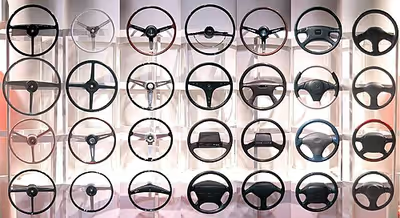
Steering wheels for land vehicles are generally circular. They are mounted to the steering column by a hub connected to the outer ring of the steering wheel by one or more spokes (single spoke wheels being a relatively rare exception). Other types of vehicles may use a modified circular design, a butterfly shape, or some other shape, such as a yoke.
On some Tesla models, the steering control is through a yoke rectangle shaped with rounded edges and two pistol grips.
The C8 Corvette includes a square-type steering wheel with rounded corners, described as a 'squircle'. The objective of the flat bottom is to ease diver egress while the flattened top enhances the line of sight when driving.
General Motors applied for a US patent for a modular steering control that can be updated with components or changed in shape ranging from a traditional circle to a yoke.
Driver controls other than steering
In addition to its use in steering, the steering wheel and its column are the usual location for driver activated controls such as the horn, turn signals, and wipers.
And the steering wheel may have other driver activated controls that permit the driver to continue to grasp the wheel while operating and at the same time manipulate the control: cruise control, audio system, and telephone controls, as well as paddle-shifters.
Driver safety
Steering wheels that were rigid and mounted on non-collapsible steering columns increased the risk of impaling the driver in a severe crash. The first collapsible steering column was invented in 1934 but was never successfully marketed. By 1956, Ford came out with a safety steering wheel that was set high above the post with spokes that would flex, but the column was still rigid. In 1968, United States regulations (FMVSS Standard No. 204) were implemented concerning the acceptable rearward movement of the steering wheel in case of a crash. Collapsible steering columns were required to meet that standard. Before this invention, the Citroën DS incorporated a curved and off-center single-spoke steering wheel designed to deflect the driver from the steering column in case of a crash.
An airbag is another driver safety component installed within the steering wheel to minimize injury from the driver's head or body contacting the steering wheel during a vehicle collision.
Power steering
Power steering affords the driver reduced effort to steer the car. Modern power steering has almost universally relied on a hydraulic system, although electrical systems are steadily replacing this technology. Mechanical power steering systems were introduced, such as on 1953 Studebakers. However, hydraulically assisted systems have prevailed.
While other methods of steering passenger cars have resulted from experiments, for example, the "wrist-twist" steering of the 1965 Mercury Park Lane concept car was controlled by two 5-inch (127 mm) rings, none have yet been deployed as successfully as the conventional large steering wheel.
Steering wheel locks
Passenger automobile regulations implemented by the U.S. Department of Transportation required the locking of steering wheel rotation (or transmission locked in "park") to hinder motor vehicle theft; in most vehicles, this is accomplished when the ignition key is removed from the ignition lock. See steering lock.
Other designs
The driver's seat and steering wheel are centrally located on certain high-performance sports cars, such as the McLaren F1, and most single-seat racing cars.
As drivers may continuously have their hands on the steering wheel for many hours, these are designed with ergonomics in mind. However, the most crucial concern is that the driver can effectively convey torque to the steering system, especially in vehicles without power steering or in the rare event of a loss of steering assist. A typical design for circular steering wheels is a steel or magnesium rim with a plastic or rubberized grip molded over and around it. Some drivers purchase vinyl or textile steering wheel covers to enhance grip and comfort or simply as decoration. Another device used to make steering easier is the brodie knob.
A similar device in aircraft is the yoke. Water vessels not steered from a stern-mounted tiller are directed with the ship's wheel, which may have inspired the concept of the steering wheel. The steering wheel is better than other user interfaces and has persisted because driving requires precise feedback that is provided by a large interface.
Early Formula One cars used steering wheels taken directly from road cars. They were normally made from wood. Without interior cabin packaging constraints, they tended to be made as large a diameter as possible to reduce the effort needed to turn. As cars grew progressively lower and driver's areas more compact throughout the 1960s and 1970s, steering wheels became smaller to fit into the interior space.
Spokes in steering wheel
The number of spokes in the steering wheel has continuously changed. Most early cars had four-spoke steering wheels.
A Banjo steering wheel was an option in early automobiles. They predate power steering. The wire spokes were a buffer or absorber between the driver's hands and the vibration transmitted from the road surfaces. Most were three- or four-spokes made of four or five wires in each spoke, hence the name "Banjo".
Adjustable steering wheels
Tilt wheel
Edward James Lobdell developed the original tilt wheel in the early 1900s. A 7-position tilt wheel was introduced by the Saginaw Division of General Motors in 1963 for all passenger car divisions except Chevrolet which received the tilt wheel in 1964. This tilt wheel was also supplied to the other US automakers (except Ford). Originally a luxury option on cars, the tilt function helps to adjust the steering wheel by moving the wheel through an arc in an up and down motion. Tilt Steering Wheels rely upon a ratchet joint located in the steering column just below the steering wheel. The wheel can be adjusted upward or downward by disengaging the ratchet lock while the steering column remains stationary below the joint. Some designs place the pivot slightly forward along the column, allowing for a fair amount of vertical movement of the steering wheel with slight actual tilt. In contrast, other designs place the pivot almost inside the steering wheel, allowing adjustment of the angle of the steering wheel with nearly no change in its height.
Adjustable steering column
An adjustable steering column allows the steering wheel height to be adjusted with only a small, useful change in tilt. Most of these systems work with compression locks or electric motors instead of ratchet mechanisms; the latter may be capable of moving to a memorized position when a given driver uses the car or automatically moving up and forward to ease egress.
Telescope wheel
Many pre-war British cars offered telescoping steering wheels that required loosening a locknut before adjustment, many using the Douglas ASW (Adjustable Steering Wheel). In 1949, the Jaguar XK120 introduced a new steering wheel supplied by Bluemel that was driver-adjustable by loosening a sleeve around the column by hand. The 1955-1957 Ford Thunderbird had a similar design with 3 inches (76 mm) of total travel. In 1956, the travel was restricted to 2 inches (51 mm). A patent was filed regarding a telescoping steering wheel in July 1942 by Bernard Maurer of the Saginaw Steering Gear Division of General Motors (now Nexteer Automotive). Nevertheless, GM would not offer a telescoping wheel of their own until the debut of the optional telescopic wheel on the 1965 Corvette and Corvair, and the optional tilt/telescope wheel on 1965 Cadillacs. The GM column was released by twisting a locking ring surrounding the center hub and offered a 3-inch (76 mm) range of adjustment.
Swing-away steering wheel
A swing-away steering column was introduced in the 1961 Ford Thunderbird and made available on other Ford products during the 1960s. The swing-away steering wheel allowed the steering wheel to move 9 inches (229 mm) to the right when the transmission selector was in the "park" position to make the driver's exit and entry easier.
Tilt-away steering wheel
A tilt-away wheel was introduced by Ford in 1967 after updates to Federal Motor Vehicle Safety Standards requirements. Though it was an update to the swing-away steering wheel, which did not meet updated safety standards, it offers limited movement but added convenience due to the automatic pop-over function over its predecessor.
Quick release hub steering wheel
Some steering wheels can be mounted on a detachable or a quick-release hub. The steering wheel can be removed without using tools by pressing a button. The system is often found in narrow-spaced racing cars to facilitate the driver getting in and out, as well as in other cars as an anti-theft device. The quick-release connector is often brand-specific, with some makes being interchangeable. The most common mounting pattern is 6×70 mm, which denotes a bolt circle pattern with six bolts placed along a circle 70 mm in diameter. Other examples of common bolt patterns are 3×1.75 in (44.45 mm), 5×2.75 in (69.85 mm), 6×74 mm and 6×2.75 in (69.85 mm). The quick release itself is often proprietary.
Usage
The steering wheel should be used with strategic movements of the hand and wrist in spinning motions. Caution and care should be used to ensure the safety of the extremities. The constant motions used must be performed with caution. "Proper posture of the hand-arm system while using hand tools is essential. As a rule, the wrist should not be bent, but must be kept straight to avoid overexertion of tissues like tendons and tendon sheaths and compression of nerves and blood vessels."
Turning the steering wheel while the vehicle is stationary is called dry steering. It is generally advised to avoid dry steering as it strains the steering mechanism and causes undue wear to the tires.
History of integrated buttons and controls
The first button added to the steering wheel was a switch to activate the car's electric horn. Traditionally located on the steering wheel hub or center pad, the horn switch was sometimes placed on the spokes or activated via a decorative horn ring, which obviated the necessity of moving a hand away from the rim. Electrical connections are made via a slip ring. A further development, the Rim Blow steering wheel, integrated the horn switch into the steering wheel rim.
In 1966, Ford offered the Highway Pilot Speed Control option with steering wheel pad-mounted rocker switches, on its Thunderbird. Uniquely, the Thunderbird also lightly applied the brakes and illuminated the stop lamps when the Retard was continuously depressed with the cruise control on, but not engaged.
In 1974, Lincoln added two rocker switches on the steering wheel to activate various cruise control functions on the Continental and Continental Mark IV. In 1988, Pontiac offered a steering wheel with 12 buttons controlling various audio functions on the Trans-Am, 6000 STE and Bonneville.
In the 1990s, a proliferation of new buttons began to appear on automobile steering wheels. Remote or alternate adjustments could include vehicle audio, telephone, and voice control navigation. Scroll wheels or buttons are often used to set volume levels or page through menus and change radio stations or audio tracks. These controls can use universal interfaces, wired or wirelessly.
Other uses
Arcade steering wheels
Game controllers are available for arcade cabinets, personal computers, and console games that are designed to look and feel like a steering wheel and intended for use in racing games. An early example is the Telstar Arcade, which featured a wheel in 1977 for use in the Road Race game that came packaged with it. Some modern video game steering wheels employ haptic technology to simulate the feedback a real driver feels from a steering wheel, as well as buttons to allow for more inputs.