

Step function
Linear combination of indicator functions of real intervals
- 2 min read
- 3 chapters

Related on Lably
Through Function (mathematics), Real number and Linear combination
Definition and first consequences
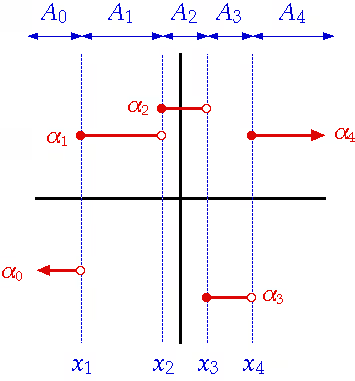
A function is called a step function if it can be written as
- , for all real numbers
where , are real numbers, are intervals, and is the indicator function of :
In this definition, the intervals can be assumed to have the following two properties:
- The intervals are pairwise disjoint: for
- The union of the intervals is the entire real line:
Indeed, if that is not the case to start with, a different set of intervals can be picked for which these assumptions hold. For example, the step function
can be written as
Variations in the definition
Sometimes, the intervals are required to be right-open or allowed to be singleton. The condition that the collection of intervals must be finite is often dropped, especially in school mathematics, though it must still be locally finite, resulting in the definition of piecewise constant functions.
Sign in to keep reading
2 more chapters are free with a Lably account.
Examples
- A constant function is a trivial example of a step function. Then there is only one interval,
- The sign function sgn(x), which is −1 for negative numbers and +1 for positive numbers, and is the simplest non-constant step function.
- The Heaviside function H(x), which is 0 for negative numbers and 1 for positive numbers, is equivalent to the sign function, up to a shift and scale of range (). It is the mathematical concept behind some test signals, such as those used to determine the step response of a dynamical system.
- The rectangular function, the normalized boxcar function, is used to model a unit pulse.
Non-examples
- The integer part function is not a step function according to the definition of this article, since it has an infinite number of intervals. However, some authors also define step functions with an infinite number of intervals.
Properties
- The sum and product of two step functions is again a step function. The product of a step function with a number is also a step function. As such, the step functions form an algebra over the real numbers.
- A step function takes only a finite number of values. If the intervals for in the above definition of the step function are disjoint and their union is the real line, then for all
- The definite integral of a step function is a piecewise linear function.
- The Lebesgue integral of a step function is where is the length of the interval , and it is assumed here that all intervals have finite length. In fact, this equality (viewed as a definition) can be the first step in constructing the Lebesgue integral.
- A discrete random variable is sometimes defined as a random variable whose cumulative distribution function is piecewise constant. In this case, it is locally a step function (globally, it may have an infinite number of steps). Usually however, any random variable with only countably many possible values is called a discrete random variable, in this case their cumulative distribution function is not necessarily locally a step function, as infinitely many intervals can accumulate in a finite region.