

Swaminarayan Sampradaya
Hindu sect founded in 1801 by Sahajanand Swami
- 31 min read
- 5 chapters

Related on Lably
During his lifetime, Swaminarayan institutionalized his charisma and beliefs in various ways. He constructed six mandirs to facilitate followers' devotional worship of God, and encouraged the creation of a scriptural tradition. In 1826, in a legal document titled the Lekh, Swaminarayan created two dioceses, the Laxmi Narayan Dev Gadi (Vadtal Gadi) and Nar Narayan Dev Gadi (Ahmedabad Gadi), with a hereditary leadership of acharyas and their wives, who were authorized to install statues of deities in temples and to initiate ascetics.
In Swaminarayan's soteriology the ultimate goal of life is to become Brahmarūpa, attaining the form (rūpa) of Aksharbrahman, in which the jiva is liberated from maya and saṃsāra (the cycle of births and deaths), and enjoys eternal bliss, offering sādhya bhakti, continuous and pure devotion to God.
While rooted in Ramanuja's Vishishtadvaita, for which he stated his affinity, and incorporating devotional elements of Vallabha's Pushtimarg, Sahajanand Swaminarayan gave his own specific interpretations of the classical Hindu texts. As in Vishishtadvaita, God and jiva are forever distinct, but a distinction is also made between Parabrahman (Purushottama, Narayana, the highest Brahman) and Aksharbrahman ('lower Brahman', the first manifestation of Brahman in empirical reality) as two distinct eternal realities. This distinction is emphasized by BAPS-swamis as a defining characteristic, and referred to as Akshar-Purushottam Darshan to distinguish the Swaminarayan Darshana, Swaminarayan's views or teachings, from other Vedanta-traditions.
In the 20th century, due to "different interpretations of authentic successorship," various denominations split-off from the dioceses. All groups regard Swaminarayan as God, but differ in their theology and the religious leadership they accept. The BAPS, split-off in 1907 from Vadtal Gadi, venerates "a lineage of akṣaragurus, or living gurus, [which] has been retroactively traced back to Gunatitanand Swami."
Socially, Swaminarayan accepted caste-based discrimination within the religious community, but inspired followers to engage in humanitarian service activities, leading various denominations of the Swaminarayan Sampradaya to currently provide humanitarian service globally.
Early history
Origins
The Swaminarayan Sampradaya developed out of Ramanand Swami's Uddhav Sampraday, a Gujarat-based Sri Vaishnavism teacher rooted in Ramanuja's Vishishtadvaita. It takes its name from Ramanand's successor, Sahajanand Swami, who was a charismatic leader and gained fame as Swaminarayan. The various branches of the Swaminarayan-tradition relate their origin to Sahajanand Swami, but an exact "modern historical account" of his life cannot be reconstructed, given the hagiographic nature of the stories preserved among his followers.
Sahajanand Swami
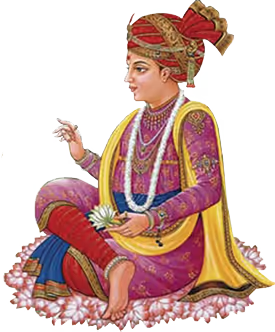
Sahajanand Swami was born on 3 April 1781 in the village of Chhapaiya in present-day Uttar Pradesh, India, and given the name Ghansyam. After his parents' death, he renounced his home at the age of 11 and traveled for 7 years as a child yogi around India, taking the name Neelkanth, before settling in the hermitage of Ramanand Swami, a Vaishnava religious leader in present-day Gujarat. Ramanand Swami initiated him as a Vaishnavite ascetic on 28 October 1800, giving him the name Sahajanand Swami. According to the Swaminarayan-tradition, Ramanand appointed Sahajanand to be his successor and the leader of the sampradaya in 1801, shortly before his death.
Ramanand Swami died on 17 December 1801, and Sahajanand Swami became the new leader of the remains of the Uddhav Sampraday, despite "considerable opposition." Several members left the group, or were expelled by Sahajanand Swami, and one group established a new group, together with one of the four temples of Ramanand. While the Krishna-iconography in the original temples, as well as the Vachanamritam and the Shikshapatri, reflect a belief in Krishna as Purushottam, as early as 1804, Sahajanand Swami himself was described as the manifestation of God, and over his life, he would be worshipped as God by thousands of followers. Nevertheless, according to Kim in the original sampradaya Sahajanand Swami is not "necessarily" regarded as Purushottam.
In time, both the leader and the group became known by the name "Swaminarayan." According to the "Swaminarayan origin narrative", shortly after his succession, Sahajanand Swami directed devotees to chant a new mantra, "Swaminarayan" (Svāmīnārāyaṇa), a compound of two Sanskrit words: Swami (Svāmī) and Narayan (Nārāyaṇa), that is, Vishnu c.q. Purushottam. According to the Swaminarayan-tradition, Narayana was also a second name given to Naharajand when he was initiated as an ascetic.
Growth and opposition
The sampradaya grew quickly over the 30 years under Swaminarayan's leadership, with British sources estimating at least 100,000 followers by the 1820s. He was a charismatic personality, and in the early period of the Swaminarayan movement, followers were often induced into a visionary trance state interpreted as samadhi, either by direct contact with Swaminarayan or by chanting the Swaminarayan mantra, in which they had visions of their "chosen deity" (istadevata). Swaminarayan was criticized for receiving large gifts from his followers after renouncing the world and assuming leadership of the fellowship. Swaminarayan responded that he accepts gifts because "it was appropriate for the person to give" and to satisfy the devotion of his followers but he does not seek it out of personal desire.
In the first fifteen years of his leadership, until the arrival of the British colonizers in Gujarat, Swaminarayan's ministry "faced great opposition," and a number of attempts at his life, "by both religious and secular powers," are reported. Swaminarayan accepted people from all castes, undermining caste-based discrimination, which lead to criticism and opposition from high-caste Hindus. While Sahajanand's ethical reforms have been regarded as a protest against immoral Pushtimarg practices, Sahajanand was in fact influenced by and positive towards Vallabha and other Vaisnava-traditions, and he incorporated elements of Vallabha's Pushtimarg, popular in Gujarat, to gain recognition. His reforms may have been primarily targeted against Tantrics, and against practices "associated with village and tribal deities."
According to David Hardiman, the lower classes were attracted to Swaminarayan's community because they aspired to the same success and mercantile ideology. It grew, states Hardiman, in an era of British colonial rule where land taxes were raised to unprecedented heights, lands were "snatched from village communities", and poverty spread. According to Hardiman, Sahajanand's pacifist approach to community re-organization and reaching out to the lowest classes of his day found support with the British rulers, but it also furthered their exploitation by the British, the local moneylenders and richer farmers.
Swaminarayan ordained 3,000 swamis over the span of his leadership, with 500 of them into the highest state of asceticism as paramhansas, thereby allowing them to suspend all distinguishing practices, like applying sacred marks. Swaminarayan encouraged his swamis to serve others. During the devastating famine of 1813–14 in Kathiawar, for example, the swamis collected alms in unaffected regions of Gujarat to distribute among the afflicted. As teachers and preachers, they were instrumental in spreading Swaminarayan's teachings throughout Guajarat, which aided to the rapid growth of the sampradaya, and they created the "sacred literature" of the sampradaya, authoring scriptural commentaries and composing bhakti poetry.
Temples
Toward the end of his life, Swaminarayan institutionalized his charisma in various ways: the building of temples to facilitate worship; the writing of sacred texts; and the creation of a religious organization for the initiation of ascetics. He instituted the mandir tradition of the sampradaya to provide followers a space for devotional worship (upasana, upāsanā) to God. He constructed six mandirs in the following locations, housing images of Krishna which are regarded as representations of Swaminarayan by his followers:
- Swaminarayan Temple, Ahmedabad dedicated to Nar Narayan (1822)
- Swaminarayan Mandir, Bhuj dedicated to Nar Narayan (1823)
- Swaminarayan Mandir, Vadtal dedicated to Radha Krishna and Lakshmi Narayan (1824)
- Shri Swaminarayan Mandir, Dholera dedicated to Radha Madan Mohan (1826)
- Shri Swaminarayan Mandir, Junagadh dedicated to Ranchhodrai and Radha Ramandev (1827)
- Swaminarayan Mandir, Gadhada dedicated to Radha Gopinath (1828).
Swaminarayan installed murtis of various manifestations of Krishna in the temples. For example, idol of Vishnu was installed with his consort Lakshmi and idol of Krishna was installed with his consort Radha to highlight the representation of God and his ideal devotee in the central shrines of each of these temple. He also installed his own image in the form of Harikrishna in a sideshrine at the mandir at Vadtal. The BAPS initiated the tradition of installing murtis of God (Swaminarayan) and his ideal devotee to facilitate his followers' pursuit of moksha.
Vadtal Gadi and Ahmedabad Gadi
In the early years of the sampradaya, Swaminarayan personally directed control of the spiritual and administrative duties. Swaminarayan later delegated responsibilities amongst swamis, householders, and the members of his family. Before his death, Swaminarayan established two dioceses, the Laxmi Narayan Dev Gadi (Vadtal Gadi) and Nar Narayan Dev Gadi (Ahmedabad Gadi) as recorded in the Lekh, based on the Vadtal and Ahmedabad mandirs, respectively.
Acharyas
On 21 November 1825, he appointed two of his nephews as acharyas to administer the two gadis, or dioceses, adopting them as his own sons and establishing a hereditary line of succession. These acharyas came from his immediate family after sending representatives to search them out in Uttar Pradesh. They were authorized to "administer his temple properties" which are distributed among them. Ayodhyaprasadji, son of his elder brother Rampratap, became acharya of the Nar Narayan Dev Gadi (Ahmedabad diocese), and Raghuvirji, son of his younger brother Ichcharam, became acharya of the Laxmi Narayan Dev Gadi (Vadtal diocese). Siddhant paksh believes Ajendraprasad is the current acharya of the Vadtal Gadi. Due to Swaminarayan's initiation into the Uddhav sampradaya, the Vadtal and Ahmedabad-branches trace the authority of their acharyas to Ramanuja's guru parampara.
Death of Swaminarayan
Swaminarayan died on 1 June 1830, but the sampradaya continued to grow, with British officials counting 287,687 followers by 1872. By 2001, the number of members had grown to an estimated 5 million followers.
Schisms
Currently the following branches exist:
- Laxmi Narayan Dev Gadi (Vadtal Gadi) (1825, established by Swaminarayan)
- - International Swaminarayan Satsang Mandal (ISSM)(daughter-branch, USA)
- - Laxminarayan Dev Yuvak Mandal (LNDYM)(youth-wing)
- - Shree Swaminarayan Agyna Upasana Satsang Mandal (SSAUSM)(daughter-branch, USA)
- Bochasanwasi Akshar Purushottam Swaminarayan Sanstha (BAPS)(split-off from Vadtal Gadi in 1907, established by Shastriji Maharaj)
- Gunatit Samaj (Yogi Divine Society (YDS), split-off from BAPS in 1966. Several wings:YDS, The Anoopam Mission, and The Gunatit Jyot
- Swaminarayan Gurukul (educational institution established in 1947, by Dharmajivandasji Swami in order to spread sadvidya in students around the world)
- Nar Narayan Dev Gadi (Ahmedabad Gadi) (1825, established by Swaminarayan)
- - International Swaminarayan Satsang Organisation (ISSO)(daughter-branch, USA)
- - ISSO Seva (2001, charity organisation)
- - Narnarayan Dev Yuvak Mandal (NNDYM)(youth organisation)
- Swaminarayan Gadi (Maninagar)(split-off from Ahmedabad Gadi in the 1940s)
- Swaminarayan Mandir Vasna Sanstha (SMVS)(split-off from Swaminarayan Gadi in 1987)
- - International Swaminarayan Satsang Organisation (ISSO)(daughter-branch, USA)
Different interpretations of succession
In the 20th century, due to "different interpretations of authentic successorship," various branches split-off from the diocese, the largest being the BAPS. All groups regard Swaminarayan as the manifestation of God but differ in their theology and the religious leadership they accept.
The Vadtal Gadi and Ahmedabad Gadi are the original institutions, with a hereditary leadership in the form of acharyas. The succession was established in the Lekh, a legal document authored by Swaminarayan. It is followed by the Nar-Narayan (Ahmedabad) and Laxmi-Narayan (Vadtal) branches, but "downplay[ed] or ignored" by other branches that "emphasis the authority of the sadhus over the acharya."
Williams notes that "this important function of the acharya as religious specialist is emphasized in all the Swaminarayan scriptures including the Desh Vibhag Lekh. In the Shikshapatri Verse 62: 'My followers should worship only those images of the lord that are given by the acharya or installed by him. In Vachanamrut Vadtal I-18.4 and in other scriptures, Swaminarayan signifies the importance of Dharmakul (family of Dharmadev, Swaminarayan's father), and states that those who know him to be their deity and desire moksha shall follow only the Swaminarayan Sampraday under the leadership of the acharyas which he has established and their successors.
According to the Vadtal branch, "Gopalanand Swami was the chief ascetic disciple of Sajahanand," and "the acharyas have the sole authority to initiate sadhus and to install images in the temples." According to the BAPS, the largest Swaminarayan offshoot, Gunatitanand Swami was appointed successor of Sajahanand, and "the chief ascetics had been given the authority to perform the primary rituals of the group, including the initiation of sadhus," and "this authority had not been revoked when the acharyas were appointed." They furthermore argue that those who life a strictly virtuous life are the ones worthy of inheritance. According to Williams, "[t]he emphasis is on the spiritual lineage rather than the hereditary lineage, and the claim is that the one who observes the rules should be the acharya."
According to the BAPS, Swaminarayan established two modes of succession: a hereditary administrative mode through the Lekh; and a spiritual mode established in the Vachanamrut, in which Swaminarayan conveyed his theological doctrines. According to the BAPS, Swaminarayan described a spiritual mode of succession whose purpose is purely soteriological, reflecting his principle that a form of God who lives "before one's eyes" is necessary for aspirants to attain moksha (liberation). They venerate "a lineage of akṣaragurus, or living gurus, [which] has been retroactively traced back to Gunatitanand Swami." According to the BAPS, Swaminarayan identified Gunatitanand Swami as the first successor in this lineage. For the sadhus of the Vadtal diocese, the idea that Swaminarayan had appointed Gunatitanand as his spiritual successor was a heretical teaching, and they "refused to worship what they considered to be a human being."
Bochasanwasi Akshar Purushottam Swaminarayan Sanstha
The Bochasanwasi Akshar Purushottam Swaminarayan Sanstha (BAPS) was formed in 1907, by Shastriji Maharaj (Shastri Yagnapurushdas). He broke away from the Vadtal diocese and created BAPS according to his own interpretation of Akshar (Aksharbrahma) and Purushottam. As articulated in the BAPS-theology of Akṣara-Puruṣottama Upāsanā, BAPS adherents, following Shastriji Maharaj, believe that Swaminarayan introduced Gunatitanand Swami as his ideal devotee, from which a spiritual lineage of gurus began, reflecting Shastriji Maharaj's idea that a form of God who lives "before one's eyes" who is to be worshipped is necessary for aspirants to attain moksha (liberation).
Gunatit Samaj
The Yogi Divine Society (YDS) was established in 1966, by Dadubhai Patel and his brother, Babubhai after they were excommunicated from BAPS by Yogiji Maharaj. The brothers were expelled after it was discovered that Dadubhai illicitly collected and misappropriated funds and, falsely claiming that he was acting on the organization's behalf, led a number of young women to renounce their families and join his ashram under his leadership. After Dadubhai's death in 1986, an ascetic named Hariprasad Swami became the leader of the Yogi Divine Society. Yogi Divine Society became known as the Gunatit Samaj and consists of several wings: namely, YDS, The Anoopam Mission, and The Gunatit Jyot.
Swaminarayan Gadi (Maninagar)
The Swaminarayan Gadi (Maninagar) was founded in the 1940s by Muktajivandas Swami after he left the Ahmedabad diocese with the belief that Gopalanand Swami, a paramhansa from Swaminarayan's time, was the spiritual successor to Swaminarayan. The current spiritual leader is Jitendrapriyadasji Swami. In addition, the Swaminarayan Gadi reveres Nirgundasji Swami, Ishwarcharandasji Swami, and Purushottampriya Swami.
Followers of the Swaminarayan Gadi accept the Rahasyarth Pradeepika Tika, a five-volume work written by Abji Bapa, as an authentic exegesis of the Vachanamrut.
Sign in to keep reading
4 more chapters are free with a Lably account.
Beliefs and practices
Swaminarayan's views are found in the Vachanamrut (Vacanāmṛta), the principal theological text of the Swaminarayan Sampradaya. As followers believe Swaminarayan to be the manifestation of Parabrahman, or Puruṣottama, his views are considered a direct revelation of God. In the Vachanamrut, Swaminarayan describes that the ultimate goal of life is moksha (mokṣa), a spiritual state of ultimate liberation from the cycle of births and deaths and characterized by eternal bliss and devotion to God.
Background
Swaminayaran's siddhanta ("view," "doctrine") emerged within the Vedanta tradition, particularly the Vaishnava tradition as articulated by Ramanuja, Madhva, Vallabha, and Chaitanya. Swaminarayan's interpretation of the classical Hindu texts has similarities with Ramanuja's Vishistadvaita, for which he stated his affinity. He also incorporated elements of Vallabha's Pushtimarg, which belongs to Shuddhadvaita, to gain recognition. Yet, there are also metaphysical and philosophical divergences between Swaminarayan's and Ramanuja's teachings, most notably the distinction between Purushottam and Aksharbrahman, referred to by BAPS-swamis as the Akshar-Purushottam Darshan (philosophy) and used to set apart Swaminarayan's teachings from other Vedanta traditions. While the Vadtal Mandir states that "Swaminarayan propagated a philosophy called Vishistadvaita," a number of BAPS-swamis argue that Swaminarayan's teachings are a distinct system within the Vedanta-tradition.
Soteriology - Brahmarūp
In Swaminarayan's soteriology, the ultimate goal of life is to become Brahmarūp, attaining the form (rūpa) of Aksharbrahman, in which the jiva is liberated from maya and saṃsāra (the cycle of births and deaths), and in which the jiva offers sādhya bhakti, continuous and pure devotion to God. Whereas identification with Purushottam is impossible, Brahmarūpa as identification with Akshrabrahman is feasible and encouraged, though the jiva or ishwar remains distinct from Aksharbrahman.
To become Brahmarūp, an individual must overcome the ignorance of maya, which Swaminarayan describes as self-identification with the physical body, personal talents, and material possessions. Swaminarayan explains in the Vachanamrut that ekantik dharma is a means to earn God's grace and attain liberation. Ekantik dharma (ekāntik dharma) consists of dharma (dharma; religious and moral duties), gnan (jñāna; realization of the atman and Paramatman) vairagya (vairāgya; dispassion for worldly objects), and bhakti (recognition of Swaminarayan as Purushottam and devotion to him, coupled with the understanding of God's greatness).
Various branches of the Swaminarayan Sampradaya differ in their belief of how to attain moksha. The Narnarayan and Laxminarayan Gadis believe moksha is attained by worshipping the sacred images of Swaminarayan installed by acharyas. In the BAPS reading of the Vachanamrut and other scriptures, the jiva becomes brahmarūp, or like Aksharbrahman, under the guidance of the manifest form of God. The Swaminarayan Gadi (Maninagar) believes that moksha can be attained through the lineage of gurus beginning with Gopalanand Swami.
Ekantik dharma
Ekantik dharma (ekāntik dharma) is an important element of the Swaminarayan Sampradaya, and its establishment is one of the reasons why Swaminarayan is believed to have incarnated. Ekantik dharma consists of dharma, gnan, vairagya, and bhakti.
Dharma
Dharma consists of religious and moral duties according to one's responsibilities and situation. All Swaminarayan Hindus who are householders maintain five basic vows: abstaining from theft, gambling, adultery, meat, and intoxicants like alcohol. As part of their dharma, swamis additionally endeavor to perfect the five virtues of non-lust (nishkam/niṣkāma), non-greed (nirlobh/nirlobha), non-attachment (nissneh/nissneha), non-taste (niswad/nissvada), and non-ego (nirman/nirmāna). Another aspect of the practice of dharma is the Swaminarayan diet, a type of vegetarianism, similar to that practiced generally by Vaishnava sampradayas, that entails abstaining from animal flesh, eggs, onions, and garlic.
Gnan (jnana)
Gnan is knowledge of Parabrahman and realizing oneself as the atman. Basic practices of gnan include the daily study of scriptures like the Vachanamrut and Shikshapatri and weekly participation in congregational worship services (sabha/sabhā) at the mandir (temple), in which scriptural discourses geared towards personal and spiritual growth occur. According to the BAPS, in the Vachanamrut Swaminarayan explains that adhering to the Aksharbrahman Guru's commands is commensurate with perfectly embodying gnan—that is, realizing oneself as the atman.
Vairagya
Vairagya is dispassion for worldly objects. Swaminarayan Hindus cultivate vairagya through practices like fasting on Ekadashi days, two of which occur every month, and observing extra fasts, during the holy months of Chaturmas (a period of four months between July and October) Vairagya is realized by adhering to the codes of conduct, inclusive of these practices, serving other devotees physically, listening to discourses, and engaging in devotion.
Bhakti
Bhakti involves devotion towards God, while understanding God's greatness and identifying one's inner core — atman — with Aksharbrahman. Adherents believe that they can achieve moksha, or freedom from the cycle of birth and death, by becoming aksharrup (or brahmarup), that is, by attaining qualities similar to Akshar (or Aksharbrahman) and worshipping Purushottam (or Parabrahman; the supreme living entity; God). Important bhakti rituals for Swaminarayan Hindus include puja (pūjā; personal worship of God), arti (ārtī; the ritual waving of lighted wicks around murtis, or images), thal (thāl; the offering of food to murtis of God), and cheshta (ceṣtā; the singing of devotional songs that celebrate the divine acts and form of Swaminarayan).
During puja, adherents ritually worship Swaminarayan, and for the BAPS and some other denominations, also the lineage of Aksharbrahman Gurus through whom Swaminarayan is believed to be manifest. At the beginning of the puja ritual, men imprint a symbol known as the tilak chandlo on their forehead, and women imprint a chandlo. The tilak which is a U-shaped saffron-colored symbol made of sandalwood represents God's feet. The chandlo is a red symbol made of kumkum to symbolize Lakshmi, the goddess of fortune and prosperity. Collectively the two symbolize Lakshmi living in the heart of Swaminarayan.
The worship of Swamianarayan is an important element of the swaminarayan religion. For the Ahmedabad and Vadtal diocese, Swaminarayan is present in his images and in his sacred scriptures. For the BAPS, Narayan, who is Purushottam, can only be reached through contact with Purushottam, in the form of the guru, the abode of god. For the BAPS, by associating with and understanding that Aksharbrahman guru, alternatively referred to as the Satpurush, Ekantik Bhakta or Ekantik Sant, spiritual seekers can transcend the influences of maya and attain spiritual perfection.
Other bhakti rituals included in Swaminarayan religious practice are abhishek (abhiśeka), the bathing of a murti of God, mahapuja (māhāpūjā), a collective worship of God usually performed on auspicious days or festivals, and mansi (mānsi) puja, worship of God offered mentally.
In general, Swaminarayan was positive about "other Vaishnava and Krishnite traditions," and Swaminarayan "adopted three aspects of Vallabhacharya practice," namely "the pattern of temple worship, fasts, and observances of festivals." Shruti Patel argues that such a consistency with existing practices, notably the Pushtimarg, would have aided in "sanctioning [the] novelty" of the Swaminarayan Sampradaya.
Manifestation of God
Swaminarayan's view on god was theanthropic, the idea that "the most extalted of the manifestations of god are in a divine form in human shape," teaching that "god's divine form has a human-shaped form." Most followers believe that Swaminarayan was the 'manifest' form of this supreme God. By 'manifest', it is understood that the very same transcendent entity who possesses a divine form in his abode assumes a human form that is still "totally divine," but "accessible" to his human devotees.
Three stances regarding the ontological position of Sahajanand Swami, c.q. Swaminarayan, can be found in the tradition and its history: as guru, as an avatar of Krishna, or as a manifestation of God c.q. Purushottam, the highest Godhead, himself.
According to Williams, "Some followers hold the position that Sahajanand taught that Krishna was the highest manifestation of Parabrahman or Purushottam and that he was the only appropriate object of devotion and meditation." According to Kim, in the original sampradaya "Sahajanand Swami is not necessarily seen to occupy the space of ultimate reality," purna purushottam, and the Krishna-iconography in the original temples, as well as the Vachanamritam and the Shikshapatri, reflect a belief in Krishna as Purushottam.
According to Williams another, more accepted idea, is that "Sahajanand was a manifestation of Krishna," an understanding reflected in the Ahmedabad and Vadtal mandirs, where statues of NarNarayan and Lakshmi Narayan are enshrined, but where Swaminarayan's uniqueness is also emphasized.
Most followers, including the BAPS, take a third stance, that "Swaminarayan is the single, complete manifestation of Purushottam, the supreme god, superior to [...] all other manifestations of god, including Rama and Krishna." He was thus "not a manifestation of Krishna, as some believed," but "the full manifestation of Purushottam, the supreme person himself." These other manifestations of God, of which Rama and Krishna are two examples, are known as avatars, and according to Paramtattvadas Purushottam (or God) is believed to be "metaphysically different" from them and their cause, the avatarin, whom Swaminarayan revealed as himself.
Akshar-Purushottam Darsana
The BAPS puts a strong emphasis on the distinction between Akshar and Purushottam, which it sees as a defining difference between Ramanuja's Vishistadvaita and other systems of Vedanta, and Swaminarayan's teachings. While his preference for Ramanuja's theology is stated in the sacred text, the Shikshapatri (Śikṣāpatrī), in his discourses collected in the Vachanamrut Swaminarayan gave a somewhat different explanation of the classical Hindu texts. In Ramanuja's understanding, there are three entities: Parabrahman, maya (māyā), and jiva (jīva). Throughout the Vachanamrut, Swaminarayan identifies five eternal and distinct entities: Parabrahman, Aksharbrahman (Akṣarabrahman, also Akshara, Akṣara, or Brahman), maya, ishwar (īśvara), and jiva. This distinction between Akshar and Purushottam is referred to by the BAPS as Akshar-Purushottam Darshan or Aksarabrahma-Parabrahma-Darsanam, (darśana, philosophy) and used as an alternate name for Swaminarayan Darshana, Swaminarayan's views or teachings. This emphasis on the distinction between Akshar and Purushottam is also reflected in its name and the prominent position of Akshar as the living guru.
BAPS-theologian Paramtattvadas (2017) and others further elaborate on these five eternal realities:
God is Parabrahman, the all-doer (kartā, "omniagent"), possessing an eternal and divine form (sākār,) but transcending all entities (sarvoparī, ), and forever manifests on Earth to liberate spiritual seekers (pragat).
Aksharbrahman, from akshar (अक्षर, "imperishable," "unalterable"), and Brahman, is the second highest entity and has four forms: 1) Parabrahman's divine abode; 2) the ideal devotee of Parabrahman, eternally residing in that divine abode; 3) the sentient substratum pervading and supporting the cosmos (chidakash, cidākāśa); and 4) the Aksharbrahman Guru, who serves as the manifest form of God on earth. In the BAPS, the gurus is the ideal devotee and Aksharbrahman Guru through whom God guides aspirants to moksha. This further interpretation of Akshar is one of the features that distinguishes Swaminarayan's theology from others.
Maya refers to the universal material source used by Parabrahman to create the world. Maya has three gunas (guṇas, qualities) which are found to varying degrees in everything formed of it: serenity (sattva), passion (rajas), and darkness (tamas). Maya also refers to the ignorance which enshrouds both ishwars and jivas, which results in their bondage to the cycle of births and deaths (transmigration) and subsequently suffering.
Ishwars are sentient beings responsible for the creation, sustenance, and dissolution of the cosmos, at the behest of Parabrahman. While they are metaphysically higher than jivas, they too are bound by maya and must transcend it to attain moksha.
Jivas, also known as atmans, are distinct, eternal entities, composed of consciousness that can reside in bodies, animating them. The jiva is inherently pure and flawless, though under the influence of maya, jivas falsely believe themselves to be the bodies they inhabit and remain bound to the cycle of transmigration.
Mandir tradition
The Swaminarayan Sampradaya is well known for its mandirs, or Hindu places of worship. From Swaminarayan's time through the present, mandirs functioned as centers of worship and gathering as well as hubs for cultural and theological education. They can vary in consecration rituals and architecture, which can be adapted to the means of the local congregation.
Murti puja
The Swaminarayan Sampradaya is a bhakti tradition that believes God possesses an eternal, divine, human-like, transcendent form. Thus, Swaminarayan mandirs facilitate devotion to God by housing murtis which are believed to resemble God's divine form. The murtis are consecrated through the prana pratishta (prāṅa pratiṣṭha) ceremony, after which God is believed to reside in the murtis. Consequently, the worship practiced in Swaminarayan mandirs is believed to directly reach God.
After the consecration of a mandir, various rituals are regularly performed in it. Arti is a ritual which involves singing a devotional song of praise, while waving a flame before the murtis. Arti is performed five times per day in shikharbaddha mandirs and twice per day in hari mandirs. Thal, a ritual offering of food to God accompanied by devotional songs, is also regularly offered three times per day to the murtis in Swaminarayan mandirs. The sanctified food is distributed to devotees after the ritual.
In all major Swaminarayan temples, usually Radha Krishna, Lakshmi Narayan, Nar Narayan and Swaminarayan idols are worshipped.
Devotees also engage with the murtis in a Swaminarayan mandir through other worship rituals, including darshan, dandvat, and pradakshina. Darshan is the devotional act of viewing the murtis, which are adorned with elegant clothing and ornaments. Dandvats (daṇdavat), or prostrations, before the murtis symbolize surrendering to God. Pradakshina (pradakṣiṇā), or circumambulations around the murtis, express the desire to keep God at the center of the devotees' lives.
Community building and worship
Swaminarayan mandirs also serve as hubs for congregational worship and theological and cultural education. Singing devotional songs, delivering katha (sermons), and performing rituals such as arti all occur daily in Swaminarayan mandirs. In addition, devotees from the surrounding community gather at least once per week, often on a weekend, to perform these activities congregationally.
Cultural and theological instruction is also delivered on this day of weekly congregation. Cultural instruction may include Gujarati language instruction; training in music and dance; and preparation for festival performances. Theological instruction includes classes on the tradition's history and doctrines, and the life and work of the tradition's gurus.
Types of Swaminarayan temples
Swaminarayan followers conduct their worship in various types of mandirs. The homes of Swaminarayan devotees contain ghar mandirs, or home shrines, which serve as spaces for the daily performance of worship and ritual activities such as arti, thal, and reading sermons or scripture.
The majority of freestanding public Swaminarayan mandirs are hari mandirs, whose architectural style and consecration rituals are adopted to the means available to the local congregation.
As a means of expressing their devotion to Swaminarayan and their guru, some congregations elect to construct stone, shikharbaddha mandirs following Hindu architectural scriptures. In addition to being an expression of devotion, congregants strengthen their sense of community by cooperatively volunteering to construct these mandirs.
A fourth type of mandir, called a mahamandiram (mahāmandiram) can be found in India and the United States, in New Delhi, Gandhinagar, Gujarat, and Robbinsville, NJ. These mahamandirs are the largest type of mandir constructed and they contain exhibits which present the life of Swaminarayan and the history of Hinduism in various formats with the goal of inspiring introspection and self-improvement.
Scriptural tradition
In addition to Swaminarayan's acceptance of perennial Hindu texts such as the four Vedas, Vedanta-sutras, and the Bhagavad Gita, Swaminarayan encouraged the creation of a scriptural tradition specific to the Swaminarayan Sampradaya, as part of the institutionalization of his charisma. Along with theological texts with revelatory status, the genres of textual production in the Swaminarayan Sampradaya include sacred biographies, ethical precepts, commentaries, and philosophical treatises.
Vachanamrut
The Vachanamrut, literally the 'immortalizing ambrosia in the form of words', is the fundamental text for the Swaminarayan Sampradaya, containing Swaminarayan's interpretations of the classical Hindu texts. The text is a compilation of 273 discourses, with each discourse within the collection also called a Vachanamrut. Swaminarayan delivered these discourses in Gujarati between the years of 1819–1829, and his senior disciples noted his teachings while they were delivered and compiled them during Swaminarayan's lifetime. In this scripture, Swaminarayan gives his interpretation of the classical Hindu texts, which includes five eternal entities: jiva, ishwar, maya, Aksharbrahman, Parabrahman. He also describes the ultimate goal of life, moksha (mokṣa), a spiritual state of ultimate liberation from the cycle of births and deaths and characterized by eternal bliss and devotion to God. To attain this state, Swaminarayan states that the jiva needs to follow the four-fold practice of ekantik dharma to transcend maya and become brahmarup and reside in the service of God.
As followers believe Swaminarayan to be God, the Vachanamrut is considered a direct revelation of God and thus the most precise interpretation of the Upanishads, Bhagavad Gita, and other important Hindu scriptures. This scripture is read by followers regularly and discourses are conducted daily in Swaminarayan temples around the world.
Shikshapatri
The Shikshapatri is a composition of 212 Sanskrit verses believed to be authored by Swaminarayan and completed in 1826. As an 'epistle of precepts,' the verses primarily communicate the Swaminarayan Sampradaya's moral injunctions for devotees which should be read daily. Swaminarayan states that the Shikshapatri is not merely his words but his personified form and merits worship in its own right.
Sacred biographies
The Swaminarayan Sampradaya has produced voluminous biographical literature on Swaminarayan. The Satsangi Jivan, a five volume Sanskrit sacred biography of Swaminarayan, consists of 17,627 verses written by Shatananda Muni that also incorporates some of Swaminarayan's teachings. The Bhaktachintamani is a sacred biography of Swaminarayan composed by Nishkulanand Swami. Consisting of 8,536 couplets, this biography serves as a record of Swaminarayan's life and teachings. The Harililamrut is a longer biographical text in verse written by Dalpatram and published in 1907. The Harilila Kalpataru a 33,000-verse Sanskrit biographical text, was written by Achintyanand Brahmachari, at the suggestion of Gunatitanand Swami. These and many other sacred biographies complement the theological texts, insofar as their incidents serve as practical applications of the theology.
Swamini Vato
The Swamini Vato is a compilation of teachings delivered by Gunatitanand Swami over the course of his forty-year ministry, which is valued by the BAPS. He was one of Swaminarayan's foremost disciple, and according to the BAPS and some denominations of the Swaminarayan Sampradaya, he was the first manifestation of Swaminarayan in a lineage of Aksharbrahman Gurus. Similarly to the Vachanamrut, Gunatitanand Swami's followers recorded his teachings, which were compiled in his lifetime and reviewed by Gunatitanand Swami himself. These teachings were first published by Balmukund Swami in 5 chapters and then 7 chapters by Krishnaji Ada. The text consists of approximately 1,478 excerpts taken from Gunatitanand Swami's sermons. In his teachings, he reflects on the nature of human experience and offers thoughts on how one ought to frame the intentions with which they act in this world, while also elaborating on Swaminarayan's supremacy, the importance of the sadhu, and the means for attaining liberation. Often, Gunatitanand Swami elaborates upon topics or passages from the Vachanamrut, which lends the text to be considered a 'natural commentary' on the Vachanamrut within the Swaminarayan Sampradaya. In addition, he often made references to other Hindu texts, parables, and occurrences in daily life in order not only to explain spiritual concepts, but also to provide guidance on how to live them.
Vedanta commentaries
Early commentaries
From its early history, the Swaminarayan Sampradaya has also been involved in the practice of producing Sanskrit commentarial work as a way of engaging with the broader scholastic community. The classical Vedanta school of philosophy and theology is of particular import for the Swaminarayan Sampradaya, which has produced exegetical work on the three canonical Vedanta texts—the Upanishads, Brahmasutras, and the Bhagavad Gita. While Swaminarayan himself did not author a commentary on these texts, he engaged with them and their interpretations in the Vachanamrut. The earliest Vedanta commentarial literature in the Swaminarayan Sampradaya reflects a heavy dependence on the Vedanta systems of Ramanuja and Vallabha. Although authorship of these nineteenth-century and early twentieth-century texts are attributed to two of Swaminarayan's eminent disciples, Muktanand Swami and Gopalanand Swami,
Swaminarayan Bhashyam
The most comprehensive commentarial work on Vedanta in the Swaminarayan Sampradaya is the Swaminarayan Bhashyam authored by Bhadreshdas Swami, an ordained monk of BAPS. It is a five-volume work written in Sanskrit and published between 2009 and 2012. The format and style of exegesis and argument conform with the classical tradition of Vedanta commentarial writing. In more than two thousand pages, the commentator Bhadreshdas Swami, offers detailed interpretations of the principal ten Upanishads, the Bhagavad Gita, and the Brahmasutras (Vedanta Sutras) that articulate Swaminarayan's ideas and interpretations.
The Swaminarayan Bhashyam has led to some recognition for Swaminarayan's Akshar-Purushottam distinction as a distinct view within Vedanta. The Shri Kashi Vidvat Parishad, an authoritative council of scholars of Vedic dharma and philosophy throughout India, stated in a meeting in Varanasi on 31 July 2017 that it is "appropriate to identify Sri Svāminārāyaṇa's Vedānta by the title: Akṣarapuruṣottama Darśana," and that his siddhanta ("view," "doctrine") on the Akshar-Purushottam distinction is "distinct from Advaita, Viśiṣṭādvaita, and all other doctrines." Swaminarayan's Akshar-Purushottam darshan was also acclaimed as a distinct view within Vedanta in 2018 by professor Ashok Aklujkar, at the 17th World Sanskrit Conference, stating that the Swaminarayan Bhashyam "very clearly and effectively explains that Akshar is distinct from Purushottam."
Influence on society
Humanitarian Service
In addition to his efforts in social reform, Swaminarayan was instrumental in providing humanitarian aid to the people of Gujarat during turbulent times of famine. When given the opportunity to receive two boons from his guru, Swaminarayan asked to receive any miseries destined for followers and to bear any scarcities of food or clothing in place of any followers. In the initial years of the sampradaya, Swaminaryan maintained almshouses throughout Gujarat and directed swamis to maintain the almshouses even under the threat of physical injury by opponents. During a particularly harsh famine in 1813–14, Swaminarayan himself collected and distributed grains to those who were suffering, and he had step wells and water reservoirs dug in various villages. He codified devotees' engagement with humanitarian service in the Shikshapatri, instructing followers to help the poor and those in need during natural disasters, to establish schools, and to serve the ill, according to their ability.
Consequently, various denominations of the Swaminarayan Sampradaya currently engage in humanitarian service at a global scale. ISSO Seva, a subsidiary of the Ahmedabad diocese, is involved in disaster relief, food and blood donation drives in the United States and providing accessible healthcare in Africa. BAPS Charities, a humanitarian services wing of the Baps, engages in medical, educational, and disaster relief efforts. The Gunatit Samaj also hosts medical camps, provides educational services, healthcare, and other social services in India. The Swaminarayan Gadi (Maninagar) diocese primarily hosts health camps and other social services in the UK, Africa and North America. SVG Charity, a subsidiary of the Laxmi Narayan Dev Gadi, is involved in disaster relief, food and medicine donations, blood drives, and organ donation registration drives across the United States, Europe, Canada, and India.
Caste
During Swaminarayan's time, the oppressive nature of caste-based customs, like endogamy, dress codes, and commensality, pervaded many aspects of society. Religious groups and other institutions often regulated membership based on caste, and Swaminarayan too supported the caste system. According to Williams, caste distinctions and inconsistencies between caste theory and practice still exist within the Swaminarayan sampraday.
Dalits or the former untouchables were banned from Swaminarayan temples from the beginning of certain sects. There was however one case a separate temple being built at Chhani near Vadodra for the dalits. After the Indian Independence in 1947, in order to be exempted from the Bombay Harijan Temple Entry Act of November 1947, which made it illegal for any temple to bar its doors to the previously outcaste communities, the Nar Narayan diocese went to court to claim that they were not 'Hindus', but members of an entirely different religion. Since the sect was not "Hindu", they argued that the Temple Entry Act did not apply to them. The sect did win the case in 1951, which was later overturned by the Indian Supreme court.
Swaminarayan demanded a vow from his followers that they would not accept food from members of lower castes, and explicated this in the Shikshapatri, in which Swaminarayan states that his followers should follow rules of the caste system when consuming food and water:
None shall receive food and water, which are unacceptable at the hands of some people under scruples of caste system, may the same happen to the sanctified portions of the Shri Krishna, except at Jagannath Puri."
BAPS-member Parikh attributes this statement to "deep-rooted rigidities of age-old varna-stratied society," and speculates that "Possibly, Swaminarayan sought to subtly subvert and thereby undermine the traditional social order instead of negating it outright through such prescriptions."
BAPS-sadhu Mangalnidhidas acknowledges that Swaminarayan accepted the caste system, which according to Mangalnidhidas may have been "a strategic accommodation to the entrenched traditions of the various elements in Hindu society," but acknowledging that this may have had "unintended negative consequences such as the reinforcement of caste identities." Mangalnidhidas states that, in the early years of the Swaminarayan Sampradaya, high-caste Hindus criticized Swaminarayan for his teachings, inclusiveness, and practices that undermined caste-based discrimination, and argues that, overall, Swaminarayan's followers, practices and teachings helped reduce the oppressive nature of caste-based customs prevalent in that era and drew individuals of lower strata towards the Swaminarayan sampraday.