


Related on Lably
Through Indian Ocean, Monsoon and Physiology
Terrestriality and migration
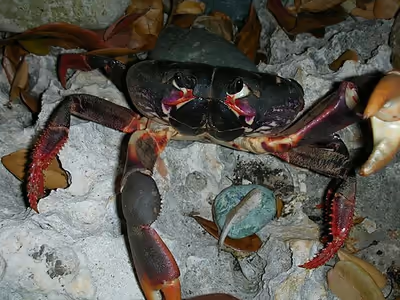
No clear distinction is made between "terrestrial", "semiterrestrial", and "aquatic" crabs. Rather, a continuum of terrestriality is displayed among the true crabs, although most land-adapted crabs must still return to water to release their eggs. Some species of terrestrial crabs can be found many kilometres from the sea, but have to complete annual migrations to the sea. For example, following the Indian Ocean monsoon, the Christmas Island red crab (Gecarcoidea natalis) migrates en masse, forming a "living carpet" of crabs. The crabs can travel up to 1.46 km (0.91 mi) in a day, and up to 4 km (2.5 mi) in total. Only a few land crabs, including certain Geosesarma species, have direct development (the mother carries the eggs until they have become tiny, fully developed crabs), and these do not need access to water to breed. Many crabs belonging to the family Potamidae, which contains mostly freshwater crabs, have developed a semiterrestrial (for instance the genus Nanhaipotamon) to terrestrial life history, and are sometimes independent of fresh water for reproduction (for instance the genus Tiwaripotamon).
Sign in to keep reading
One more chapter is free with a Lably account.
Ecology
Terrestrial crabs are often similar to freshwater crabs, since the physiological changes needed for living in fresh water are preadaptations for terrestrial living. On some oceanic islands, terrestrial crabs occupy the top of the energy pyramid.