


Related on Lably
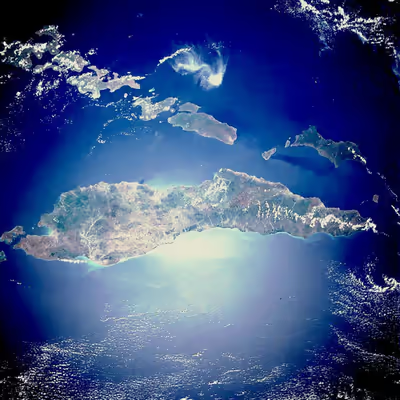
With a population of over 3 million people, the island is divided between the sovereign states of Timor-Leste in the eastern part and Indonesia in the western part. The Indonesian part, known as West Timor, is inhabited by around 2 million people and constitutes part of the province of East Nusa Tenggara. Timor-Leste, previously under Indonesian occupation from 1975 to 1999, has a population of around 1.3 million. Within West Timor lies an exclave of Timor-Leste called Oecusse District. The island had previously been divided between the Dutch and Portuguese colonial empires.
History
The earliest historical record about Timor island is the 13th-century Chinese Zhu Fan Zhi, where it is called Ti-wu and is noted for its sandalwood. In the 14th-century, Javanese Nagarakretagama, Canto 14, Timur is identified as an island within Majapahit's realm. Timor was incorporated into ancient Javanese, Chinese and Indian trading networks of the 14th century as an exporter of aromatic sandalwood, slaves, honey and wax, and was settled by both the Portuguese, in the end of the 16th century, and the Dutch, based in Kupang, in the mid-17th century.
As the nearest island with a European settlement at the time, Timor was the destination of William Bligh and seamen loyal to him following the infamous mutiny on the Bounty in 1789. It was also where survivors of the wrecked HMS Pandora, sent to arrest the Bounty mutineers, landed in 1791 after that ship sank in the Great Barrier Reef.
The island has been politically divided in two parts for centuries. The Dutch and Portuguese fought for control of the island until it was divided by treaty in 1859, but they still did not formally resolve the matter of the boundary until 1912. West Timor, was known as Dutch Timor until 1949 when it became Indonesian Timor, a part of the nation of Indonesia which was formed from the old Netherlands East Indies; while East Timor was known as Portuguese Timor, a Portuguese colony until 1975. It includes the exclave of Oecussi-Ambeno in West Timor.
Although Portugal was neutral during World War II, in December 1941, Portuguese Timor was occupied by Australian and Dutch forces, which were expecting a Japanese invasion. This Australian military intervention dragged Portuguese Timor into the Pacific War but it also slowed the Japanese expansion. When the Japanese did occupy Timor, in February 1942, a 400-strong Dutch-Australian force and large numbers of Timorese volunteers engaged them in a one-year guerrilla campaign. After the allied evacuation in February 1943 the East Timorese continued fighting the Japanese, with comparatively little collaboration with the enemy taking place. This assistance cost the civilian population dearly: Japanese forces burned many villages and seized food supplies. The Japanese occupation resulted in the deaths of between 40,000 and 70,000 Timorese.
Following the 1974 Carnation Revolution, a military coup in Portugal, the Portuguese began to withdraw from Timor. The subsequent internal unrest and fear of the communist Fretilin party led to an invasion by Indonesia, who opposed the concept of an independent East Timor. In 1975, East Timor was annexed by Indonesia and became known as Timor Timur or 'Tim-Tim' for short. It was regarded by Indonesia as the country's 27th province, but this was never recognised by the United Nations (UN) or Portugal.
The people of East Timor, through Falintil the military wing of Fretilin, resisted 35,000 Indonesian troops in a prolonged guerrilla campaign, but the whole island remained under Indonesian control until a referendum held in 1999 under a UN-sponsored agreement between Indonesia and Portugal in which its people rejected the offer of autonomy within Indonesia. The UN then temporarily governed East Timor until it became independent as Timor-Leste in 2002 under the presidency of Falintil leader Xanana Gusmão. Political strife continued, as the new nation coped with poverty. Nevertheless, the UN presence was much reduced.
A group of people on the Indonesian side of Timor have been reported active since 2001 trying to establish a Great Timor state. However, there is no real evidence that the people of West Timor, most of whom are ethnically Atoni, the traditional enemy of the East Timorese, have any interest in such a union. Furthermore, the current government of Timor-Leste recognizes the existing boundary.
Sign in to keep reading
7 more chapters are free with a Lably account.
Language, ethnic groups and religion
Anthropologists identify eleven distinct ethno-linguistic groups in Timor. The largest are the Atoni of western Timor and the Tetun of central and eastern Timor. Most indigenous Timorese languages belong to the Timor–Babar branch of the Austronesian languages spoken throughout the Indonesian archipelago. Although lexical evidence is lacking, the non-Austronesian languages of Timor are thought to be related to languages spoken on Halmahera and in Western New Guinea. Some are so mixed that it is difficult to tell which family they descend from.
The official languages of Timor-Leste are Tetun and Portuguese, while in West Timor it is Indonesian, although Uab Meto (also known as Dawan language) is the local Atoni language spoken throughout Kupang, South Central Timur and North Central Timur Regencies. Indonesian, a standardized dialect of Malay, is also widely spoken and understood in Timor-Leste.
Christianity is the dominant religion throughout the island of Timor, at about 90% of the population. However, it is unequally distributed as West Timor is 58% Protestant and 37% Catholic, and Timor-Leste is 98% Catholic and 1% Protestant. Islam and animism make up most of the remainder at about 5% each across the island.
Geography
Timor is located north of Australia and Oceania, and is one of the easternmost Sunda Islands and the easternmost of Lesser Sunda Islands. Together with Sumba, Babar and associated smaller islands, Timor forms the southern outer archipelago of the Lesser Sunda Islands with the inner islands of Flores, Alor and Wetar to the north, and beyond them Sulawesi.
Timor is the principal island of the Outer Banda Arc, which is being uplifted by arc-continent collision with the Australian continent. Timor consists mostly of rocks from the Australian continental margin that are accreted to the Banda Arc. It occupies a forearc position in front of the active volcanic arc that forms the islands in the Flores region to the north. The orientation of the main axis of the island also differs from its neighbors. These features have been explained as the result of being on the northern edge of the Indo-Australian Plate as it meets the Eurasian Plate and pushes into Southeast Asia. The climate includes a long dry season (April-November) with hot winds blowing over from Australia. Rivers on the island include the North and South Laclo Rivers in Timor-Leste. The mountains, which reach up to nearly 3000m in elevation, are one of the most mature parts of the Banda Range, which stretches from Sumba to Seram. Mutis is the highest mountain in West Timor and Ramelau is the highest mountain in Timor Leste.
The largest towns on the island are the provincial capital of Kupang in West Timor, Indonesia and the Portuguese colonial towns of Dili the capital, and Baucau in Timor-Leste. Poor roads make transport to inland areas difficult, especially in Timor-Leste. Sources of revenue include gas and oil in the Timor Sea, coffee growing and tourism.
Geology
Timor is an aerially exposed portion of the Banda Forearc formed by collision of Eurasian oceanic crust and continental crust of the Australian plate. This is a unique convergent margin where a thick continental margin is forced under thinner oceanic crust. The result is a large accretionary wedge of imbricated thrust sheets composed of Cretaceous and Tertiary distal material of the Australian continental margin thrust on top of Australian continental shelf deposits. Timor is well known for its structural complexity. Debate continues about the nature of deformation of continental crust. Some researchers advocate shallow thin-skinned deformation, while others favor shallow thin-skinned with some basement deformation.
Timor also has potential for significant petroleum development. Onshore and offshore exploration efforts have been attempted with varying success. Timor host dozens of natural oil and gas seeps with most exploration concentrated on the north end of the Island where oil seeps are prevalent. Carbon rich shales from the island have been found with TOC up to 23%. Such shales buried deep in the subsurface could act as high-quality source rocks. Jurassic marine shoreface and turbidite sands of the Plover and Militia Formations are proven reservoirs in the North Australian Shelf. Over pressured Upper Jurassic silt and mudstones shales may also provide adequate seals for hydrocarbons. Research focusing on the structure of deformed basement rocks provides insight into possible onshore and offshore structural and stratigraphic traps for future petroleum development.
Demographics
Most populous settlements
- Provincial/municipality capital
- National capital
Administration
2018 and 2023
2023
West Timor
West Timor is part of the East Nusa Tenggara province. It was formerly split into the City of Kupang (a kabupaten or regency-level administrative area) and four regencies (kabupaten); from west to east these are: Kupang, Timor Tengah Selatan (South Central Timor), Timor Tengah Utara (North Central Timor) and Belu. However, a fifth regency – Malaka – was in 2012 formed from the southern half of Belu Regency. Note that the administrative area has shrunk as Rote Ndao Regency (Rote and Ndoa islands to the southwest) and Sabu Raijua Regency (the Savu Islands further west) were split off in 2002 and 2009 respectively from Kupang Regency. The island accounts for 35.5% of the provincial population.
Timor-Leste
Timor-Leste is divided into thirteen municipalities, which in turn are subdivided into 65 administrative posts, 442 sucos (villages), and 2,225 aldeias (hamlets).
Flora and fauna
Timor and its offshore islands such as Atauro, a former place of exile increasingly known for its beaches and coral, as well as Jaco along with Wetar and the other Barat Daya Islands to the northeast constitute the Timor and Wetar deciduous forests ecoregion. The natural vegetation was tropical dry broadleaf forests with an undergrowth of shrubs and grasses supporting a rich wildlife. However much of the original forest has been cleared for farming, especially on the coasts of Timor and on the smaller islands like Atauro. Apart from one large block in the centre of Timor only patches remain. This ecoregion is part of the Wallacea area with a mixture of plants and animals of Asian and Australasian origin; it lies in the western part of Wallacea, in which Asian species predominate.
Many trees are deciduous or partly deciduous, dropping their leaves during the dry season, there are also evergreen and thorn trees in the woodland. Typical trees of the lowland slopes include Sterculia foetida, Calophyllum teysmannii and Aleurites moluccanus.
During the Pleistocene epoch, Timor was the abode of extinct giant monitor lizards similar to the Komodo dragon. Like Flores, Sumba and Sulawesi, Timor was also once a habitat of extinct dwarf stegodonts, relatives of elephants.
Fauna of today includes a number of endemic species such as the distinctive Timor shrew and Timor rat. The northern common cuscus, a marsupial of Australasian origin occurs as well, but is thought to be introduced. The island have a great number of birds, mainly of Asian origin with some of Australasian origin. There is a total of 250 species of which twenty four are endemic, due to the relative isolation of Timor, including five threatened species; the slaty cuckoo-dove, Wetar ground dove, Timor green pigeon, Timor imperial pigeon, and iris lorikeet.
Saltwater crocodiles are found in the wetlands whereas reticulated pythons can be found in forests and grasslands of Timor. However, the population sizes and status are unknown.
Frog species in Timor include Duttaphrynus melanostictus, Hoplobatrachus tigerinus, Limnonectes timorensis, Litoria everetti, and Polypedates leucomystax. A new species of microlyhid frog belonging to the genus Kaloula has also recently been discovered in Timor.
Late Cretaceous fossils of marine vertebrates are known from Timor-Leste deposits. These include mosasaurs such as Globidens timorensis, lamniforme sharks, coelacanths and the choristodere Champsosaurus.
Time zone
- East Nusa Tenggara (West Timor)
- Timor-Leste (most of state)