


Related on Lably
Through Algorithm, Operating system and Quicksort
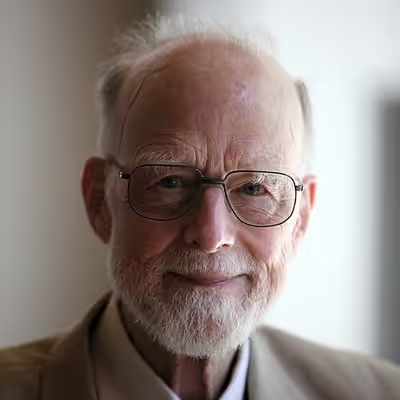
Hoare developed the sorting algorithm quicksort in 1959–1960. He developed Hoare logic, an axiomatic basis for verifying program correctness. In the semantics of concurrency, he introduced the formal language communicating sequential processes (CSP) to specify the interactions of concurrent processes, and along with Edsger Dijkstra, formulated the dining philosophers problem. From 1977 on, he held positions at the University of Oxford as well as at Microsoft Research in Cambridge.
Early life and education
Tony Hoare was born in Colombo, Ceylon (now Sri Lanka) on 11 January 1934, to British parents; his father was a colonial civil servant and his mother was the daughter of a tea planter. Hoare was privately educated in England at the Dragon School in Oxford and the King's School in Canterbury. He then studied Classics and Philosophy ("Greats") at the University of Oxford as an undergraduate student at Merton College, Oxford. On graduating in 1956 he did 18 months National Service in the Royal Navy, where he learned Russian. He returned to the University of Oxford in 1958 to study for a postgraduate certificate in statistics, and it was here that he began computer programming, having been taught Autocode on the Ferranti Mercury by Leslie Fox. He then went to Moscow State University as a British Council exchange student, where he studied machine translation supervised by Andrey Kolmogorov.
Sign in to keep reading
3 more chapters are free with a Lably account.
Research and career
In 1960, Hoare left the Soviet Union and began working at Elliott Brothers Ltd, a small computer manufacturing firm located in London. There, he implemented a compiler for the language ALGOL 60 and began developing major algorithms.
Hoare was involved with developing international standards in programming and informatics, as a member of the International Federation for Information Processing (IFIP) Working Group 2.1 on Algorithmic Languages and Calculi, which specified, maintains, and supports the languages ALGOL 60 and ALGOL 68.
Hoare became the Professor of Computing Science at the Queen's University of Belfast in 1968, and in 1977 returned to Oxford as the Professor of Computing to lead the Programming Research Group in the Oxford University Computing Laboratory (now Department of Computer Science, University of Oxford), following the death of Christopher Strachey. He became the first Christopher Strachey Professor of Computing on its establishment in 1988 until his retirement at Oxford in 2000. He was an Emeritus Professor there, and also a principal researcher at Microsoft Research in Cambridge, England.
Hoare's most significant work has been in the following areas: his sorting and selection algorithm (Quicksort and Quickselect), Hoare logic, the formal language communicating sequential processes (CSP) used to specify the interactions between concurrent processes (and implemented in various programming languages such as occam), structuring computer operating systems using the monitor concept, and the axiomatic specification of programming languages.
Speaking at a software conference in 2009, Hoare apologised for inventing the null reference:
I call it my billion-dollar mistake. It was the invention of the null reference in 1965. At that time, I was designing the first comprehensive type system for references in an object-oriented language (ALGOL W). My goal was to ensure that all use of references should be absolutely safe, with checking performed automatically by the compiler. But I couldn't resist the temptation to put in a null reference, simply because it was so easy to implement. This has led to innumerable errors, vulnerabilities, and system crashes, which have probably caused a billion dollars of pain and damage in the last forty years.
For many years under his leadership, Hoare's Oxford department worked on formal specification languages such as CSP and the Z notation. These did not achieve the expected take-up by industry, and in 1995, Hoare was led to reflect upon the original assumptions:
Ten years ago, researchers into formal methods (and I was the most mistaken among them) predicted that the programming world would embrace with gratitude every assistance promised by formalisation to solve the problems of reliability that arise when programs get large and more safety-critical. Programs have now got very large and very critical – well beyond the scale which can be comfortably tackled by formal methods. There have been many problems and failures, but these have nearly always been attributable to inadequate analysis of requirements or inadequate management control. It has turned out that the world just does not suffer significantly from the kind of problem that our research was originally intended to solve.
A commemorative article of reminiscences was written in tribute to Hoare for his 90th birthday.
Personal life and death
In 1962, Hoare married Jill Pym, a member of his research team, with whom he had three children. He died on 5 March 2026, aged 92.
Books
- Dahl, O.-J.; Dijkstra, E. W.; Hoare, C. A. R. (1972). Structured Programming. Academic Press. ISBN 978-0-12-200550-3. OCLC 23937947.
- Hoare, C. A. R. (1985). Communicating Sequential Processes. Prentice Hall International Series in Computer Science. ISBN 978-0131532717 (hardback) or ISBN 978-0131532892 (paperback). (Available online at http://www.usingcsp.com/ Archived 1 February 2021 at the Wayback Machine in PDF format.)
- Hoare, C. A. R. (1989). C. B., Jones (ed.). Essays in computing science. Prentice Hall International Series in Computer Science. ISBN 978-0-13-284027-9.
- Hoare, C. A. R.; Gordon, M. J. C. (1992). Mechanised Reasoning and Hardware Design. Prentice Hall International Series in Computer Science. ISBN 978-0-13-572405-7. OCLC 25712842.
- Hoare, C. A. R.; He, Jifeng (1998). Unifying Theories of Programming. Prentice Hall International Series in Computer Science. ISBN 978-0-13-458761-5. OCLC 38199961.