

Tunguska event
1908 air burst explosion in Siberia, Russia
- 25 min read
- 4 chapters

Related on Lably
Through Recorded history, Prehistory and Atmosphere of Earth
The event is attributed to a meteor air burst, the atmospheric explosion of a stony asteroid about 50–60 m (160–200 ft) wide. The asteroid approached from the east-south-east, probably with a relatively high speed of about 27 km/s. Though the incident is classified as an impact event, the object is thought to have exploded at an altitude of 5–10 km (3–6 mi) rather than hitting the Earth's surface, leaving no impact crater.
Occurring over an area of 2,150 km2 (830 sq mi) in the sparsely populated East Siberian taiga, the explosion felled a significant amount of trees. Eyewitness accounts suggest up to three people may have died. An explosion of the Tunguska magnitude would be capable of destroying a large metropolitan area.
The event has been depicted in numerous works of fiction.
Description
On 30 June [O.S. 17 June] 1908, at around 7:14 local time (UTC+07:00) in the morning, Evenki natives and Russian settlers in the hills northwest of Lake Baikal observed a bluish light, nearly as bright as the Sun, moving across the sky and leaving a thin trail. Closer to the horizon, there was a flash producing a billowing cloud, followed by a pillar of fire that cast a red light on the landscape. The pillar split in two and faded, turning to black. About 10 minutes later, there was a sound similar to artillery fire. Eyewitnesses closer to the explosion reported that the source of the sound moved from the east to the north of them. The sounds were accompanied by a shock wave that knocked people off their feet and broke windows hundreds of kilometres away.
The explosion registered at seismic stations across Eurasia, and air waves from the blast were detected in Germany, Denmark, Croatia, and the United Kingdom – and as far away as Batavia, Dutch East Indies (now Indonesia), and Washington, D.C., United States. It is estimated that, in some places, the resulting shock wave was equivalent to an earthquake measuring 5.0 on the Richter scale.
Over the next few days, night skies in Asia and Europe were aglow. There are contemporaneous reports of brightly lit photographs being successfully taken at midnight (without the aid of flashbulbs) in Sweden and Scotland. It has been theorised that this sustained glowing effect was due to light passing through high-altitude ice particles that had formed at extremely low temperatures as a result of the explosion – a phenomenon that decades later was reproduced on a much smaller scale by Space Shuttles. In the United States, a Smithsonian Astrophysical Observatory program at the Mount Wilson Observatory in California observed a months-long decrease in atmospheric transparency consistent with an increase in suspended dust particles.
Selected eyewitness reports
Though the region of Siberia in which the explosion occurred was very sparsely populated in 1908, there are accounts of the event from eyewitnesses, and regional newspapers reported the event shortly after it occurred.
The testimony of S. Semenov, as recorded by Russian mineralogist Leonid Kulik's expedition in 1930:
At breakfast time I was sitting by the house at Vanavara Trading Post [approximately 65 km (40 mi) south of the explosion], facing north. [...] I suddenly saw that directly to the north, over Onkoul's Tunguska Road, the sky split in two and fire appeared high and wide over the forest [as Semenov showed, about 50 degrees up – expedition note]. The split in the sky grew larger, and the entire northern side was covered with fire. At that moment I became so hot that I couldn't bear it as if my shirt was on fire; from the northern side, where the fire was, came strong heat. I wanted to tear off my shirt and throw it down, but then the sky shut closed, and a strong thump sounded, and I was thrown a few metres. I lost my senses for a moment, but then my wife ran out and led me to the house. After that such noise came, as if rocks were falling or cannons were firing, the Earth shook, and when I was on the ground, I pressed my head down, fearing rocks would smash it. When the sky opened up, hot wind raced between the houses, like from cannons, which left traces in the ground like pathways, and it damaged some crops. Later we saw that many windows were shattered, and in the barn, a part of the iron lock snapped.
Testimony of Chuchan of the Shanyagir tribe, as recorded by I. M. Suslov in 1926:
We had a hut by the river with my brother Chekaren. We were sleeping. Suddenly we both woke up at the same time. Somebody shoved us. We heard whistling and felt strong wind. Chekaren said "Can you hear all those birds flying overhead?" We were both in the hut, couldn't see what was going on outside. Suddenly, I got shoved again, this time so hard I fell into the fire. I got scared. Chekaren got scared too. We started crying out for father, mother, brother, but no one answered. There was noise beyond the hut, we could hear trees falling down. Chekaren and I got out of our sleeping bags and wanted to run out, but then the thunder struck. This was the first thunder. The Earth began to move and rock, the wind hit our hut and knocked it over. My body was pushed down by sticks, but my head was in the clear. Then I saw a wonder: trees were falling, the branches were on fire, it became mighty bright, how can I say this, as if there was a second sun, my eyes were hurting, I even closed them. It was like what the Russians call lightning. And immediately there was a loud thunderclap. This was the second thunder. The morning was sunny, there were no clouds, our Sun was shining brightly as usual, and suddenly there came a second one!
Chekaren and I had some difficulty getting out from under the remains of our hut. Then we saw that above, but in a different place, there was another flash, and loud thunder came. This was the third thunder strike. Wind came again, knocked us off our feet, struck the fallen trees.
We looked at the fallen trees, watched the tree tops get snapped off, watched the fires. Suddenly Chekaren yelled "Look up" and pointed with his hand. I looked there and saw another flash, and it made another thunder. But the noise was less than before. This was the fourth strike, like normal thunder.
Now I remember well there was also one more thunder strike, but it was small, and somewhere far away, where the Sun goes to sleep.
Sibir newspaper, 2 July 1908:
On the morning of 17th of June, around 9:00 (UTC+7), we observed an unusual natural occurrence. In the north Karelinski village [200 versts (210 km) north of Kirensk] the peasants saw to the northwest, rather high above the horizon, some strangely bright (impossible to look at) bluish-white heavenly body, which for 10 minutes moved downwards. The body appeared as a "pipe", i.e., a cylinder. The sky was cloudless, only a small dark cloud was observed in the general direction of the bright body. It was hot and dry. As the body neared the ground (forest), the bright body seemed to smudge, and then turned into a giant billow of black smoke, and a loud knocking (not thunder) was heard as if large stones were falling, or artillery was fired. All buildings shook. At the same time the cloud began emitting flames of uncertain shapes. All villagers were stricken with panic and took to the streets, women cried, thinking it was the end of the world. The author of these lines was meantime in the forest about 6 versts (6.4 km) north of Kirensk and heard to the north-east some kind of artillery barrage, that repeated at intervals of 15 minutes at least 10 times. In Kirensk in a few buildings in the walls facing north-east window glass shook.
Siberian Life newspaper, 27 July 1908:
When the meteorite fell, strong tremors in the ground were observed, and near the Lovat village of the Kansk uezd two strong explosions were heard, as if from large-calibre artillery.
Krasnoyaretz newspaper, 13 July 1908:
Kezhemskoye village. On the 17th an unusual atmospheric event was observed. At 7:43 the noise akin to a strong wind was heard. Immediately afterward a horrific thump sounded, followed by an earthquake that literally shook the buildings as if they were hit by a large log or a heavy rock. The first thump was followed by a second, and then a third. Then the interval between the first and the third thumps was accompanied by an unusual underground rattle, similar to a railway upon which dozens of trains are travelling at the same time. Afterward, for 5 to 6 minutes an exact likeness of artillery fire was heard: 50 to 60 salvoes in short, equal intervals, which got progressively weaker. After 1.5–2 minutes after one of the "barrages" six more thumps were heard, like cannon firing, but individual, loud and accompanied by tremors. The sky, at the first sight, appeared to be clear. There was no wind and no clouds. Upon closer inspection to the north, i.e. where most of the thumps were heard, a kind of an ashen cloud was seen near the horizon, which kept getting smaller and more transparent and possibly by around 14:00–15:00 (UTC+7) completely disappeared.
Sign in to keep reading
3 more chapters are free with a Lably account.
Scientific investigation
Since the 1908 event, an estimated 1,000 scholarly papers (most in Russian) have been published about the Tunguska explosion. Owing to the site's remoteness and the limited instrumentation available at the time of the event, modern scientific interpretations of its cause and magnitude have relied chiefly on damage assessments and geological studies conducted many years after the event. Estimates of its energy have ranged from 3–30 megatons of TNT (13–126 PJ).
Not until more than a decade after the event did any scientific analysis of the region take place, in part due to the area's isolation and significant political upheaval affecting Russia in the 1910s. In 1921, the Russian mineralogist Leonid Kulik led a team to the Podkamennaya Tunguska River basin to conduct a survey for the Soviet Academy of Sciences. Although they never visited the central blast area, the many local accounts of the event led Kulik to believe that a giant meteorite impact had caused the event. Upon returning, he persuaded the Soviet government to fund an expedition to the suspected impact zone, based on the prospect of salvaging meteoric iron.
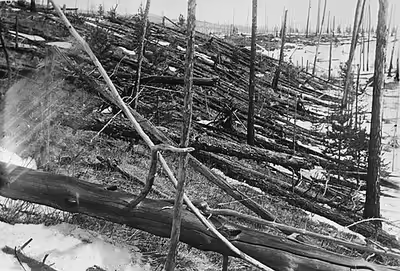
Kulik led a scientific expedition to the Tunguska blast site in 1927. He hired local Evenki hunters to guide his team to the centre of the blast area, where they expected to find an impact crater. To their surprise, there was no crater at ground zero. Instead, they found a zone, roughly 8 km (5.0 mi) across, where the trees were scorched and devoid of branches, but still standing upright. Trees farther from the centre had been partly scorched and knocked down away from the centre, creating a large radial pattern of downed trees.
In the 1960s, it was established that the zone of levelled forest occupied an area of 2,150 km2 (830 sq mi), its shape resembling a gigantic spread-eagled butterfly with a "wingspan" of 70 km (43 mi) and a "body length" of 55 km (34 mi). Upon closer examination, Kulik found holes that he erroneously concluded were meteorite holes; he did not have the means at that time to excavate the holes.
During the next 10 years, there were three more expeditions to the area. Kulik found several dozen little "pothole" bogs, each 10–50 m (33–164 ft) in diameter, that he thought might be meteoric craters. After a laborious exercise in draining one of these bogs—the so-called "Suslov's crater" of 32 m (105 ft) in diameter—he found an old tree stump on the bottom, ruling out the possibility that it was a meteoric crater. In 1938, Kulik arranged for an aerial photographic survey of the area, covering the 250 km2 (95 sq mi) central part of the levelled forest. The original negatives of these aerial photographs—1,500 negatives, each 18 by 18 cm (7.1 by 7.1 in)—were burned in 1975 by order of Yevgeny Krinov, then Chairman of the Committee on Meteorites of the USSR Academy of Sciences, as part of an initiative to dispose of increasingly flammable nitrate film. Positive prints were preserved for further study in Tomsk.
Expeditions sent to the area in the 1950s and 1960s found microscopic silicate and magnetite spheres in siftings of the soil. Similar spheres were predicted to exist in the felled trees, although they could not be detected by contemporary means. Later expeditions did identify such spheres in the resin of the trees. Chemical analysis showed that the spheres contained high proportions of nickel relative to iron, which is also found in meteorites, leading to the conclusion they were of extraterrestrial origin. The concentration of the spheres in different regions of the soil was also found to be consistent with the expected distribution of debris from a meteor air burst. Later studies of the spheres found unusual ratios of numerous other metals relative to the surrounding environment, which was taken as further evidence of their extraterrestrial origin.
Chemical analysis of peat bogs from the area also revealed numerous anomalies considered consistent with an impact event. The isotopic signatures of carbon, hydrogen, and nitrogen at the layer of the bogs corresponding to 1908 were found to be inconsistent with the isotopic ratios measured in the adjacent layers, and this abnormality was not found in bogs outside the area. The region of the bogs showing these anomalous signatures also contains an unusually high proportion of iridium, similar to the iridium layer found in the Cretaceous–Paleogene boundary. These unusual proportions are believed to result from debris from the falling body that deposited in the bogs. The nitrogen is believed to have been deposited as acid rain, a suspected fallout from the explosion.
Other scientists disagree: "Some papers report that hydrogen, carbon and nitrogen isotopic compositions with signatures similar to those of CI and CM carbonaceous chondrites were found in Tunguska peat layers dating from the TE, and that iridium anomalies were also observed. Measurements performed in other laboratories have not confirmed these results."
Researcher John Anfinogenov has suggested that a boulder found at the event site, known as "John's stone", is a remnant of the meteorite, but oxygen isotope analysis of the quartzite suggests that it is of hydrothermal origin, and probably related to Permian-Triassic Siberian Traps magmatism.
In 2013, a team of researchers published the results of an analysis of micro-samples from a peat bog near the centre of the affected area, which show fragments that may be of extraterrestrial origin.
Although it is widely claimed the impact resulted in the felling of over 80 million trees, this was based on a preliminary guess multiplying tree density by impacted area that overestimated the area of devastation by a factor of four, so is likely to be incorrect. The largest accurately recorded felled trees are around 44 cm (17 in) in trunk diameter and not around 1 m (3.3 ft) that has been claimed by some sources.
The observations of decreased atmospheric transparency at the Mount Wilson Observatory in California have been used to calculate that roughly a million tons of dust were released into the stratosphere. Further modelling suggests that shock waves from the falling meteor generated up to 30 Mt of nitric oxide (NO) in the stratosphere and mesosphere which resulted in a peak ozone depletion of 35-45% for early 1909, and ones of ~30% in 1910, and ~15% in 1911, and a tripling of UV-B intensity at the ground at latitude 30°N.
Earth impactor model
The leading scientific explanation for the explosion is a meteor air burst by an asteroid 6–10 km (4–6 mi) above the Earth's surface. Meteoroids enter Earth's atmosphere from outer space every day, travelling at a speed of at least 11 km/s (40,000 km/h; 25,000 mph), the escape velocity of the Earth. The heat generated by compression of air in front of the body (ram pressure) as it travels through the atmosphere is immense and most meteoroids burn up or explode before they reach the ground. Early estimates of the energy of the Tunguska air burst ranged from 10–15 to 30 megatons of TNT (42–63 to 126 PJ), depending on the exact height of the burst as estimated when the scaling laws from the effects of nuclear weapons are employed.
More recent calculations that include the effect of the object's momentum find that more of the energy was focused downward than would be the case from a nuclear explosion and estimate that the air burst had an energy range of 3–5 Mt (13–21 PJ). The 15-megaton (Mt) estimate represents an energy about 1,000 times greater than that of the Trinity nuclear test, and roughly equal to that of the United States' Castle Bravo nuclear test in 1954 (which measured 15.2 Mt) and one third that of the Soviet Union's Tsar Bomba test in 1961. A 2019 paper suggests the explosive power of the Tunguska event may have been around 20–30 Mt.
Since the second half of the 20th century, close monitoring of Earth's atmosphere through infrasound and satellite observation has shown that asteroid air bursts with energies comparable to those of nuclear weapons routinely occur, although Tunguska-sized events, on the order of 5–15 Mt, are much rarer. Eugene Shoemaker estimated that 20 kt events occur annually and that Tunguska-sized events occur about once every 300 years. More recent estimates place Tunguska-sized events at about once every thousand years, with five-kiloton air bursts averaging about once per year. Most of these are thought to be caused by asteroid impactors, as opposed to mechanically weaker cometary materials, based on their typical penetration depths into the Earth's atmosphere. The largest asteroid air burst observed with modern instrumentation was the 500 kt Chelyabinsk meteor in 2013, which shattered windows and produced meteorites.
Glancing impact hypothesis
In 2020, a group of Russian scientists used a range of computer models to calculate the passage of asteroids with diameters of 200, 100, and 50 metres at oblique angles across Earth's atmosphere. They used a range of assumptions about the object's composition as if it was made of iron, rock, or ice. The model that most closely matched the observed event was an iron asteroid up to 200 metres in diameter, travelling at 11.2 km per second, that glanced off the Earth's atmosphere and returned into solar orbit.
Blast pattern
The explosion's effect on the trees near the explosion's hypocentre was similar to the effects of the conventional Operation Blowdown in Australia. These effects are caused by the blast wave produced by large air-burst explosions. The trees directly below the explosion are stripped as the blast wave moves vertically downward, but remain standing upright, while trees farther away are knocked over because the blast wave is travelling closer to horizontal when it reaches them.
Soviet experiments performed in the mid-1960s, with model forests (made of matches on wire stakes) and small explosive charges slid downward on wires, produced butterfly-shaped blast patterns similar to the pattern found at the Tunguska site. The experiments suggested that the object had approached at an angle of roughly 30° from the ground and 115° from north, and had exploded in midair.
Asteroid or comet
In 1930, the British meteorologist and mathematician F. J. W. Whipple suggested that the Tunguska body was a small comet. A comet is composed of dust and volatiles, such as water ice and frozen gases, and could have been completely vaporised by the impact with Earth's atmosphere, leaving no obvious traces. The comet hypothesis was further supported by the glowing skies (or "skyglows" or "bright nights") observed across Eurasia for several evenings after the impact, which are possibly explained by dust and ice that had been dispersed from the comet's tail across the upper atmosphere. The cometary hypothesis gained a general acceptance among Soviet Tunguska investigators by the 1960s.
In 1978, Slovak astronomer Ľubor Kresák suggested that the body was a fragment of Comet Encke, a periodic comet with a period of just over three years that stays entirely within Jupiter's orbit. It is also responsible for the Beta Taurids, an annual meteor shower with a maximum activity around 28–29 June. The Tunguska event coincided with that shower's peak activity, the Tunguska object's approximate trajectory is consistent with what would be expected from a fragment of Comet Encke, and a hypothetical risk corridor has now been calculated demonstrating that if the impactor had arrived a few minutes earlier it would have exploded over the US or Canada. It is now known that bodies of this kind explode at frequent intervals tens to hundreds of kilometres above the ground. Military satellites have been observing these explosions for decades. In 2019 astronomers searched for hypothesised asteroids ~100 metres in diameter from the Taurid swarm between 5–11 July, and 21 July – 10 August. As of February 2020, there have been no reports of discoveries of any such objects.
In 1983, astronomer Zdeněk Sekanina published a paper criticising the comet hypothesis. He pointed out that a body composed of cometary material, travelling through the atmosphere along such a shallow trajectory, ought to have disintegrated, whereas the Tunguska body apparently remained intact into the lower atmosphere. Sekanina also argued that the evidence pointed to a dense rocky object, probably of asteroidal origin. This hypothesis was further boosted in 2001, when Farinella, Foschini, et al. released a study calculating the probabilities based on orbital modelling extracted from the atmospheric trajectories of the Tunguska object. They concluded with a probability of 83% that the object moved on an asteroidal path originating from the asteroid belt, rather than on a cometary one (probability of 17%). Proponents of the comet hypothesis have suggested that the object was an extinct comet with a stony mantle that allowed it to penetrate the atmosphere.
The chief difficulty in the asteroid hypothesis is that a stony object should have produced a large crater where it struck the ground, but no such crater has been found. It has been hypothesised that the asteroid's passage through the atmosphere caused pressures and temperatures to build up to a point where the asteroid abruptly disintegrated in a huge explosion. The destruction would have to have been so complete that no remnants of substantial size survived, and the material scattered into the upper atmosphere during the explosion would have caused the skyglows. Models published in 1993 suggested that the stony body would have been about 60 m (200 ft) across, with physical properties somewhere between an ordinary chondrite and a carbonaceous chondrite. Typical carbonaceous chondrite substance tends to be dissolved with water rather quickly unless it is frozen.
Christopher Chyba and others have proposed a process whereby a stony asteroid could have exhibited the Tunguska impactor's behaviour. Their models show that when the forces opposing a body's descent become greater than the cohesive force holding it together, it blows apart, releasing nearly all its energy at once. The result is no crater, with damage distributed over a fairly wide radius, and all the damage resulting from the thermal energy the blast releases.
During the 1990s, Italian researchers, coordinated by the physicist Giuseppe Longo from the University of Bologna, extracted resin from the core of the trees in the area of impact to examine trapped particles that were present during the 1908 event. They found high levels of material commonly found in rocky asteroids and rarely found in comets.
Kelly et al. (2009) contend that the impact was caused by a comet because of the sightings of noctilucent clouds following the impact, a phenomenon caused by massive amounts of water vapour in the upper atmosphere. They compared the noctilucent cloud phenomenon to the exhaust plume from NASA's Endeavour Space Shuttle. A team of Russian researchers led by Edward Drobyshevski in 2009 suggested that the near-Earth asteroid 2005 NB56 may be a possible candidate for the Tunguska object's parent body as the asteroid made a close approach of 0.06945 astronomical units (27 LD) from Earth on 27 June 1908, three days before the Tunguska impact. The team suspected that 2005 NB56's orbit likely fits with the Tunguska object's modelled orbit, even with the effects of weak non-gravitational forces. In 2013, analysis of fragments from the Tunguska site by a joint US-European team was consistent with an iron meteorite.
Chelyabinsk meteor
The February 2013 Chelyabinsk bolide event provided ample data for scientists to create new models for the Tunguska event. Researchers used data from both Tunguska and Chelyabinsk to perform a statistical study of over 50 million combinations of bolide and entry properties that could produce Tunguska-scale damage when breaking apart or exploding at similar altitudes. Some models focused on combinations of properties which created scenarios with similar effects to the tree-fall pattern as well as the atmospheric and seismic pressure waves of Tunguska. Four different computer models produced similar results; they concluded that the likeliest candidate for the Tunguska impactor was a stony body between 50–80 m (164–262 ft) in diameter, entering the atmosphere at roughly 55,000 km/h (34,000 mph), exploding at 10–14 km (6–9 mi) altitude, and releasing explosive energy equivalent to between 10–30 megatons. This is similar to the blast energy equivalent of the 1980 volcanic eruption of Mount St. Helens. The researchers also concluded impactors of this size hit the Earth only at an average interval scale of millennia.
Lake Cheko
In June 2007, scientists from the University of Bologna identified a lake in the Tunguska region as a possible impact crater from the event. They do not dispute that the Tunguska body exploded in midair, but believe that a 10 m (33 ft) fragment survived the explosion and struck the ground. Lake Cheko is a small bowl-shaped lake about 8 km (5.0 mi) north-northwest of the hypocentre.
The hypothesis has been disputed by other impact crater specialists. A 1961 investigation had dismissed a modern origin of Lake Cheko, saying that the presence of metres-thick silt deposits on the lake bed suggests an age of at least 5,000 years, but more recent research suggests that only a metre or so of the sediment layer on the lake bed is "normal lacustrine sedimentation", a depth consistent with an age of about 100 years. Acoustic-echo soundings of the lake floor support the hypothesis that the Tunguska event formed the lake. The soundings revealed a conical shape for the lake bed, which is consistent with an impact crater. Magnetic readings indicate a possible metre-sized chunk of rock below the lake's deepest point that may be a fragment of the colliding body. Finally, the lake's long axis points to the Tunguska explosion's hypocentre, about 7.0 km (4.3 mi) away. Work is still being done at Lake Cheko to determine its origins.
The main points of the study are that:
Cheko, a small lake located in Siberia close to the epicentre of the 1908 Tunguska explosion, might fill a crater left by the impact of a fragment of a cosmic body. Sediment cores from the lake's bottom were studied to support or reject this hypothesis. A 175-centimetre-long (69 in) core, collected near the center of the lake, consists of an upper c. 1-metre-thick (39 in) sequence of lacustrine deposits overlaying coarser chaotic material. 210
Pb and 137
Cs indicate that the transition from lower to upper sequence occurred close to the time of the Tunguska event. Pollen analysis reveals that remains of aquatic plants are abundant in the top post-1908 sequence but are absent in the lower pre-1908 portion of the core. These results, including organic C, N, and δ13C data, suggest that Lake Cheko formed at the time of the Tunguska event. Pollen assemblages confirm the presence of two different units, above and below the ~100 cm level. The upper 100 cm long section, in addition to pollen of taiga forest trees such as Abies, Betula, Juniperus, Larix, Pinus, Picea, and Populus, contains abundant remains of hydrophytes, i.e., aquatic plants probably deposited under lacustrine conditions similar to those prevailing today. These include both free-floating plants and rooted plants, growing usually in water up to 3–4 metres in depth (Callitriche, Hottonia, Lemna, Hydrocharis, Myriophyllum, Nuphar, Nymphaea, Potamogeton, Sagittaria). In contrast, the lower unit (below ~100 cm) contains abundant forest tree pollen, but no hydrophytes, suggesting that no lake existed then, but a taiga forest growing on marshy ground. Pollen and microcharcoal show a progressive reduction in the taiga forest, from the bottom of the core upward. This reduction may have been caused by fires (two local episodes below ~100 cm), then by the TE and the formation of the lake (between 100 and 90 cm), and again by subsequent fires (one local fire in the upper 40 cm).
In 2017, new research by Russian scientists pointed to a rejection of the theory that the Tunguska event created Lake Cheko. They used soil research to determine that the lake is 280 years old or even much older; in any case clearly older than the Tunguska event. In analysing soils from the bottom of Lake Cheko, they identified a layer of radionuclide contamination from mid-20th century nuclear testing at Novaya Zemlya. The depth of this layer gave an average annual sedimentation rate of between 3.6 and 4.6 mm a year. These sedimentation values are less than half of the 1 cm/year calculated by Gasperini et al. in their 2009 publication on their analysis of the core they took from Lake Cheko in 1999. The Russian scientists in 2017 counted at least 280 such annual varves in the 1260 mm long core sample pulled from the bottom of the lake, representing an age older than the Tunguska event.
Additionally, there are problems with impact physics: It is unlikely that a stony meteorite in the right size range would have the mechanical strength necessary to survive atmospheric passage intact while retaining a velocity high enough to excavate a crater that size on reaching the ground.
Geophysical hypotheses
Though scientific consensus is that the Tunguska explosion was caused by the impact of a small asteroid, there are some dissenters. Astrophysicist Wolfgang Kundt has proposed that the Tunguska event was caused by the release and subsequent explosion of 10 million tons of natural gas from within the Earth's crust. The basic idea is that natural gas leaked out of the crust and then rose to its equal-density height in the atmosphere; from there, it drifted downwind, in a sort of wick, which eventually found an ignition source such as lightning. Once the gas was ignited, the fire streaked along the wick, and then down to the source of the leak in the ground, whereupon there was an explosion.
The similar verneshot hypothesis has also been proposed as a possible cause of the Tunguska event. Other research has proposed a geophysical mechanism for the event.
Similar event
A smaller air burst occurred over a populated area on 15 February 2013, at Chelyabinsk in the Ural district of Russia. The exploding meteoroid was determined to have been an asteroid that measured about 17–20 m (56–66 ft) across. It had an estimated initial mass of 11,000 tons and exploded with an energy release of approximately 500 kilotons. The air burst inflicted over 1,200 injuries, mainly from broken glass falling from windows shattered by its shock wave.
Another meteor air burst occurred off the east coast of the Kamchatka Peninsula in eastern Russia on 18 December 2018.This was the third largest recorded meteor since 1900 after the Chelyabinsk meteor entry in February 2013 and the Tunguska event.
Aftermath
In fiction
In fiction, many alternative explanations for the event appear. The notion that it was caused by an alien spaceship is a popular one that gained prominence following the publication of Russian science fiction writer Alexander Kazantsev's 1946 short story "Explosion".
International Asteroid Day
In 2016, the United Nations proclaimed 30 June as the annual International Asteroid Day, to raise awareness about asteroids and efforts at planetary defence.