

Bolide
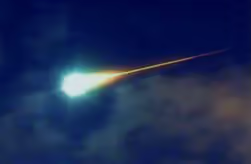
Extremely bright meteor
- 3 min read
- 3 chapters

Related on Lably
Through Atmosphere, Missile and Asteroid
Definitions
The word bolide (; from Italian via Latin, from Ancient Greek βολίς (bolís) 'missile') may refer to somewhat different phenomena depending on the context in which the word appears, and readers may need to make inferences to determine which meaning is intended in a particular publication. An early usage occurs in Natural History, where Pliny the Elder describes two types of prodigies, "those which are called lampades and those which are called bolides". At least one of the prodigies described by Pliny (a "spark" that fell, grew to the "size of the moon", and "returned into the heavens") has been interpreted by astronomers as a bolide in the modern sense. His description of an object coming near the earth and continuing back into the sky matches the expected trajectory of a fireball crossing above an observer. A 1771 fireball that burst above Melun, France, was widely discussed by contemporary astronomers as a "bolide" and was the subject of an official French Academy of Sciences investigation led by Jean-Baptiste Le Roy. In 1794, Ernst Chladni published a book proposing that meteors were small objects that fell to Earth from space and that small bodies existed in space beyond the moon. Though initially ridiculed, Chladni's book became the starting point for the modern field of meteoritics.
Astronomers use the word to describe any extremely bright meteor (or fireball), especially one that explodes in the atmosphere. Some astronomical definitions specify an apparent magnitude of −4 or brighter. A superbolide reaches an apparent magnitude of −17 or brighter, which is about 51 times brighter than the full moon. Recent examples of superbolides include the Sutter's Mill meteorite in California and the Chelyabinsk meteor in Russia.
Geologists use the word to describe a very large impact event. The geological definition covers any generic large crater-forming impacting body whose composition (for example, whether it is a rocky or metallic asteroid, or an icy comet) is unknown.
Sign in to keep reading
2 more chapters are free with a Lably account.
Astronomy
The IAU has no official definition of "bolide", and generally considers the term synonymous with fireball, a brighter-than-usual meteor; however, the term generally applies to fireballs reaching an apparent magnitude −4 or brighter. Astronomers tend to use bolide to identify an exceptionally bright fireball, particularly one that explodes (sometimes called a detonating fireball). It may also be used to mean a fireball that is audible.
Superbolide
Selected superbolide air bursts:
- Tunguska event (Russia, 1908)
- 2009 Sulawesi superbolide (Indonesia, 2009)
- Chelyabinsk meteor (Russia, 2013)
Geology
Geologists use the term bolide differently from astronomers. In geology, it indicates a very large impactor. For example, the Woods Hole Coastal and Marine Science Center of the USGS uses bolide for any large crater-forming impacting body whose origin and composition is unknown, as, for example, whether it was a stony or metallic asteroid, or a less dense, icy comet made of volatiles, such as water, ammonia, and methane.
The most notable example is the bolide that caused the Chicxulub crater in Mexico, 66 million years ago. Scientific consensus agrees that this event directly led to the extinction of all non-avian dinosaurs, and it is evidenced by a thin layer of iridium found at that geological layer marking the K–Pg boundary.