

Umbra, penumbra and antumbra
Distinct parts of a shadow
- 2 min read
- 3 chapters
- 2 labs on Lably

Learn it on Lably
These phenomena are generally observed within solar systems, as the size of the stars within the system are larger than the orbiting satellites, hence these terms are most often used for the shadows cast by celestial bodies, though they are sometimes used to describe levels of darkness, such as in sunspots.
Umbra
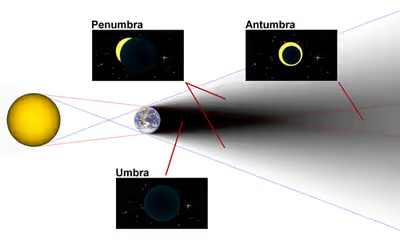
The umbra (Latin for 'shadow') is the innermost and darkest part of a shadow, where the light source is completely blocked by the occluding body. An observer within the umbra experiences a total occultation. The umbra of a round body occluding a round light source forms a right circular cone. When viewed from the cone's apex, the two bodies appear the same size.
The distance from the Moon to the apex of its umbra is roughly equal to that between the Moon and Earth: 384,402 km (238,856 mi). Since Earth's diameter is 3.7 times the Moon's, its umbra extends correspondingly farther: roughly 1.4 million km (870,000 mi).
Sign in to keep reading
2 more chapters are free with a Lably account.
Penumbra
The penumbra (from Latin paene 'almost, nearly' and umbra 'shadow') is the region in which only a portion of the light source is obscured by the occluding body, and an observer in the penumbra experiences a partial eclipse.
An alternative definition is that the penumbra is the region where some or all of the light source is obscured (i.e., the umbra is a subset of the penumbra). For example, NASA's Navigation and Ancillary Information Facility defines that a body in the umbra is also within the penumbra.
Antumbra
The antumbra (from Latin ante 'before' and umbra 'shadow') is the region from which the occluding body appears entirely within the disc of the light source. An observer in this region experiences an annular eclipse, in which a bright ring is visible around the eclipsing body. If the observer moves closer to the light source, the apparent size of the occluding body increases until it causes a full umbra.