


Related on Lably
Through Public transport and Kilometre
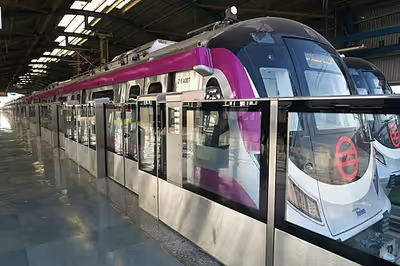
The presence of metro rail in India began with commissioning of the first system in Kolkata in 1984. They were later introduced gradually in other cities like Delhi and Bengaluru, eventually becoming popular in all urban agglomerations.
According to a report published in 2025, a total of 36.5 billion people traveled annually in metro systems across India's fifteen major cities, placing the country as one of the busiest urban rapid transit hubs in the world in terms of commuters. In 2025, the Delhi Metro alone carries an average of 46.3 lakh (4.63 million) passengers daily, and the Delhi-Meerut RRTS has an operational speed of 160 km/h. Across all metro systems in India, daily ridership is expected to be significantly higher, possibly exceeding 10 million. As of 2026, the cumulative length of 1,070.06 kilometres (664.90 miles) of twenty-one metro systems in India makes it the third longest in operation in the world.
The Ministry of Urban Development's Urban Transport wing is the nodal division for coordination, appraisal, and approval of Urban Transport matters including Metro Rail Projects at the central level. All the interventions in urban transport by the Ministry of Urban Development are carried out under the provisions of the National Urban Transport Policy, 2006.
Currently, the Delhi-Meerut RRTS is the fastest urban rail transit system in India, featuring an operational speed of 160 km/h and an average speed (including stoppage time) of 100 km/h.
Terminology
Indian cities have various types of urban transit systems operational, under construction and planned. These systems are being implemented based on the population of a city, financial feasibility and demand.
† Note: Suburban rail in India utilises the broad gauge network of Indian Railways and mostly shares the network and infrastructure with the rest of Indian Railway services.
‡ Note: Light Rail systems are mostly fenced and can be built with complete right of way if preferred so.
- Metro: The rapid transit or popularly known as metro in India, is an urban high-capacity rail system, commonly operated in metropolitan cities. These systems are segregated from Indian Railways and have their right-of-way.
- Suburban rail: Suburban rail or popularly known as local train system in India, is an urban rail transit system where the suburbs are connected to the city's centre. These systems are linked to and operated by Indian Railways. Example: Mumbai Suburban Railway.
- Medium-capacity rail: It is a rapid transit (metro) system which has a capacity higher than light rail but lower than rapid transit system to serve a medium demand. It is built considering the future rise in demand, so that it can be converted into a regular metro. Example: Rapid Metro Gurgaon.
- Light rail: Light rail which is also known as Metro Lite is used in cities that have low demand. It is a combination of rapid transit and tram systems. It has a higher capacity and speed compared to tram services and has dedicated tracks that are mostly fenced. Example: Srinagar Metro.
- Monorail: This system has trains running on a single rail/beam. It has found its application in medium capacity transport. The system however finds use case in specific scenarios such as the need for a higher capacity system on hilly terrains or in cities with tighter spaces where a surface level light rail or elevated metro would not be possible. However, rake procurement and quick emergency evacuation issues remain. Example: Mumbai Monorail.
- Regional rapid rail: This system is operated either between two similarly sized cities, which are close to each other or between a larger city and smaller cities lying nearby. Example: Delhi–Meerut RRTS.
- Tram: These systems are one of the oldest modes of urban transport in India. They are low capacity, slow-moving trains which run on tracks that are embedded in the urban streets. Example: Kolkata Tram.
- Funiculur: It is a type of cable railway system that connects points along a railway track laid on a steep slope. The system is characterized by two counterbalanced carriages (also called cars or trains) permanently attached to opposite ends of a haulage cable, which is looped over a pulley at the upper end of the track. Example: Malanggad funiculur near Thane.
Non-rail based urban transit
- Bus rapid transit: The bus rapid transit systems in India use conventional buses or high capacity buses and have their own right-of-way, separated from the rest of the traffic. Example: Ahmedabad Bus Rapid Transit System.
- Metro Neo: These are the bus rapid transit systems that use overhead wires with power supply, similar to a trolleybus but with a higher capacity. They also have either a complete or partial right-of-way. Example: Greater Nashik Metro.
- Water metro: A water-based urban transit system usually implemented in cities which are situated on river banks. These systems are basically integrated ferry systems. Example: Kochi Water Metro.
- Aerial lift: A ropeway/cableway system which is usually implemented on tourist and hilly regions. However, due its low cost and footprint during construction, it is being considered as a low capacity urban transportation solution where the demand is not high and where the spaces are too tight for an elevated metro or surface level light rail. Example: Kashi ropeway.
Sign in to keep reading
11 more chapters are free with a Lably account.
History
Early history
The first-ever mode of the urban rail transit system in India was commuter rail (or suburban rail), built in Mumbai on 16 April 1853. The first passenger train was flagged off from Bori Bunder (present-day Chhatrapati Shivaji Terminus in Mumbai) from where it travelled to Thane, covering a distance of 34 km in an hour and fifteen minutes. This made it the Asia's first suburban railway. At the turn of the 20th century, tram systems began to sprawl across the four major cities of India, viz. Delhi, Kolkata, Chennai and Mumbai, and helped local population to meet their intracity transportation needs. Horse-drawn tram was first introduced in Kolkata in 1873 and the electric trams began to operate in Chennai in 1895, later the cities of Mumbai, Kanpur, and Delhi saw trams being introduced. These services were discontinued in all Indian cities between 1933 and 1964, except for Kolkata where they operate on streets to the present day as heritage.
Metro and mass rapid transit
In September 1919, during a session of the Imperial Legislative Council at Shimla, a committee was set up by W. E. Crum that recommended a metro line for Kolkata. The next proposal for a metro system was mooted by government of West Bengal in 1949-50 and a survey was conducted by French experts. However, the proposal could not be brought into the effect and India had to wait for its first metro service. It was twenty three years later when the foundation stone was laid in Kolkata in 1972 to commence the construction of the ambitious metro system. On 24 October 1984, India saw its first metro system operational in Kolkata. After several struggles and bureaucratic hurdles, a stretch of 3.4 km was opened with five stations on the line. On 1 November 1995, the Chennai MRTS began its operations, becoming the first fully elevated railway line and also the country's longest elevated suburban railway corridor spanning 18 km on the elevated section alone of total 24.3 km.
The first concept of an urban rapid transit system in Delhi came out during 1969, when a traffic and travel characteristics study was conducted. The bus systems which catered the public transportation in the city soon began to run out of capacity and the traffic was on the rise, this soon became a growing concern. The concepts for an urban transit system were considered as the need for the country's capital. After planning, a proposal was made in 1984, which revealed plans for constructing three underground corridors and augmentation of the existing suburban rail system. The construction began on 1 October 1998 and the first line was operational on 24 December 2002. With 348.12 kilometres (216.31 mi), the Delhi Metro went on to be the longest and by far the busiest metro system in India, which also served as a role model to other Indian cities.
Monorails and their replacement
While the political capital of India was expanding on its success by constructing new metro lines, suburban railways remained as the dominant mode of transport in the financial capital, Mumbai. According to Mumbai Metropolitan Region Development Authority (MMRDA) the city bus services operating in narrow and crowded areas of the city were slow-moving and caused traffic congestion hence a rapid transit system was necessary. Since the city already had planned metro services and since the suburban railways also connected major parts of the city, a feeder system to these services was proposed in the form of Monorail. After the construction was completed, On 1 February 2014, Mumbai Monorail became the first of its kind in India.
In the early 2010s, many cities had conceived the plan to build monorails as the major urban transportation solution to their cities. However, Mumbai's monorail soon began to reveal the underlying problems of a monorail system. The issues such as low ridership, inefficient track maintenance (accessibility of the tracks during maintenance as well as the time taken to repair the tracks), train slowing down at the switches and for the fact that the monorail tracks had to be entirely elevated with a dedicated depot and set of rolling stocks, raised the concerns on feasibility, cost of construction and operation of the new lines significantly. For the similar reasons, almost all of the monorail systems around the world are seen in amusement parks or similar theme parks instead as a solution to the urban public transportation. A traditional light rail system soon emerged as the efficient mode but with cheaper cost and greater capacity than what monorail offered. As a result, many Indian cities replaced their proposed monorail projects with either a regular metro or a light rail system.
Rapid transit
There are currently 21 operational rapid transit (officially and popularly called Metro) systems in seventeen cities across India, with Delhi Metro being the largest. As of July 2024, India has 1,001.13 kilometres (622.07 miles) of operational metro lines in 18 cities. India's metro network is the third longest in the world, behind China and USA. A further 779.27 km of lines are under construction.
Apart from the Kolkata Metro (which has its own zone under Indian Railways), these rapid transit metro lines are not operated by Indian Railways, but a separate set of local authorities. In addition to their metro systems, the cities of Chennai and Hyderabad have mass transit systems operated by the Indian Railways, known as the Chennai Suburban, the Chennai MRTS, and the Hyderabad MMTS, respectively. The first rapid transit system in India is the Kolkata Metro, which started operations in 1984. Kolkata Metro also the first underwater metro line in the country. The Delhi Metro has the largest network in the entire country.
Implementation
In 2006, the National Urban Transport Policy had proposed the construction of a metro rail system in every city with a population of at least 20 lakh (2 million) people.
From 2002 to 2014, the Indian metro infrastructure expanded by 248 km.
Later on 11 August 2014, Government of India had announced that it would provide financial assistance for the implementation of a metro rail system to all Indian cities having a population of more than 1 million. In May 2015, the Government of India approved the Union Urban Development Ministry's proposal to implement metro rail systems in 50 cities, with the majority of the planned projects were to be implemented through special purpose vehicles, which will be established as 50:50 joint ventures between the Union and respective State Government. The Government of India would invest an estimated ₹5 lakh crore (US$52 billion).
In a new draft policy unveiled in March 2017, the Government of India stated that it wanted state governments to consider metro rail as the "last option" and implement it only after considering all other possible mass rapid transit systems. The decision was taken due to the high cost of constructing metro rail systems. In August 2017, the Government of India announced that it would not provide financial assistance to the new metro rail project unless some sort of private partnership is involved.
List of systems
- As of 7 September 2026
- Table note
^* Indicates ridership figures based on the fiscal year rather than the calendar year.
Systems in development
- As of 31 July 2026
Under construction
Planned
List of lines
- As of 14 August 2026
India has a total of 47 lines of metro under operation in 21 cities.
Note: Only operational lines are listed.
Suburban rail
Suburban rail plays a major role in the public transport system of many major Indian cities. These services are operated by Indian Railways. Suburban rail is a rail service between a central business district and the suburbs, a conurbation or other locations that draw large numbers of people daily. The trains are called suburban trains. These trains are also referred to as "local trains" or "locals". The suburban rail systems in Hyderabad, Pune, Lucknow–Kanpur and Delhi do not have dedicated suburban tracks but share tracks with long-distance trains. The suburban rail system of Mumbai, Kolkata and Chennai have both dedicated tracks and tracks shared with long-distance trains.
The first suburban rail system in India is Mumbai Suburban Railway, which started operations in 1853. The Kolkata Suburban Railway has the largest network in the entire country. The Chennai Suburban Railway started its operations in 1931.
Suburban trains that handle commuter traffic are all electric multiple units (EMUs). They usually have nine or 12 coaches, though can sometimes include 15 to handle rush hour traffic. One unit of an EMU train consists of one power car and two general coaches. Thus a nine coach EMU is made up of three units having one power car at each end and one at the middle. The rakes in the suburban rails run on 25 kV AC. Ridership on India's suburban railways has risen from 1.2 million in 1970–71 to 4.4 million in 2012–13. The suburban railways of Mumbai, Kolkata and Chennai occupy no more than 7.1% of the Indian Railways network, but account for 53.2% of all railway passengers. In some cities of India, the opening of rapid transit systems has led to a decline in the use of the suburban rail system.
- As of 2 May 2026
Systems in development
- As of 24 April 2024
Under construction
Regional rapid transit
Regional rapid transit systems in India are higher-speed passenger rail services that operate beyond the limits of urban areas, and either connect similarly sized cities, or metropolitan cities and surrounding towns/cities, outside at the outer rim of a suburban belt.
The following list excludes passenger train services provided by Indian Railways.
Systems in development
- As of 26 February 2026
Under construction
Planned
Monorail
The Mumbai Monorail, which opened on 2 February 2014, is the first and only operational monorail system used for urban transit in India. Many other Indian cities had planned monorail projects, as a feeder system to the metro, but with issues like fewer options of rake manufacturers, lower capacity but high cost to construct, difficulty in evacuation during an emergency led to them considering a light rail instead.
Systems in development
Planned
Abandoned systems
Defunct
Light rail
Light rail transit (LRT) or popularly known as Metrolite in India, is a form of urban rail transit characterized by a combination of rapid transit and tram systems. It usually operates at a higher capacity than trams, and often on an exclusive right-of-way similar to rapid transit. Several tier-2 cities in India have proposed light rail systems.
Under construction
Planned
Tram
The Kolkata Tram, built in 1873, is the oldest and the only operational tram in India. Seen as a heritage ride despite being a plausible urban transit that is also in profit. In addition to trains, trams were introduced in many cities in the late 19th century, though almost all of these systems were defunct eventually. Due to construction of Kolkata Metro's Green Line from Salt Lake to Howrah, just 14 kilometres (8.7 mi) of tramline is operational in Kolkata.
Abandoned systems
Defunct
Funicular railway
India's longest funicular railway — a 1.2 km cable-hauled rail line near Kalyan in Thane district, Maharashtra (outskirts of the Mumbai Metropolitan Region) — has been inaugurated after years of planning and construction, replacing a strenuous multi-hour uphill climb with a 7–10 minute ride and significantly improving access up the slope. The system can carry about 120 passengers per trip, and is expected to boost convenience, safety and visitor numbers in the area.
Standardisation
Track gauge
Unlike broad gauge which forms the majority of the railway tracks in the sub-continent, metro rail lines in India are mainly of standard gauge. Projects like the Kolkata Metro and Delhi Metro used broad gauge for their earliest lines, but to procure modern foreign rakes and to adopt international standard, India used standard gauge for all the following lines.
NCMC
Part of the 'One Nation, One Card' policy of the Government of India, the National Common Mobility Card is an inter-operable transport card that enables users to pay for multiple kinds of transport charges like metros and buses, as well as do other things like retail shopping and money withdrawal. It is enabled through the RuPay card mechanism. The Ministry of Housing and Urban Affairs have been working on the card since 2006, when it was envisaged as a cashless fare payment system in accordance with the National Urban Transport Policy, 2006 (NUTP-2006). Its aim was to provide seamless connectivity to passengers across transit systems, leading to convenience, higher digital payments penetration, savings on closed loop card lifecycle management cost, and reduced operating cost.
Manufacturing
There are multiple metro manufacturers in India. Under the Union Government's Make in India program, about 75% of the rolling stock procured for use on Indian metro systems are required to be manufactured in India.