


Related on Lably
Through Queen Victoria and United Kingdom
Description
Vegetative characteristics
Victoria species are rhizomatous, aquatic, short-lived, perennial herbs with tuberous rhizomes bearing contractile adventitious roots. The floating leaves are peltate and orbicular. The margin of the lamina is raised to form a rim 10–20 cm (4–8 in) high. The lamina possesses stomatodes (i.e. microscopic perforations) which are believed to allow rainwater to escape. The leaves emerge from a stipular sheath 16 cm (6 in) long and wide or more. The abaxial leaf surface possesses prominent, reticulate venation. In Victoria amazonica the leaves are glabrous, with long, hard spines and the underside is red. In Victoria cruziana the leaves are fuzzy with soft spines and the underside is purple. The shape of the rims is also different.
Generative characteristics
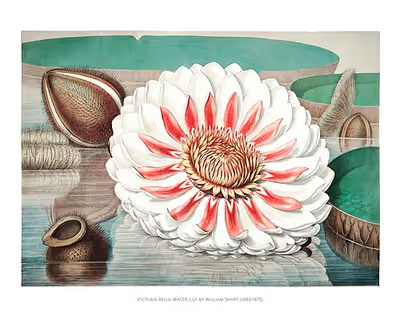
The up to 25 cm wide, nocturnal, thermogenic, solitary, actinomorphic, chasmogamous, protogynous flowers have prickly pedicels with 4 primary and 8 secondary air canals. The flowers have four prickly, petaloid, 12 cm long, and 7–8 cm wide sepals. The 50-100 petals gradually transition towards the shape of the stamens, however there is an abrupt change between the innermost petals to the outermost staminodia. The androeceum consists of 150–200 stamens. The gynoecium consists of 30–44 fused carpels. The 0–15 cm wide, spiny, irregularly dehiscencent fruit bears arillate, glabrous, smooth or granular seeds. Proliferating pseudanthia are absent.
Sign in to keep reading
4 more chapters are free with a Lably account.
Cytology
The ploidy level is 2x and the chromosome count ranges from 2n = 20 to 2n = 24.
Taxonomy
Victoria R.H.Schomb. was published by Robert Hermann Schomburgk in September 1837. The type species is Victoria regina R.H.Schomb. The genus has two synonyms, both published within the same year with the same name: Victoria Lindl. published by John Lindley in October 1837 and Victoria J. E. Gray published by John Edward Gray in December 1837. There is, however, disagreement over the correct taxon authority. Victoria R.H.Schomb. is seen as correct by several sources, but Victoria Lindl. is also widely regarded as correct, despite being published a month later.
Species
Evolutionary relationships
Together with the genus Euryale, Victoria may be placed within the genus Nymphaea, rendering it paraphyletic in its current circumscription.
Ecology
Habitat
It occurs in lakes and streams.
Pollination
Victoria flowers are pollinated by Cyclocephala beetles.
Use
Horticulture
Victoria is a popular ornamental plant.
Food
The seeds, petioles, and rhizomes are used as food.
Other uses
Root extracts are used as black dye.