

Volcanic crater lake
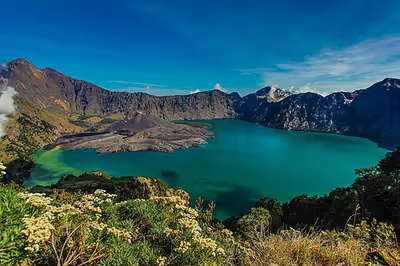
Lake formed within a volcanic crater
- 3 min read
- 5 chapters

Related on Lably
Through Precipitation, Groundwater and Evaporation
Formation
Lakes in calderas fill large craters formed by the collapse of a volcano during an eruption. Rain, snow and ice melt, and groundwater accumulate in the calderas to form crater lakes. These lakes are often cold, freshwater lakes, but may also be warm and highly acidic, due to hydrothermal nature of their origin.
Lakes in maars (low-profile volcanoes, below the level of the surrounding terrain), fill medium-sized craters where an eruption deposited debris around a vent.
Crater lakes form as the created depression, within the crater rim, is filled by water. The water may come from precipitation, groundwater circulation (often hydrothermal fluids in the case of volcanic craters) or melted ice. Its level rises until an equilibrium is reached between the rates of incoming and outgoing water. Sources of water loss singly or together may include evaporation, subsurface seepage, and, in places, surface leakage or overflow when the lake level reaches the lowest point on its rim. At such a saddle location, the upper portion of the lake is contained only by its adjacent natural volcanic dam; continued leakage through or surface outflow across the dam can erode its included material, thus lowering lake level until a new equilibrium of water flow, erosion, and rock resistance is established. If the volcanic dam portion erodes rapidly or fails catastrophically, the occurrence produces a breakout or outburst flood. With changes in environmental conditions over time, the occurrence of such floods is common to all natural dam types.
These lakes may become soda lakes, many of which are associated with active tectonic and volcanic zones.
Sign in to keep reading
4 more chapters are free with a Lably account.
Examples
A well-known crater lake, which bears the same name as the geological feature, is Crater Lake in Oregon, United States. It is located in the caldera of Mount Mazama. It is the deepest lake in the United States with a depth of 594 m (1,949 ft). Crater Lake is fed solely by falling rain and snow, with no inflow or outflow at the surface, and hence is one of the clearest lakes in the world.
Due to their unstable environments, some crater lakes exist only intermittently. Caldera lakes in contrast can be quite large and long-lasting. For instance, Lake Toba in Indonesia formed after its eruption around 75,000 years ago. At around 100 kilometres (62 mi) by 30 kilometres (19 mi) in extent and 505 metres (1,657 ft) deep at its deepest point, Lake Toba is the largest crater lake in the world.
The highest volcano in the world, 6,893-m (22,615-ft) Ojos del Salado in Chile, has a permanent crater lake about 100 m (330 ft) in diameter at an elevation of 6,390 m (20,965 ft) on its eastern side.
Around Mount Gambier in South Australia, there is a cluster of crater lakes, of which Blue Lake / Warwar is the most well known.
Dangers
While many crater lakes are picturesque, they can also be deadly. Gas discharges from Lake Nyos in Cameroon suffocated 1,800 people in 1986, and crater lakes such as Mount Ruapehu's in New Zealand often contribute to destructive lahars.
Distinction from other volcanic lakes
Certain bodies of water, although their formation is directly related to volcanic activity, are not usually referred to as crater lakes, including:
- Lakes created by volcanic dams due to lava flowing outside of the volcanic edifice/caldera, such as Garibaldi Lake in Canada, Fuji Five Lakes in Japan
- Closed atoll lagoons, such as Clipperton lagoon, whose formation process also implies subsequent biogeomorphologic processes
- Ponds encountered at the bottom of waterfalls occurring in volcanic canyons in a volcanic context, but not within a volcanic edifice/caldera (such as Trou de Fer on Réunion Island)