


Related on Lably
Through Lake, Base (chemistry) and Sodium carbonate
In spite of their apparent inhospitability, soda lakes are often highly productive ecosystems, compared to their (pH-neutral) freshwater counterparts. Gross primary production (photosynthesis) rates above 10 g C m−2 day−1 (grams of carbon per square meter per day), over 16 times the global average for lakes and streams (0.6 g C m−2 day−1), have been measured. This makes them the most productive aquatic environments on Earth. An important reason for the high productivity is the virtually unlimited availability of dissolved carbon dioxide.
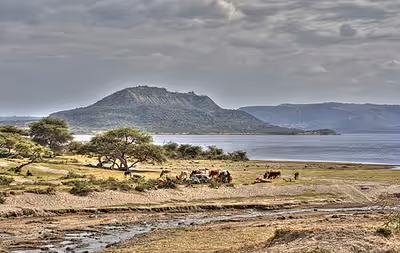
Soda lakes occur naturally throughout the world (see table below), typically in arid and semi-arid areas and in connection to tectonic rifts like the East African Rift Valley. The pH of most freshwater lakes is on the alkaline side of neutrality and many exhibit similar water chemistries to soda lakes, only less extreme.
Geology, geochemistry and genesis
In order for a lake to become alkalic, a special combination of geographical, geological and climatic conditions are required. First of all, a suitable topography is needed, that limits the outflow of water from the lake. When the outflow is completely prevented, this is called an endorheic basin. Craters or depressions formed by tectonic rifting often provide such topological depressions.
There are exceptions to the "no outlet" rule: both Lake Kivu and Lake Tanganyika have outlets but also have the characteristics of soda lakes, and Lake Tanganyika even grows microbialites.
The high alkalinity and salinity arise through evaporation of the lake water. This requires suitable climatic conditions, in order for the inflow to balance outflow through evaporation. The rate at which carbonate salts are dissolved into the lake water also depends on the surrounding geology and can in some cases lead to relatively high alkalinity even in lakes with significant outflow.
Another critical geological condition for the formation of a soda lake is the relative absence of soluble magnesium or calcium. Otherwise, dissolved magnesium (Mg2+) or calcium (Ca2+) will quickly remove the carbonate ions, through the precipitation of minerals such as calcite, magnesite or dolomite, effectively neutralizing the pH of the lake water. This results in a neutral (or slightly basic) salt lake instead. A good example is the Dead Sea, which is very rich in Mg2+. In some soda lakes, inflow of Ca2+ through subterranean seeps, can lead to localized precipitation. In Mono Lake, California and Lake Van, Turkey, such precipitation has formed columns of tufa rising above the lake surface.
Many soda lakes are strongly stratified, with a well-oxygenated upper layer (epilimnion) and an anoxic lower layer (hypolimnion), without oxygen and often high concentrations of sulfide. Stratification can be permanent, or with seasonal mixing. The depth of the oxic/anoxic interface separating the two layers varies from a few centimeters to near the bottom sediments, depending on local conditions. In either case, it represents an important barrier, both physically and between strongly contrasting biochemical conditions.
Sign in to keep reading
4 more chapters are free with a Lably account.
Biodiversity
A rich diversity of microbial life inhabit soda lakes, often in dense concentrations. This makes them unusually productive ecosystems and leads to permanent or seasonal "algae blooms" with visible colouration in many lakes. The colour varies between particular lakes, depending on their predominant life forms and can range from green to orange or red.
Compared to freshwater ecosystems, life in soda lakes is often completely dominated by prokaryotes, i.e. bacteria and archaea, particularly in those with more "extreme" conditions (higher alkalinity and salinity, or lower oxygen content). However, a rich diversity of eukaryotic algae, protists and fungi have also been encountered in many soda lakes.
Multicellular animals such as crustaceans (notably the brine shrimp Artemia and the copepod Paradiaptomus africanus) and fish (e.g. Alcolapia), are also found in many of the less extreme soda lakes, adapted to the extreme conditions of these alkalic and often saline environments. Particularly in the East African Rift Valley, microorganisms in soda lakes also provide the main food source for vast flocks of the lesser flamingo (Phoeniconaias minor). The cyanobacteria of the genus Arthrospira (formerly Spirulina) are a particularly preferred food source for these birds, owing to their large cell size and high nutritional value. Declines in East African soda lake productivity due to rising water levels threaten this food source. This may force lesser flamingos to move north and south, away from the equator.
Microbial diversity surveys and species richness
In general, the microbial biodiversity of soda lakes is relatively poorly studied. Many studies have focused on the primary producers, namely the photosynthesizing cyanobacteria or eukaryotic algae (see Carbon cycle). As studies have traditionally relied on microscopy, identification has been hindered by the fact that many soda lakes harbour poorly studied species, unique to these relatively unusual habitats and in many cases thought to be endemic, i.e. existing only in one lake. The morphology (appearance) of algae and other organisms may also vary from lake to lake, depending on local conditions, making their identification more difficult, which has probably led to several instances of taxonomic confusions in the scientific literature.
Since 2006, a number of studies have used molecular methods such as DNA fingerprinting or sequencing to study the diversity of organisms in soda lakes. These methods are based on DNA extracted directly from the environment and thus do not require microorganisms to be cultured. This is a major advantage, as culturing of novel microorganisms is a laborious technique known to seriously bias the outcome of diversity studies, since only about one in a hundred organisms can be cultured using standard techniques. For microorganisms, the phylogenetic marker gene small subunit (SSU) ribosomal RNA is typically targeted, due to its good properties such as existence in all cellular organisms and ability to be used as a "molecular clock" to trace the evolutionary history of an organism. For instance, 16S ribosomal RNA gene clone libraries revealed that the bacterial community of the lake with the highest salinity was characterized by a higher recent accelerated diversification than the community of a freshwater lake, whereas the phylogenetic diversity in the hypersaline lake was lower than that in a freshwater lake. Culture-independent surveys have revealed that the diversity of microorganisms in soda lakes is very high, with species richness (number of species present) of individual lakes often rivaling that of freshwater ecosystems.
Biogeography and uniqueness
In addition to their rich biodiversity, soda lakes often harbour many unique species, adapted to alkalic conditions and unable to live in environments with neutral pH. These are called alkaliphiles. Organisms also adapted to high salinity are called haloalkaliphiles. Culture-independent genetic surveys have shown that soda lakes contain an unusually high amount of alkaliphilic microorganisms with low genetic similarity to known species. This indicates a long evolutionary history of adaptation to these habitats with few new species from other environments becoming adapted over time.
In-depth genetic surveys also show an unusually low overlap in the microbial community present, between soda lakes with slightly different conditions such as pH and salinity. This trend is especially strong in the bottom layer (hypolimnion) of stratified lakes, probably because of the isolated character of such environments. Diversity data from soda lakes suggest the existence of many endemic microbial species, unique to individual lakes. This is a controversial finding, since conventional wisdom in microbial ecology dictates that most microbial species are cosmopolitan and dispersed globally, thanks to their enormous population sizes, a famous hypothesis first formulated by Lourens Baas Becking in 1934 ("Everything is everywhere, but the environment selects").
Ecology
Carbon cycle
Photosynthesis provides the primary energy source for life in soda lakes and this process dominates the activity at the surface. The most important photosynthesizers are typically cyanobacteria, but in many less "extreme" soda lakes, eukaryotes such as green algae (Chlorophyta) can also dominate. Major genera of cyanobacteria typically found in soda lakes include Arthrospira (formerly Spirulina) (notably A. platensis), Anabaenopsis, Cyanospira, Synechococcus or Chroococcus. In more saline soda lakes, haloalkaliphilic archaea such as Halobacteria and bacteria such as Halorhodospira dominate photosynthesis. However, it is not clear whether this is an autotrophic process or if these require organic carbon from cyanobacterial blooms, occurring during periods of heavy rainfall that dilute the surface waters.
Below the surface, anoxygenic photosynthesizers using other substances than carbon dioxide for photosynthesis also contribute to primary production in many soda lakes. These include purple sulfur bacteria such as Ectothiorhodospiraceae and purple non-sulfur bacteria such as Rhodobacteraceae (for example the species Rhodobaca bogoriensis isolated from Lake Bogoria).
The photosynthesizing bacteria provide a food source for a vast diversity of aerobic and anaerobic organotrophic microorganisms from phyla including Pseudomonadota, Bacteroidota, Spirochaetota, Bacillota, Thermotogota, Deinococcota, Planctomycetota, Actinomycetota, Gemmatimonadota, and more. The stepwise anaerobic fermentation of organic compounds originating from the primary producers, results in one-carbon (C1) compounds such as methanol and methylamine.
At the bottom of lakes (in the sediment or hypolimnion, methanogens use these compounds to derive energy, by producing methane, a procedure known as methanogenesis. A diversity of methanogens including the archaeal genera Methanocalculus, Methanolobus, Methanosaeta, Methanosalsus and Methanoculleus have been found in soda lake sediments. When the resulting methane reaches the aerobic water of a soda lake, it can be consumed by methane-oxidizing bacteria such as Methylobacter or Methylomicrobium.
Sulfur cycle
Sulfur-reducing bacteria are common in anoxic layers of soda lakes. These reduce sulfate and organic sulfur from dead cells into sulfide (S2−). Anoxic layers of soda lakes are therefore often rich in sulfide. As opposed to neutral lakes, the high pH prohibits the release of hydrogen sulfide (H2S) in gas form. Genera of alkaliphilic sulfur-reducers found in soda lakes include Desulfonatronovibrio and Desulfonatronum. These also play important an ecological role besides in the cycling of sulfur, as they also consume hydrogen, resulting from the fermentation of organic matter.
Sulfur-oxidating bacteria instead derive their energy from oxidation of the sulfide reaching the oxygenated layers of soda lakes. Some of these are photosynthetic sulfur phototrophs, which means that they also require light to derive energy. Examples of alkaliphilic sulfur-oxidizing bacteria are the genera Thioalkalivibrio, Thiorhodospira, Thioalkalimicrobium and Natronhydrogenobacter.
Nitrogen and other nutrients
Nitrogen is a limiting nutrient for growth in many soda lakes, making the internal nitrogen cycle very important for their ecological functioning. One possible source of bio-available nitrogen is diazotrophic cyanobacteria, which can fix nitrogen from the atmosphere during photosynthesis. However, many of the dominant cyanobacteria found in soda lakes such as Arthrospira are probably not able to fix nitrogen. Ammonia, a nitrogen-containing waste product from degradation of dead cells, can be lost from soda lakes through volatilization because of the high pH. This can hinder nitrification, in which ammonia is "recycled" to the bio-available form nitrate. However, ammonia oxidation seems to be efficiently carried out in soda lakes in either case, probably by ammonia-oxidizing bacteria as well as Thaumarchaea.
Climate change
Changes in the biogeochemical cycling of soda lakes occur with seasonal variation and the availability of nutrients (eutrophic status). These cycling changes, involving the increased availability of organic carbon from high photosynthetic rates (like during and after cyanobacterial blooms), can increase the productivity of methanogenic microbes (see Carbon cycle) and increase the emission of methane, a notable greenhouse gas, from soda lakes. This interaction between carbon metabolism and methane production may be a characteristic biogeochemical process in soda lakes, and makes them a significant contributor of biogenic greenhouse gas, like wetlands.
The productivity of soda lakes may decrease in response to increased rainfall due to climate change. Rising water levels disrupt their ecology and have occurred alongside a decline in phytoplankton productivity, most notably in east Africa. Conversely, increased temperatures and evaporation at other lakes, most notably in the Western hemisphere, threaten to both reduce water levels and increase their productivity through microbial blooms, resulting in the exacerbation of aforementioned greenhouse gas emissions and a reduction in biodiversity.
The ecological future of soda lakes remains uncertain as they maintain a delicate microbial ecology and are highly susceptible to anthropogenic climate change. While the long-term impacts of this continual change are yet unclear with respect to their biodiversity, as shifts in microbial fauna occur and productivity changes, the habitat availability of notable migratory species like the Lesser Flamingo in East Africa is subject to change.
List of soda lakes
The following table lists some examples of soda lakes by region, listing country, pH and salinity. NA indicates 'data not available':
Industrial use
Many water-soluble chemicals are extracted from the soda lake waters worldwide. Lithium carbonate (see Lake Zabuye), potash (see lake Lop Nur and Qinghai Salt Lake Potash), soda ash (see Lake Abijatta and Lake Natron), etc. are extracted in large quantities. Lithium carbonate is a raw material in production of lithium which has applications in lithium storage batteries widely used in modern electronic gadgets and electrically powered automobiles. Water of some soda lakes are rich in dissolved uranium carbonate. Algaculture is carried out on a commercial scale with soda lake water.