


Related on Lably
Through Herbivore and Extinction
Description
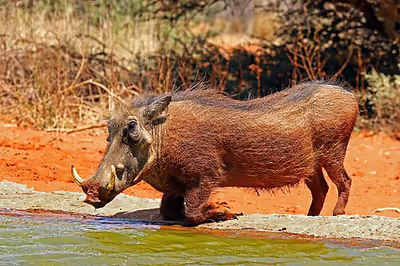
Although covered in bristly hairs, a warthog's body and head appear largely bare, from a distance, with only a crest of hair along the back and the tufts on the face and tail being obvious. The English name "wart"-hog refers to their facial wattles, which are particularly distinct in males. The males also have very prominent tusks, which reach a length of 10 to 25 inches (25 to 64 centimetres); females' tusks are always smaller. They are largely herbivorous, but, like most suids, opportunistically eat invertebrates or small animals, even scavenging on carrion. While both species remain fairly common and widespread, and considered to be of Least Concern by the IUCN, the nominate subspecies of desert warthog, commonly known as the Cape warthog (P. a. aethiopicus) was extinct by around 1865.
Sign in to keep reading
One more chapter is free with a Lably account.
Species in taxonomic order
The genus Phacochoerus contains two species. The two species emerged from ecological barriers. P. africanus were found with a lack of upper incisors, while P. aethiopicus were found with a full set.