

Winter squash
Squash harvested and eaten in mature stage; skin hardened into tough rind
- 2 min read
- 3 chapters

Related on Lably
Through Fruit, Pumpkin and Carbohydrate
Varieties
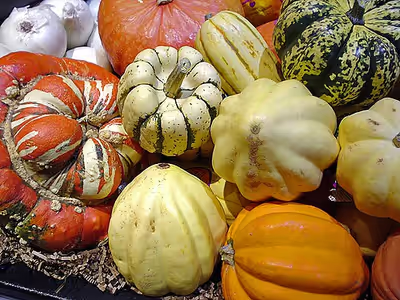
At least five species in the genus Cucurbita have been domesticated and have cultivars grown as winter squashes: C. argyrosperma, C. ficifolia, C. maxima, C. moschata, and C. pepo.
Cultivars of winter squash that are round and orange are called pumpkins. In New Zealand and Australian English, the term pumpkin generally refers to the broader category called winter squash elsewhere.
Sign in to keep reading
2 more chapters are free with a Lably account.
Planting and harvesting
Squash is a frost-tender plant meaning that the seeds do not germinate in cold soil. Winter squash seeds germinate best when the soil temperature is 21 to 35 °C (70 to 95 °F), with the warmer end of the range being optimal. It is harvested whenever the fruit has turned a deep, solid color and the skin is hard. Most winter squash is harvested in September or October in the Northern Hemisphere, before the danger of heavy frosts.
Although winter squashes are grown in many regions, they are relatively economically unimportant, with few exceptions. They are grown extensively in tropical America, Japan, Northern Italy, and certain areas of the United States. The calabazas of the West Indies and the forms grown by the people of Mexico and Central America are not uniform, pure varieties but extremely variable in size, shape, and color. Since these species are normally cross-pollinated, it is now difficult to keep a variety pure.
Nutritional value
Raw winter squash (such as acorn or butternut squash) is 90% water, 9% carbohydrates, 1% protein. It contains negligible fat (table), except in the oil-rich seeds. In a 100 gram reference amount, it supplies 34 calories and is a moderate source (10-19% of the Daily Value, DV) of vitamin C (15% DV) and vitamin B6 (12% DV), with no other micronutrients in significant content (table). It is also a source of the provitamin A carotenoid, beta-carotene.