


Related on Lably
Through Indian Ocean, Australia and Japan
The word wobbegong is thought to come from Dharug, an Australian Aboriginal language, and means shaggy beard, referring to the growths around the mouth of the shark.
Description
Wobbegongs are bottom-dwelling sharks, spending much of their time resting on the sea floor. Most species have a maximum length of 1.25 m (4.1 ft), but the largest, the spotted wobbegong, Orectolobus maculatus, and banded wobbegong, O. halei, reach about 3 m (9.8 ft) in length.
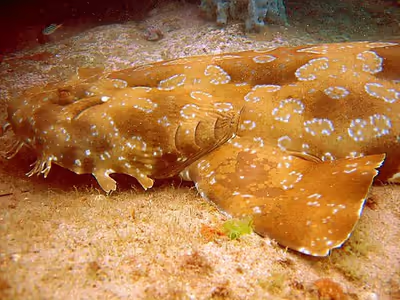
Wobbegongs are well camouflaged by a symmetrical pattern of bold markings resembling a carpet. Because of this striking pattern, wobbegongs and their close relatives are often referred to as carpet sharks.
The camouflage is improved by the presence of small, weed-like whisker lobes surrounding the wobbegong's jaw, which help to camouflage it and act as sensory barbs. Wobbegongs make use of their camouflage to hide among rocks and catch smaller fish that swim too close, typical of ambush predators. Wobbegongs also have powerful jaws with needle-like teeth to assist in catching reef fish and other sharks for food. The blood cells of several species of wobbegongs have been described.
Sign in to keep reading
3 more chapters are free with a Lably account.
Interaction with humans
Wobbegongs are generally not considered dangerous to humans but have attacked swimmers, snorkelers, and scuba-divers, who inadvertently come close to them. The Australian Shark Attack File contains more than 50 records of unprovoked attacks by wobbegongs and the International Shark Attack File has 31 records, none of them fatal. Wobbegongs have also bitten surfers. Wobbegongs are very flexible and can easily bite a hand holding their tail. They have many small but sharp teeth and their bite can be severe, even through a wetsuit; having bitten, they have been known to hang on and can be very difficult to remove.
Wobbegongs are attacked much more often by humans; in Australia, wobbegong skin is used to make leather.
Captivity
Although most wobbegong species are unsuitable for home aquaria owing to their large adult size, this has not stopped some of the smaller species from being sold in the aquarium trade. Small wobbegong species, such as the tasselled wobbegong and Ward's wobbegong, are "ideal" sharks for home aquarists to keep because they are an appropriate size and are lethargic, enabling them to be accommodated within the limited space of a home tank, although they consume tankmates, even quite large ones. Some aquarists, by contrast, see the lack of activity to be a drawback to keeping wobbegongs and prefer more active sharks. Wobbegongs are largely nocturnal, and owing to their slow metabolism, do not have to be fed as often as other sharks. Most do well on two feedings weekly. Underfed wobbegongs can be recognised by visibly atrophied dorsal musculature.
Genera and species
The 12 living species of wobbegong, in three genera, are:
- Genus Eucrossorhinus Regan, 1908
- Eucrossorhinus dasypogon (Bleeker, 1867) (tasselled wobbegong)
- Genus Orectolobus Bonaparte, 1834
- Orectolobus floridus Last & Chidlow, 2008 (floral banded wobbegong)
- Orectolobus halei Whitley, 1940. (Gulf wobbegong or banded wobbegong)
- Orectolobus hutchinsi Last, Chidlow, & Compagno, 2006. (western wobbegong)
- Orectolobus japonicus Regan, 1906 (Japanese wobbegong)
- Orectolobus leptolineatus Last, Pogonoski & W. T. White, 2010 (Indonesian wobbegong)
- Orectolobus maculatus (Bonnaterre, 1788) (spotted wobbegong)
- Orectolobus ornatus (De Vis, 1883) (ornate wobbegong)
- Orectolobus parvimaculatus Last & Chidlow, 2008 (dwarf spotted wobbegong)
- Orectolobus reticulatus Last, Pogonoski, & W. T. White, 2008 (network wobbegong)
- Orectolobus wardi Whitley, 1939 (northern wobbegong)
- Genus Sutorectus Whitley, 1939
- Sutorectus tentaculatus (W. K. H. Peters, 1864) (cobbler wobbegong)
Fossil genera include:
- Cretorectolobus Case, 1978
- Eometlaouia Noubhani & Cappetta, 2002
- Orectoloboides Cappetta, 1977