


Related on Lably
Characteristics
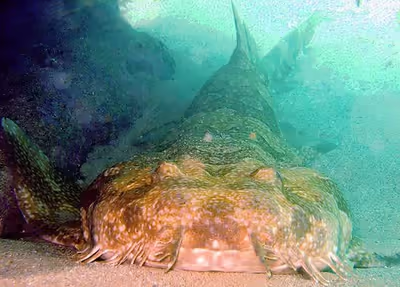
The carpet sharks are a diverse group of sharks with differing sizes, appearances, diets, and habits. They first appeared in the fossil record in the Early Jurassic; the oldest known orectolobiform genera are Folipistrix (known from Toarcian to Aalenian of Belgium and Germany), Palaeobrachaelurus (Aalenian to Barremian) and Annea (Toarcian to Bajocian of Europe). All species have two dorsal fins and a relatively short, transverse mouth that does not extend behind the eyes. Besides the nostrils are barbels, tactile sensory organs, and grooves known as nasoral grooves connect the nostrils to the mouth. Five short gill slits are just in front of the origin of the pectoral fin and the fifth slit tends to overlap the fourth one. A spiracle occurs beneath each eye which is used in respiration. The only exception to this rule is the whale shark, the spiracles of which are situated just behind the eyes. Carpet sharks derive their common name from the fact that many species have a mottled appearance with intricate patterns reminiscent of carpet designs. The patterning provides camouflage when the fish is lying on the seabed. The largest carpet shark is the whale shark (Rhincodon typus) which can grow to a length of 14 m (46 ft) to 18.8 metres (62 ft). It is the largest species of fish, but despite its size, is not dangerous, as it is a filter feeder, drawing in water through its wide mouth and sifting out the plankton. The smallest carpet shark, at up to about 30 cm (12 in) long, is the barbelthroat carpet shark, (Cirrhoscyllium expolitum). Some of the most spectacularly coloured members of the order are the necklace carpet shark (Parascyllium variolatum), the zebra shark (Stegostoma fasciatum), the Epaulette shark (Hemiscyllium ocellatum), and the ornate wobbegong (Orectolobus ornatus). Nurse sharks and whale sharks have a fringe of barbels on their snouts, and barbelthroat carpet sharks (Cirrhoscyllium expolitum) have barbels dangling from their throat regions.
Sign in to keep reading
3 more chapters are free with a Lably account.
Behaviour
Most carpet sharks feed on the seabed in shallow to medium-depth waters, detecting and picking up molluscs, crustaceans, and other small creatures. The wobbegongs tend to be ambush predators, lying hidden on the seabed until prey approaches. One has been observed swallowing a bamboo shark whole.
The methods of reproduction of carpet sharks vary. Some species are oviparous and lay eggs which may be liberated directly into the water or may be enclosed in horny egg cases. Some female sharks have been observed to push egg cases into crevices and this would be an added protection for the developing embryos. Other species are ovoviviparous and the fertilised eggs are retained in the mother's oviduct. There, the developing embryos, which are usually few in number, feed on their yolk sacs at first and later hatch out and feed on nutrients secreted by the walls of the oviduct. The young are born in an advanced state, ready to live independent lives.
Distribution
Carpet sharks are found in all the oceans of the world but predominantly in tropical and temperate waters. They are most common in the western Indo-Pacific region and are usually found in relatively deep water.
Classification
The order is small, with seven families in 13 genera and with a total of around 43 species:
Extant species
Order Orectolobiformes
- Family Brachaeluridae Applegate (blind sharks)
- Genus Brachaelurus Ogilby, 1908
- Brachaelurus colcloughi (Ogilby, 1908) (bluegrey carpetshark)
- Brachaelurus waddi (Bloch & J. G. Schneider, 1801) (blind shark)
- Genus Brachaelurus Ogilby, 1908
- Family Ginglymostomatidae Gill, 1862 (nurse sharks)
- Genus Ginglymostoma J. P. Müller & Henle, 1837
- Ginglymostoma cirratum Bonnaterre, 1788 (nurse shark)
- Ginglymostoma unami Del-Moral-Flores, Ramírez-Antonio, Angulo & Pérez-Ponce de León, 2015
- Genus Nebrius Rüppell, 1837
- Nebrius ferrugineus (Lesson, 1831) (tawny nurse shark)
- Genus Pseudoginglymostoma Dingerkus, 1986
- Pseudoginglymostoma brevicaudatum (Günther, 1867) (short-tail nurse shark)
- Genus Ginglymostoma J. P. Müller & Henle, 1837
- Family Hemiscylliidae Gill, 1862 (bamboo sharks)
- Genus Chiloscyllium J. P. Müller & Henle, 1837
- Chiloscyllium arabicum Gubanov, 1980 (Arabian carpetshark)
- Chiloscyllium burmensis Dingerkus & DeFino, 1983 (Burmese bamboo shark)
- Chiloscyllium griseum J. P. Müller & Henle, 1838 (grey bamboo shark)
- Chiloscyllium hasselti Bleeker, 1852 (Hasselt's bamboo shark)
- Chiloscyllium indicum (J. F. Gmelin, 1789) (slender bamboo shark)
- Chiloscyllium plagiosum (Anonymous, referred to Bennett, 1830) (white-spotted bamboo shark)
- Chiloscyllium punctatum J. P. Müller & Henle, 1838 (brownbanded bamboo shark)
- Genus Hemiscyllium J. P. Müller & Henle, 1837
- Hemiscyllium freycineti (Quoy & Gaimard, 1824) (Indonesian speckled carpetshark)
- Hemiscyllium galei G. R. Allen & Erdmann, 2008 (Cenderwasih epaulette shark)
- Hemiscyllium hallstromi Whitley, 1967 (Papuan epaulette shark)
- Hemiscyllium halmahera G. R. Allen, Erdmann & Dudgeon, 2013 (Halmahera epaulette shark)
- Hemiscyllium henryi G. R. Allen & Erdmann, 2008 (Henry's epaulette shark)
- Hemiscyllium michaeli G. R. Allen & Dudgeon, 2010 (Milne Bay epaulette shark)
- Hemiscyllium ocellatum (Bonnaterre, 1788) (epaulette shark)
- Hemiscyllium strahani Whitley, 1967 (hooded carpetshark)
- Hemiscyllium trispeculare J. Richardson, 1843 (speckled carpetshark)
- Genus Chiloscyllium J. P. Müller & Henle, 1837
- Family Orectolobidae Gill, 1896 (wobbegong sharks)
- Genus Eucrossorhinus Regan, 1908
- Eucrossorhinus dasypogon (Bleeker, 1867) (tasselled wobbegong)
- Genus Orectolobus Bonaparte, 1834
- Orectolobus floridus Last & Chidlow, 2008 (floral banded wobbegong)
- Orectolobus halei Whitley, 1940.
- Orectolobus hutchinsi Last, Chidlow & Compagno, 2006. (western wobbegong)
- Orectolobus japonicus Regan, 1906 (Japanese wobbegong)
- Orectolobus leptolineatus Last, Pogonoski & W. T. White, 2010 (Indonesian wobbegong)
- Orectolobus maculatus (Bonnaterre, 1788) (spotted wobbegong)
- Orectolobus ornatus (De Vis, 1883) (ornate wobbegong)
- Orectolobus parvimaculatus Last & Chidlow, 2008 (dwarf spotted wobbegong)
- Orectolobus reticulatus Last, Pogonoski & W. T. White, 2008 (network wobbegong)
- Orectolobus wardi Whitley, 1939 (northern wobbegong)
- Genus Sutorectus Whitley, 1939
- Sutorectus tentaculatus (W. K. H. Peters, 1864) (cobbler wobbegong)
- Genus Eucrossorhinus Regan, 1908
- Family Parascylliidae Gill, 1862 (collared carpet sharks)
- Genus Cirrhoscyllium H. M. Smith & Radcliffe, 1913
- Cirrhoscyllium expolitum H. M. Smith & Radcliffe, 1913 (barbelthroat carpetshark)
- Cirrhoscyllium formosanum Teng, 1959 (Taiwan saddled carpetshark)
- Cirrhoscyllium japonicum Kamohara, 1943 (saddle carpetshark)
- Genus Parascyllium Gill, 1862
- Parascyllium collare E. P. Ramsay & Ogilby, 1888 (collared carpetshark)
- Parascyllium elongatum Last & Stevens, 2008 (elongate carpetshark)
- Parascyllium ferrugineum McCulloch, 1911 (rusty carpetshark)
- Parascyllium sparsimaculatum T. Goto & Last, 2002 (ginger carpetshark)
- Parascyllium variolatum (A. H. A. Duméril, 1853) (necklace carpetshark)
- Genus Cirrhoscyllium H. M. Smith & Radcliffe, 1913
- Family Rhincodontidae (J. P. Müller & Henle, 1839) (whale sharks)
- Genus Rhincodon A. Smith, 1828
- Rhincodon typus A. Smith, 1828 (whale shark)
- Genus Rhincodon A. Smith, 1828
- Family Stegostomatidae Gill, 1862 (zebra sharks)
- Genus Stegostoma J. P. Müller & Henle, 1837
- Stegostoma fasciatum (Hermann, 1783) (zebra shark)
- Genus Stegostoma J. P. Müller & Henle, 1837
Fossil genera
The following fossil genera are recognized:
- Order Orectolobiformes
- Genus †Akaimia Rees, 2010
- Genus †Annea Thies, 1982
- Genus †Dorsetoscyllium Underwood & Ward, 2004
- Genus †Galagadon Gates, Gorscak & Makovicky, 2019
- Genus †Heterophorcynus Underwood & Ward, 2004
- Genus †Folipistrix Kriwet, 2003
- Genus †Palaeorectolobus Kriwet, 2008
- Genus †Parasquatina Herman, 1982
- Genus †Phorcynis Thiollière, 1854
- Genus †Similiteroscyllium Fuchs, Engelbrecht, Lukeneder & Kriwet, 2017
- Family Brachaeluridae
- Genus †Eostegostoma Herman & Crochard, 1977
- Genus †Garrigascyllium Guinot et al., 2014
- Genus †Magistrauia Guinot, Cappetta & Adnet, 2014
- Genus †Palaeobrachaelurus Thies, 1983
- Genus †Paraginglymostoma Thies, 1982
- Genus †Parahemiscyllium Guinot, Cappetta & Adnet, 2014
- Family Ginglymostomatidae
- Genus †Cantioscyllium Woodward, 1889
- Genus †Delpitoscyllium Noubhani & Cappetta, 1997
- Genus †Ganntouria Noubhani & Cappetta, 1997
- Genus †Hologinglymostoma Noubhani & Cappetta, 1997
- Genus †Plicatoscyllium Case & Cappetta, 1997
- Genus †Protoginglymostoma Herman & Crochard, 1977
- Family Hemiscyllidae
- Genus †Acanthoscyllium (Pictet & Humbert, 1966)
- Genus †Adnetoscyllium Guinot, Underwood, Cappetta & Ward, 2013
- Genus †Almascyllium Cappetta, 1980
- Genus †Notaramphoscyllium Engelbrecht, Mörs, Reguero & Kriwet, 2017
- Genus †Pseudospinax Müller & Diedrich, 1991
- Family †Mesiteiidae Pfeil, 2021
- Genus †Mesiteia Gorjanovic-Kramberger, 1885
- Family Orectolobidae
- Genus †Cederstroemia Siverson, 1995
- Genus †Coelometlaouia Engelbrecht, Mörs, Reguero & Kriwet, 2017
- Genus †Cretorectolobus Case, 1978
- Genus †Eometlaouia Noubhani & Cappetta, 2002
- Genus †Gryphodobatis Leidy, 1877
- Genus †Orectoloboides Cappetta, 1977
- Genus †Restesia Cook et al., 2014
- Genus †Squatiscyllium Cappetta, 1980
- Family Parascyllidae
- Genus †Pararhincodon Herman in Cappetta, 1976
- Family Rhincodontidae
- Genus †Palaeorhincodon Herman, 1974