

Yukon River
Major watercourse in northwestern North America
- 10 min read
- 9 chapters

Related on Lably
Through Pollution, Tribe (Native American) and Contraction (grammar)
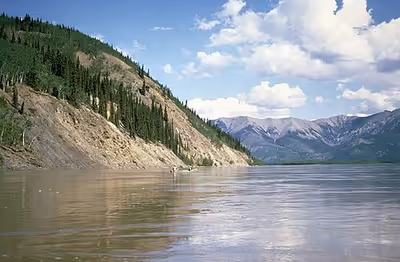
The longest river in Alaska and Yukon, it was one of the principal means of transportation during the 1896–1903 Klondike Gold Rush. A portion of the river in Yukon—"The Thirty Mile" section, from Lake Laberge to the Teslin River—is a national heritage river and a unit of Klondike Gold Rush International Historical Park. Paddle-wheel riverboats continued to ply the river until the 1950s, when the Klondike Highway was completed. After the purchase of Alaska by the United States in 1867, the Alaska Commercial Company acquired the assets of the Russian-American Company and constructed several posts at various locations on the Yukon River.
The Yukon River has a recent history of pollution from military installations, dumps, wastewater, and other sources. However, the Environmental Protection Agency does not list the Yukon River among its impaired watersheds, and water-quality data from the U.S. Geological Survey shows relatively good levels of turbidity, metals, and dissolved oxygen. The Yukon and Mackenzie rivers have much higher suspended sediment concentrations than major Siberian Arctic rivers.
The Yukon River Inter-Tribal Watershed Council, a cooperative effort of 70 First Nations and tribes in Alaska and Canada, has the goal of making the river and its tributaries safe to drink from again by supplementing and scrutinizing government data.
Name
The name Yukon, or ųųg han, is a contraction of the words in the phrase Gwichʼin: chųų gąįį han, which means white water river and refers to "the pale colour" of glacial runoff in the Yukon River. The contraction is Ųųg Han, if the /ųų/ remains nasalized, or Yuk Han, if there is no vowel nasalization. In the 1840s, the various Dene nations had differing opinions as to the literal meaning of Yukon. In 1843, the Holikachuks had told the Russian-American Company that their name for the river was Yukkhana and that this name meant big river. However, Yukkhana does not literally correspond to a Holikachuk phrase that means big river. Then, two years later, the Gwich'ins told the Hudson's Bay Company that their name for the river was Yukon and that the name meant white water river. White water river in fact corresponds to Gwich'in words that can be shortened to form Yukon. Because the Holikachuks had been trading regularly with both the Gwich’ins and the Yup'iks, the Holikachuks were in a position to borrow the Gwich'in contraction and to conflate its meaning with the meaning of Kuig-pak [River-big], which is the Yup'ik name for the same river. For that reason, the documentary evidence suggests that the Holikachuks had borrowed the contraction Ųųg Han [White Water River] from Gwich'in, and erroneously assumed that this contraction had the same literal meaning as the corresponding Yup'ik name Kuig-pak [River-big].
The Lewes River is the former name of the upper course of the Yukon, from Marsh Lake to the confluence of the Pelly River at Fort Selkirk.
Sign in to keep reading
8 more chapters are free with a Lably account.
Course
While geologists, geographers, hydrologists, and ecologists agree that the headwaters of the Yukon River are located within the northern reaches of the glaciated Coast Mountain range in British Columbia, its exact source remains the subject of some debate. According to the United States Geographic Survey, the generally accepted source of the Yukon River is the Llewellyn Glacier at the southern end of Atlin Lake in British Columbia. Others suggest that the source is Lake Lindeman at the northern end of the Chilkoot Trail. Either way, Atlin Lake flows into Tagish Lake (via the Atlin River), as eventually does Lake Lindeman after flowing into Bennett Lake. Tagish Lake then flows into Marsh Lake (via the Tagish River). The Yukon River proper starts at the northern end of Marsh Lake, just south of Whitehorse.
Some argue that the source of the Yukon River should really be Teslin Lake and the Teslin River, which has a larger flow when it reaches the Yukon at Hootalinqua. The upper end of the Yukon River was originally known as the Lewes River until it was established that it actually was the Yukon. North of Whitehorse, the Yukon River widens into Lake Laberge, made famous by Robert W. Service's "The Cremation of Sam McGee". Other large lakes that are part of the Yukon River system include Kusawa Lake (into the Takhini River) and Kluane Lake (into the Kluane and then White River).
The river passes through the communities of Whitehorse, Carmacks, (just before the Five Finger Rapids) and Dawson City in Yukon, and crossing Alaska into Eagle, Circle, Fort Yukon, Stevens Village, Rampart, Tanana, Ruby, Galena, Nulato, Grayling, Holy Cross, Russian Mission, Marshall, Pilot Station, St. Marys (which is accessible from the Yukon at Pitkas Point), and Mountain Village. After Mountain Village, the main Yukon channel frays into many channels, sprawling across the delta. There are a number of communities after the "head of passes," as the channel division is called locally: Nunum Iqua, Alakanuk, Emmonak, and Kotlik. Of those delta communities, Emmonak is the largest with roughly 760 people in the 2000 census. Emmonak's gravel airstrip is the regional hub for flights.
Hazards
Navigational obstacles on the Yukon River are the Five Finger Rapids and Rink Rapids downstream from Carmacks.
Bridges
Despite its length, there are only four vehicle-carrying bridges across the river, listed from upstream to downstream:
- The Lewes Bridge, north of Marsh Lake, Yukon, on the Alaska Highway;
- The Robert Campbell Bridge, which connects the Whitehorse suburb of Riverdale to the downtown area;
- The Yukon River Bridge in Carmacks, Yukon, on the Klondike Highway; and
- The Yukon River Bridge, north of Fairbanks, Alaska on the Dalton Highway.
A car ferry crosses the river at Dawson City in the summer; it is replaced by an ice bridge over the frozen river during the winter. Plans to build a permanent bridge were announced in March 2004, although they were subsequently put on hold because bids came in much higher than budgeted.
There are also two pedestrian-only bridges in Whitehorse, as well as a dam across the river and a hydroelectric generating station. The construction of the dam flooded the White Horse Rapids, which gave the city its name, and created Schwatka Lake.
Transportation is also performed along the river in summer by barge, enabling heavy goods, oil, and vehicles to be transported to communities along the Yukon, Tanana, Innoko, and Koyukuk rivers. This service is performed by Ruby Marine and reaches Tanana on the Yukon River and Nenana on the Tanana River.
Ecology
Some of the upper slopes of this watershed (e.g. Nulato Hills) are forested by Black Spruce. This locale near the Seward Peninsula represents the near westernmost limit of the Black Spruce, Picea mariana, one of the most widespread conifers in northern North America.
The river flows into several parklands and refuges including:
- Innoko National Wildlife Refuge
- Nowitna National Wildlife Refuge
- Yukon-Charley Rivers National Preserve
- Yukon Delta National Wildlife Refuge
- Yukon Flats National Wildlife Refuge
Discharge
Yukon at Pilot Station (121 miles upstream of mouth) minimum, average and maximum discharge:
Fisheries
The Yukon River is home to one of the longest salmon runs in the world. Each year Chinook, coho, and chum salmon return to their terminal streams in Alaska, the Yukon Territory, and British Columbia. As salmon do not eat during their spawning migration, Yukon River salmon must have great reserves of fat and energy to fuel their thousands-mile-long journey. The Chinook, which arrive at the mouth of the Yukon River in early June, have the longest journey – as many as 2,000 miles against the current, with an estimated 35–50% bound for Canada. As a result, Chinook salmon are noted for their especially rich and fatty meat and are the priciest of all Pacific salmon species.
The villages along the Yukon have historically relied on and continue to rely on salmon for their cultural, subsistence, and commercial needs. Salmon are traditionally dried, smoked, and frozen for both human and sled dog consumption. Common methods of fishing on the Yukon include set gillnets, drift nets, dip nets, and fish wheels. The preference of certain gear is largely dependent on the river's varied characteristics in different areas. Some parts of the river do not have eddies to make set-nets successful, whereas in other places the tributaries are small enough to make drifting impractical.
Over the last 20 years salmon recruitment, the number of returning adults, has taken several shocks. The late 1980s, 1990s, and 2000s have been marked by radically reduced runs for various salmon species. In the summer of 2023, the U.S. Fish and Wildlife Service counted 58,500 Chinook salmon, the second lowest season on record. The United States Department of Commerce issued a Federal Disaster Declaration for the 2008 and 2009 Commercial Chinook Yukon River fisheries, calling for the complete closure of commercial fishing along with restrictions on subsistence fishing. The root cause of these poor returns remains debated, with questions about the effects of climate change on ocean food-supply & disease prevalence in returning adults, the methods of fishing used on the river, and the effects of the Bering Sea Pollock trawl fleet on food supply and salmon bycatch. In 2010, the Alaska Department of Fish & Game's Board of Fisheries issued the first-ever restriction for net mesh size on the Yukon, reducing it to 7.5 inches (190 mm). In 2021, the Alaska Department of Fish & Game's Division of Commercial Fisheries banned all fishing of Chinook and chum salmon, including for subsistence.
Various organizations are involved to protect healthy salmon runs into the future. The Yukon River Drainage Fisheries Association was formed in 1990 by a consensus of fishers representing the entire drainage in response to recent disaster years. Its organizational goals include giving voice to the village fishers that have traditionally managed these resources, enabling communication between fishers and fishery managers, and helping to preserve the ecological integrity of salmon runs and local cultures' Traditional Ecological Knowledge
In March 2001, the U.S. & Canadian governments passed the Yukon River Salmon Agreement to better manage an internationally shared resource and ensure that more Canadian-originated salmon return across the border. The agreement is implemented through the Yukon River Panel, an international body of 12 members, equal-parts American and Canadian, that advises managers of Yukon River fisheries concerning restoration, conservation, and coordinated management.
Tribal organizations such as the Association of Village Council Presidents (AVCP), Council of Athabascan Tribal Governments (CATG), and Tanana Chiefs Conference (TCC) work to sustain Yukon River salmon to promote healthy people, cultures, and communities.
Tributaries
Yukon Territory
- Takhini River
- Big Salmon River
- Little Salmon River (Yukon)
- Nordenskiold River
- Teslin River
- Pelly River
- Macmillan River
- Stewart River
- Nadaleen River
- Lansing River
- Hess River
- Mayo River
- McQuesten River
- White River
- Donjek River
- Kluane River
- Nisling River
- Beaver Creek
- Donjek River
- Sixtymile River
- Indian River
- Klondike River
- Fortymile River
Alaska
- Tatonduk River
- Seventymile River
- Nation River
- Fourth of July Creek
- Kandik River
- Charley River
- Porcupine River
- (tributaries in the Yukon)
- Miner tributaries
- Fishing Branch
- Bell River
- Eagle River
- Rock River (Yukon)
- Driftwood River (Yukon)
- Old Crow River
- Bluefish River
- (tributaries in Alaska)
- Coleen River
- Black River
- Wood River
- Bear Mountain Creek
- Mountain Creek
- Chandalar Creek
- Sheenjek River
- Sheenjek River East Fork
- Koness River
- Eskimo Creek
- Christian River
- Chandalar River
- East Fork Chandalar River
- Junjik River
- Wind River
- Middle Fork Chandalar River
- North Fork Chandalar River
- West Fork Chandalar River
- Marten Creek
- East Fork Chandalar River
- Birch Creek
- Hadweenzic River
- Beaver Creek
- Hodzana River
- Dall River
- Ray River
- Big Salt River
- Hess Creek
- Garnet Creek
- Fish Creek
- Texas Creek
- Coal Creek
- Tanana River
- Nabesna River
- Chisana River
- Tetlin River
- Goodpaster River
- Delta River
- Salcha River
- Chena River
- Wood River
- Nenana River
- Tolovana River
- Kantishna River
- NC Creek
- Tozitna River
- Bluebell Creek
- Dagislakhna Creek
- Banddana Creek
- Blind River
- Bering Creek
- Nowitna River
- Sulatna River
- Big Creek
- Beaver Creek
- Glacier Creek
- Melozitna River
- Black Sand Creek
- Little Melozitna River
- Ruby Slough
- Yuki River
- East Fork Yuki River
- Kala Creek
- Kelly Creek
- Galena Creek
- Bishop Creek
- Koyukuk River
- Workyard Creek
- Gisasa River
- Kateel River
- Dulbi River
- Huslia River
- Nulitna River
- Tom Cook Slough
- Billy Hawk Creek
- Cutoff Slough
- Hogatza River
- Clear Creek
- Batza River
- Matthews Slough
- Little Indian River
- Indian River
- Calamity Creek
- Pocahontas Creek
- Kanuti River
- Discovery Creek
- Alatna River
- Siruk Creek
- South Fork Koyokouk River
- Jim River
- Jane Creek
- John River
- North Fork Koyukuk River
- Nulato River
- Khotol River
- Anvik River
- Bonasila River
- Stuyahok River
- Innoko River
- Paimiut Slough
- Reindeer River
- Iditarod River
- Yetna River
- First Chance Creek
- Mud River
- Dishna River
- Coffee Creek
- Tolstoi Creek
- Madison Creek
- Mastodon Creek
- Hurst Creek
- Taft Creek
- Finland Creek
- Scandinavian Creek
- North Fork Innoko River
- Tango Creek
- West Fork North Fork Innoko River
- Colorado Creek
- Paimiut Slough
- Kako Creek
- Engineer Creek
- Reindeer River
- Atchuelinguk River
- Andreafsky River
- Kashunuk River (distributary)
List of major tributaries
The main river and tributaries are (sorted in order from the mouth heading upstream):
*Period: 1971–2000
In media
The Yukon River features as the setting for the 2015 National Geographic Channel series Yukon River Run.