


Related on Lably
Through Animal, Chordate and Extinction
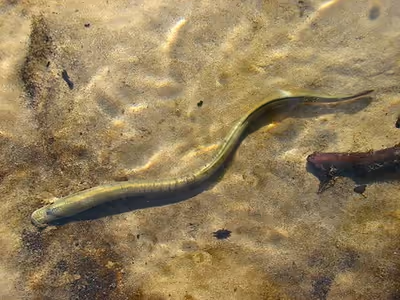
Molecular data, both from rRNA and from mtDNA as well as embryological data, strongly supports the hypothesis that both groups of living agnathans, hagfishes and lampreys, are more closely related to each other than to jawed fish, forming the superclass Cyclostomi.
The oldest fossil agnathans appeared in the Cambrian, with jawless fish, particularly "ostracoderms" reaching an apex of diversity during the Early Devonian, though they subsequently declined, with all non-cyclostome jawless fish having become extinct by the end of the Devonian. Living jawless fish comprise about 120 species in total. Hagfish are considered members of the subphylum Vertebrata, because they secondarily lost vertebrae; before this event was inferred from molecular and developmental data, the Craniata hypothesis was accepted (and is still sometimes used as a strictly morphological descriptor) to reference hagfish plus vertebrates.
Metabolism
Agnathans are ectothermic, meaning they do not regulate their own body temperature. They have no distinct stomach, but rather a long gut, more or less homogeneous throughout its length. Lampreys feed on carrion, as well as other fish and marine mammals, although some species are non-carnivorous. Anticoagulant fluids preventing blood clotting are injected into the host, causing the host to yield more blood. Hagfish are scavengers, eating mostly dead animals, although they have also been observed hunting. They use a row of sharp teeth to break down the animal. Because agnathan teeth are unable to move up and down, their possible food types are limited. Hagfish have been observed to have a prodigious appetite and can consume up to 20% of their own body weight in a single meal.
Sign in to keep reading
5 more chapters are free with a Lably account.
Morphology
In addition to the absence of jaws, modern agnathans are characterised by absence of paired fins; the presence of a notochord both in larvae and adults; and seven or more paired gill pouches. Lampreys have a light-sensitive pineal eye (homologous to the pineal gland in mammals). All living and most extinct Agnatha do not have an identifiable stomach or paired appendages. Fertilization and development are both external. There is no parental care in the Agnatha class. The Agnatha are ectothermic or cold-blooded, with a cartilaginous skeleton, and the heart contains 2 chambers.
Body covering
In modern agnathans, the body is covered in skin, with neither dermal or epidermal scales. The skin of hagfish has copious slime glands, the slime constituting their defense mechanism. The slime can sometimes clog up enemy fishes' gills, causing them to die. In direct contrast, many extinct agnathans sported extensive exoskeletons composed of either massive, heavy dermal armour or small mineralized scales.
Appendages
Almost all agnathans, including all extant agnathans, have no paired appendages, although most do have a dorsal or a caudal fin. Some fossil agnathans, such as osteostracans and pituriaspids, did have paired fins, a trait inherited in their jawed descendants.
Reproduction
Fertilization in lampreys is external. Mode of fertilization in hagfishes is not known. Development in both groups probably is external. There is no known parental care. Not much is known about the hagfish reproductive process. It is believed that hagfish only have 30 eggs over a lifetime. There is very little of the larval stage that characterizes the lamprey. Lamprey are only able to reproduce once. Lampreys reproduce in freshwater riverbeds, working in pairs to build a nest and burying their eggs about an inch beneath the sediment. The resulting hatchlings go through four years of larval development before becoming adults.
Evolution
Although a minor element of modern marine fauna, agnathans were prominent among the early fish in the early Paleozoic. Two types of Early Cambrian animal apparently having fins, vertebrate musculature, and gills are known from the early Cambrian Maotianshan shales of China: Haikouichthys and Myllokunmingia. They have been tentatively assigned to Agnatha by Janvier. A third possible agnathan from the same region is Haikouella. A possible agnathan that has not been formally described was reported by Simonetti from the Middle Cambrian Burgess Shale of British Columbia. Conodonts, a class of agnathans which arose in the early Cambrian, remained common enough until their extinction in the Triassic that their teeth (the only parts of them that were usually fossilized) are often used as index fossils from the late Cambrian to the Triassic.
Many Ordovician, Silurian, and Devonian agnathans were armored with heavy bony-spiky plates. The first armored agnathans—the ostracoderms, precursors to the bony fish and hence to the tetrapods (including humans)—are known from the middle Ordovician, and by the Late Silurian the agnathans had reached the high point of their evolution. Most of the ostracoderms, such as thelodonts, osteostracans, and galeaspids, were more closely related to the gnathostomes than to the surviving agnathans, known as cyclostomes. Cyclostomes apparently split from other agnathans before the evolution of dentine and bone, which are present in many fossil agnathans, including conodonts. Agnathans declined in the Devonian and never recovered.
Approximately 500 million years ago, two types of recombinatorial adaptive immune systems (AISs) arose in vertebrates. The jawed vertebrates diversify their repertoire of immunoglobulin domain-based T and B cell antigen receptors mainly through the rearrangement of V(D)J gene segments and somatic hypermutation, but none of the fundamental AIS recognition elements in jawed vertebrates have been found in jawless vertebrates. Instead, the AIS of jawless vertebrates is based on variable lymphocyte receptors (VLRs) that are generated through recombinatorial usage of a large panel of highly diverse leucine-rich repeat (LRR) sequences. Three VLR genes (VLRA, VLRB, and VLRC) have been identified in lampreys and hagfish, and are expressed on three distinct lymphocytes lineages. VLRA+ cells and VLRC+ cells are T-cell-like and develop in a thymus-like lympho-epithelial structure, termed thymoids. VLRB+ cells are B-cell-like, develop in hematopoietic organs, and differentiate into "VLRB antibody"-secreting plasma cells.
Classification
Phylogeny
Phylogeny based on the work of Mikko Haaramo and Delsuc et al.
Agnatha can not be consolidated into a coherent grouping without either removing any non-Cyclostomata, or by including all Vertebrata thus rendering it into a junior synonym of Vertebrata.
In 2023, Reeves and colleagues conducted a phylogenetic analyses on the placement of Lasanius based on the character dataset from Miyashita et al. (2019). They recovered a maximum consensus parsimony tree here simplified, with taxa traditionally referred to Agnatha marked by the coloured bracket: