

Bandage
Material used to support a medical dressing or injured body part
- 2 min read
- 2 chapters

Related on Lably
Through Muscle contraction and 3D printing
History
Sign in to keep reading
One more chapter is free with a Lably account.
Types
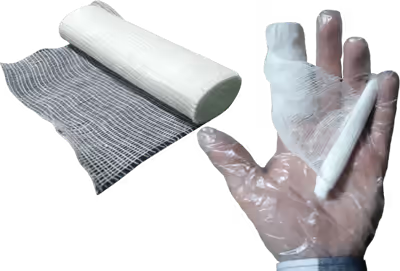
Gauze / Roller bandage
The most common type of bandage is the gauze bandage, a woven strip of material. A gauze bandage can come in any number of widths and lengths and can be used for almost any bandage application, including holding a dressing in place.
Adhesive bandage
Liquid bandage
Compression bandage
Compression bandages, or elastic bandages, refers to a wide variety of bandages with many different applications such as with kinesio tape used in sports medicine.
- Short stretch compression bandages are applied to a limb (usually for treatment of lymphedema or venous ulcers). This type of bandage is capable of shortening around the limb after application and is therefore not exerting ever-increasing pressure during inactivity. This dynamic is called resting pressure and is considered safe and comfortable for long-term treatment. Conversely, the stability of the bandage creates a very high resistance to stretch when pressure is applied through internal muscle contraction and joint movement. This force is called working pressure.
- Long stretch compression bandages have long stretch properties, meaning that their high compressive power can be easily adjusted. However, they also have a very high resting pressure and must be removed at night or if the patient is in a resting position.
Triangular bandage
Also known as a cravat bandage, a triangular bandage is a piece of cloth put into a right-angled triangle, and often provided with safety pins to secure it in place. It can be used fully unrolled as a sling, folded as a normal bandage, or for specialized applications, such as on the head. The Scouting movement popularized the use of this bandage in many of their first aid lessons, as a part of the uniform is a neckerchief which can easily be folded to form a cravat.
Kirigami bandage
A new type of bandage was invented in 2016; inspired by the art of kirigami, it uses parallel slits to better fit areas of the body that bend. The bandages have been produced with 3D-printed molds.