

Battle of Tsushima
1905 naval battle of the Russo-Japanese War
- 47 min read
- 7 chapters

Explore on Lably
ToursExplore Lably’s 3D toursThe battle involved the Japanese Combined Fleet under Admiral Tōgō Heihachirō and the Russian Second Pacific Squadron under Admiral Zinovy Rozhestvensky, which had sailed over seven months and 18,000 nautical miles (33,000 km) from the Baltic Sea. The Russians hoped to reach Vladivostok and establish naval control of the Far East to relieve the Imperial Russian Army in Manchuria. The Russian fleet had a large advantage in the number of battleships, but was overall older and slower than the Japanese fleet, and was outnumbered nearly three to one in total hulls. The Russians were sighted in the early morning on 27 May, and the battle began in the afternoon. Rozhestvensky was wounded and knocked unconscious in the initial action, and four of his battleships were sunk by sunset. At night, Japanese destroyers and torpedo boats attacked the remaining ships, and Admiral Nikolai Nebogatov surrendered in the morning of 28 May.
All 11 Russian battleships were lost, of which seven were sunk and four captured. Only a few warships escaped, with one cruiser and two destroyers reaching Vladivostok, and two auxiliary cruisers as well as one transport escaping back to Madagascar. Three cruisers were interned at Manila by the United States until the war was over. Eight auxiliaries and one destroyer were disarmed and remanded at Shanghai by China. Russian casualties were high, with more than 5,000 dead and 6,000 captured. The Japanese, who had lost no heavy ships, had 117 dead.
The loss of almost every heavy warship of the Baltic Fleet forced Russia to sue for peace, and the Treaty of Portsmouth was signed in September 1905, 340 years after the first battle against the Europeans in Battle of Fukuda Bay in 1565, the battle was hailed in Japan as one of the greatest naval victories in Japanese history, comparable to repelling the invading Kōryō (Mongol) fleets in 1274 (770 ships) and 1281 (900 ships). Admiral Tōgō was revered as a national hero. His flagship Mikasa has been preserved as a museum ship in Yokosuka Harbour.
Background
Conflict in the Far East
On 8 February 1904, destroyers of the Imperial Japanese Navy launched a surprise attack on the Russian Far East Fleet anchored in Port Arthur; three ships – two battleships and a cruiser – were damaged in the attack. The Russo-Japanese War had thus begun. Japan's first objective was to secure its lines of communication and supply to the Asian mainland, enabling it to conduct a ground war in Manchuria. To achieve this, it was necessary to neutralise Russian naval power in the Far East. At first, the Russian naval forces remained inactive and did not engage the Japanese, who staged unopposed landings in Korea. The Russians were revitalised by the arrival of Admiral Stepan Makarov and were able to achieve some degree of success against the Japanese, but on 13 April Makarov's flagship, the battleship Petropavlovsk, struck a mine and sank; Makarov was among the dead. His successors failed to challenge the Japanese Navy, and the remaining six Russian battleships and five armoured cruisers were effectively bottled up in their base at Port Arthur.
By May, the Japanese had landed forces on the Liaodong Peninsula and in August began the siege of the naval station. On 9 August, Admiral Wilgelm Vitgeft, commander of the 1st Pacific Squadron, was ordered to sortie his fleet to Vladivostok, link up with the Squadron stationed there, and then engage the Imperial Japanese Navy (IJN) in a decisive battle. Both squadrons of the Russian Pacific Fleet would ultimately become dispersed during the Battle of the Yellow Sea, where Admiral Vitgeft was killed by a salvo strike from the Japanese battleship Asahi on 10 August, and the Battle off Ulsan on 14 August 1904. What remained of Russian Pacific naval power would eventually be sunk in Port Arthur in December 1904.
Departure
With the inactivity of the First Pacific Squadron after the death of Admiral Makarov and the tightening of the Japanese noose around Port Arthur, the Russians considered sending part of their Baltic Fleet to the Far East. The plan was to relieve Port Arthur by sea, link up with the First Pacific Squadron, overwhelm the Imperial Japanese Navy, and then delay the Japanese advance into Manchuria until Russian reinforcements could arrive via the Trans-Siberian railroad and overwhelm the Japanese land forces there. As the situation in the Far East deteriorated, the Tsar (encouraged by his cousin Kaiser Wilhelm II), agreed to the formation of the Second Pacific Squadron. This would consist of five divisions of the Baltic Fleet, including 11 of its 13 battleships. The squadrons, including the later-formed Third Pacific Squadron, departed the Baltic ports of Reval (Tallinn) and Libau (Liepāja) on 15–16 October 1904 (Rozhestvensky fleet) and 2 February 1905 (Nebogatov fleet), and on 3 November 1904 (protected cruisers Oleg and Izumrud, auxiliary cruisers Ural and Terek, destroyers Gromkiy and Grozniy under the command of Captain 1st rank Leonid Dobrotvorsky.), numbering 48 ships and auxiliaries.
Dogger Bank
The Rozhestvensky and von Fölkersahm squadrons sailed through the Øresund Strait into the North Sea. The Russians had received numerous fictitious reports of Japanese torpedo boats operating in the area and were on high alert. In the Dogger Bank incident, the Rozhestvensky squadron mistook a group of British fishing trawlers operating near the Dogger Bank at night for hostile Japanese ships. The fleet fired upon the small civilian vessels, killing several British fishermen; one trawler was sunk, while another six were damaged. In confusion, the Russians even fired upon two of their own vessels, killing some of their own men. The firing continued for twenty minutes before Rozhestvensky ordered it to cease; loss of life was limited by the fact that the Russian gunnery was highly inaccurate. The British were outraged by the incident and incredulous that the Russians could mistake a group of fishing trawlers for Japanese warships, thousands of kilometres from the nearest Japanese port. Britain almost entered the war in support of Japan, with whom it had an alliance (but was neutral in the war, as their mutual defence clause stipulated "when either nation faced 'more than one' adversaries in a war"). The Royal Navy sortied and shadowed the Russian fleet until a diplomatic agreement was reached. France, which had hoped to eventually bring the British and Russians together in an anti-German bloc, intervened diplomatically to restrain Britain from declaring war. The Russians were forced to disembark officers who were suspected of misconduct to give evidence to the International Court of Inquiry at Paris, ultimately accepting responsibility for the incident and compensating the fishermen.
Routes
The draught of the newer battleships, which had proven to be considerably greater than designed, prevented their passage through the Suez Canal, causing the fleet to separate after leaving Tangier on 3 November 1904. The newer battleships, cruisers, fast auxiliaries, and destroyers for protection proceeded around the Cape of Good Hope under the command of Admiral Rozhestvensky, while the older battleships and cruisers made their way through the Suez Canal under the command of Admiral von Fölkersahm. They planned to rendezvous in Madagascar, and both sections of the fleet completed this part of the voyage. The longer journey around Africa took a toll on the Russian crews under Rozhestvensky, "who had never experienced such a different climate or such a long time at sea" as "conditions on the ships deteriorated, and disease and respiratory issues killed a number of sailors". The voyage took half a year in rough seas, with difficulty obtaining coal for refueling – as the warships could not legally enter the ports of neutral nations – and the morale of the crews plummeted. The Russians needed 500,000 short tons (450,000 t) of coal and 30 to 40 re-coaling sessions to reach French Indochina (now Vietnam), and coal was provided by 60 colliers from the Hamburg-Amerika Line. By April and May 1905 the reunited fleet had anchored at Cam Ranh Bay in French Indochina.
The Russians had been ordered to break the blockade of Port Arthur, but the Japanese land artillery sank the battleships in the port. The heavily fortified city/port had already fallen on 2 January, just after the Second Pacific Squadron arrived at Nossi Be, Madagascar, before the arrival of the Fölkersahm detachment. The objective was therefore shifted to linking up with the remaining Russian ships stationed in the port of Vladivostok, before bringing the Japanese fleet to battle.
Sign in to keep reading
6 more chapters are free with a Lably account.
Prelude
The Russians had three possible routes to enter the Sea of Japan and reach Vladivostok: the longer were the La Pérouse Strait and Tsugaru Strait, on either side of Hokkaido. Admiral Rozhestvensky did not reveal his choice even to his subordinates until 25 May, when it became apparent he chose Tsushima by ordering the fleet to head northeast after detaching transports Yaroslavl, Vladimir, Kuronia, Voronezh, Livonia and Meteor as well as auxiliary cruisers Rion and Dniepr with the instruction to go to the near-by neutral port of Shanghai. The Tsushima Strait is the body of water eastward of the Tsushima Island, located midway between the Japanese island of Kyushu and the Korean Peninsula, the shortest and most direct route from Indochina. The other routes would have required the fleet to sail east around Japan. The Japanese Combined Fleet and the Russian Second and Third Pacific Squadrons, sent from the Baltic Sea now numbering 38, would fight in the strait between Korea and Japan on the East side of Tsushima Island.
Because of the 29,000 km (18,000 mi) journey, the Russian fleet was in a poor condition for battle. Apart from the four newest Borodino-class battleships, Admiral Nebogatov's 3rd Pacific Fleet consisted of older and poorly maintained warships. Overall, the Japanese side had a manoeuvrability advantage. The long voyage, combined with a lack of opportunity for maintenance, meant the Russian ships were heavily fouled, significantly reducing their speed. The Japanese 1st Battle Division could exceed 18 knots (33 km/h) and regularly manoeuvred at 15 knots, but the Russian fleet included warships with the maximum speed of 14 to 15 knots (with new engines/boilers, normal load, and clean hull) and the auxiliaries of 10–12 knots, that limited the fleet speed to 9 knots.
Tōgō's greatest advantage was that of experience, having five of the ten fleet commanders in the history of the Russian and Japanese navy with combat experience aboard modern warships on his side, while Rozhestvensky had none. The other five were all Russian admirals whom Tōgō had defeated and not present for this battle, including Oskar Starck, who had been relieved of his command following his humiliating defeat in the Battle of Port Arthur; Admiral Stepan Makarov, killed by a mine off Port Arthur; Wilgelm Vitgeft, who had been killed in the Battle of the Yellow Sea; and Admiral (Prince) Pavel Ukhtomsky who was relieved and recalled to Mukden. Admiral Karl Jessen, who experienced the Battle off Ulsan, remained in Vladivostok.
Additionally, there were significant deficiencies in the Russian naval fleet's equipment and training. Russian naval tests with their torpedoes exposed major technological failings.
Battle
First contact
Because the Russians wanted to slip undetected into Vladivostok, they approached Japanese waters in radio silence. They steered outside regular shipping channels to reduce the chance of detection. On the night of 26 May 1905, the Russian fleet approached the Tsushima Strait.
In the night, thick fog blanketed the straits, giving the Russians an advantage. At 02:45 on 27 May Japan Standard Time (JST), the Japanese auxiliary cruiser Shinano Maru observed three lights on what appeared to be a vessel on the distant horizon and closed to investigate. These lights were from the Russian hospital ship Orel, which, in compliance with the rules of war, had continued to burn them. At 04:30, Shinano Maru approached the vessel, noting that she carried no guns and appeared to be an auxiliary. The Orel mistook the Shinano Maru for another Russian vessel and did not attempt to notify the fleet. Instead, she signaled to Shinano Maru in Russian code, which made no sense to the Japanese ship. The Shinano Maru then sighted the shapes of ten other Russian ships in the mist.
Wireless telegraphy played an important role from the start. At 04:55, Captain Narikawa of the Shinano Maru sent a message to the Combined Fleet command onboard Mikasa in Masampo that the "Enemy is in grid 203". By 05:00, intercepted radio signals informed the Russians that they had been discovered and that Japanese scouting cruisers were shadowing them. Admiral Tōgō received the message at 05:05 and immediately began to prepare his battle fleet for a sortie.
Beginning of the battle
At 06:34, before departing with the Combined Fleet, Admiral Tōgō wired a message to the navy minister in Tokyo:
In response to the report that enemy ships have been sighted, the Combined Fleet will immediately commence action and attempt to attack and destroy them. Weather today fine but high waves.
The final sentence of this telegram has become famous in Japanese military history, and has been quoted by former Japanese Prime Minister Shinzō Abe.
The entire Japanese fleet was put to sea, with Tōgō in his flagship Mikasa leading over 40 vessels to meet the Russians. Meanwhile, the shadowing Japanese scouting vessels sent wireless reports every few minutes as to the formation and course of the Russian fleet. There was mist, which reduced visibility, and the weather was poor. Wireless gave the Japanese an advantage; in his report on the battle, Admiral Tōgō noted the following:
Though a heavy fog covered the sea, making it impossible to observe anything at a distance of over 8.0 km (5 mi), [through wireless messaging] all the conditions of the enemy were as clear to us, who were a 48–64 km (30–40 mi) distant, as though they had been under our very eyes.
At 13:40, both fleets sighted each other, ready to engage. At around 13:55, Tōgō ordered the hoisting of the Z flag, issuing a predetermined announcement to the entire fleet:
The Empire's fate depends on the result of this battle, let every man do his utmost duty.
Daylight action
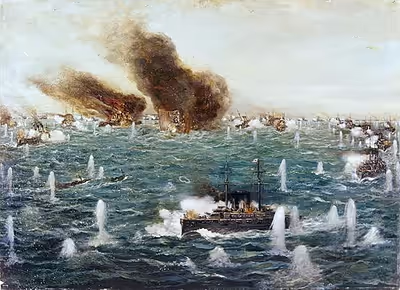
The Russians sailed from south-southwest to north-northeast; "continuing to a point of intersection which allowed only their bow guns to bear; enabling him [Tōgō] to throw most of the Russian batteries successively out of bearing." The Japanese fleet steamed from northeast to southwest, then Tōgō ordered the fleet to turn 180-degrees in sequence, which enabled his ships to take the same course as the Russians. Rozhestvensky had only two alternatives, "a charge direct, in line abreast", or to commence "a formal pitched battle." He chose the latter, and at 14:08, the Japanese flagship Mikasa was hit at about 7,000 metres, with the Japanese replying at 6,400 metres. Although Tōgō's U-turn was successful, Russian gunnery had proven surprisingly good, and the flagship Mikasa was hit 15 times in five minutes. Before the end of the engagement, she was struck 15 more times by large-calibre shells. The Japanese fleet then steamed at 15 knots; the Russian at 11 in parallel engagement. Superior Japanese gunnery took its toll, with most of the Russian battleships being crippled in thirty minutes.
Captain 2nd Rank Vladimir Semenoff, a Russian staff officer aboard the flagship Knyaz Suvorov, said, "It seemed impossible even to count the number of projectiles striking us. Shells seemed to be pouring upon us incessantly one after another. The steel plates and superstructure on the upper decks were torn to pieces, and the splinters caused many casualties. Iron ladders were crumpled up into rings, guns were literally hurled from their mountings. In addition to this, there was the unusually high temperature and liquid flame of the explosion, which seemed to spread over everything. I actually watched a steel plate catch fire from a burst."
Ninety minutes into the battle, the first warship to be sunk was the Russian battleship Oslyabya from Rozhestvensky's 2nd Battleship division. This was the first time a modern armoured warship had been sunk by gunfire alone.
By 14:45, Tōgō had "crossed the Russian T", enabling him to fire broadsides, while the Russians could reply only with their forward turrets.
A direct hit on the Russian battleship Borodino's magazines by the Japanese battleship Fuji caused her to explode, which sent smoke thousands of metres into the air and trapped all but one of her crew onboard as she sank. Rozhestvensky was knocked out of action by a shell fragment that struck his skull. In the evening, Rear Admiral Nikolai Nebogatov took over command of the Russian fleet. The Russians lost the battleships Knyaz Suvorov, Oslyabya, Imperator Aleksandr III and Borodino. The Japanese ships suffered only light damage.
Night attacks
At night, around 20:00, 21 destroyers and 45 Japanese torpedo boats were thrown against the Russians. They were deployed initially from the north, east, and west while being slightly visible, forcing the Russians, roughly in the order of cruisers, battleships, and auxiliary groups, to turn west. The Japanese were aggressive, continuing their attacks for three hours without a break; as a result, during the night, there were several collisions between the small craft and Russian warships. The Russians were dispersed in small groups. By 23:00, it appeared that the Russians had vanished, but they revealed their positions to their pursuers by switching on their searchlights – ironically, the searchlights had been turned on to spot the attackers. The old battleship Navarin struck chained floating mines laid in front of her and was forced to stop to avoid pushing the chain forward, inviting other floating mines on the chain to hit her. She was consequently torpedoed four times and sunk. Out of a crew of 622, only three survived, one to be rescued by the Japanese and the other two by a British merchant ship.
The battleship Sissoi Veliky was badly damaged by a torpedo in the stern and was scuttled the next day. Two old armoured cruisers – Admiral Nakhimov and Vladimir Monomakh – were badly damaged, the former by a torpedo hit to the bow, the latter by colliding with a Japanese destroyer. They were both scuttled by their crews the next morning off Tsushima Island, where they headed while taking on water. The night attacks placed a great strain on the Russians, as they lost two battleships and two armoured cruisers, while the Japanese lost only three torpedo boats.
XGE signal and Russian surrender
At 05:23 on 28 May, what remained of the Russian fleet was sighted heading northeast. Tōgō's battleships proceeded to surround Nebogatov's remaining squadron south of the island of Takeshima and commenced main battery fire at 12,000 meters. The Russian cruiser Izumrud then turned southeast and started to flee. Realising that his guns were outranged by at least one thousand metres, and the Japanese battleships had proven on the day before to be faster than his own so that he could not close the distance if he tried, Nebogatov ordered the four battleships remaining under his command to surrender. XGE, an international signal of surrender, was hoisted; however, the Japanese navy continued to fire as they did not have "surrender" in their code books and had to find one that did hastily. Still under heavy fire, Nebogatov then ordered a white tablecloth sent up the masthead, but Tōgō, having faced the difficult decision to sink a British transport ship full of Chinese soldiers during the First Sino-Japanese War as the commander of IJN cruiser Naniwa, knew the signal meant a request for a truce or parley, not 'surrender' in the legal definition, and that either meaning contradicted not stopping the ships.
His lieutenants found the codebook, which included the XGE signal, and reported that engine shutdown was required for the signal. Since all the Russian ships were still moving, he continued firing while the response flag signal "STOP" was hoisted. Nebogatov then ordered St. Andrew's Cross lowered and the Japanese national flag raised on the gaff and all engines stopped. Seeing the requirement for the signal met, Tōgō gave the cease-fire and accepted Nebogatov's surrender. Nebogatov surrendered, knowing that he could be shot for doing so. He said to his men:
You are young, and it is you who will one day retrieve the honour and glory of the Russian Navy. The lives of the two thousand four hundred men in these ships are more important than mine.
As an example of the level of damage inflicted on a Russian battleship, Oryol was hit by five 12-inch, nine 8-inch, 39 six-inch, and 21 smaller or unidentified shells. This damage caused her to list, and the engine ceased to operate when she was being taken by the Japanese navy to the First Battle Division home port of Sasebo in Nagasaki after Tōgō accepted the surrender. Cruiser Asama and then battleship Asahi had to tow Oryol, and their destination was changed to the closer Maizuru Naval Arsenal to avoid losing the prize of war. Her commander, Captain Yung, who was seriously injured on 27 May, died in the night of the 29th onboard battleship Asahi en route.
Capture of Rozhestvensky
Russian destroyer Buyniy, after rescuing the squadron command including Admiral Rozhestvensky from the burning Knyaz Suvorov at 17:30 during the day battle on the 27th, found cruiser Donskoi, destroyers Byedoviy and Grozniy in convoy on the morning of 28 May. Rozhestvensky chose Byedoviy to move the fleet command officers and himself, as Buyniy had sustained serious damage, and Donskoi, being an old ship, was very slow. (Later in the afternoon, Buyniy was sunk by gunfire from Donskoi after taking the crew aboard.) Leaving the struggling Buyniy and the slow Donskoi behind, Byedoviy and Grozniy headed for Vladivostok.
Japanese destroyers Sazanami and Kagerō had mechanical issues during the night battle on the 27th and had to fix the problems at the Port of Ulsan. Both destroyers finished their temporary repair work by the morning of the 28th and left the port together. They spotted the two Russian destroyers on the way to join the rest of the Combined Fleet and engaged at 15:25.
Destroyer Grozniy increased speed being chased by Kagerō, but Byedoviy slowed down and stopped in the face of firing and approaching Sazanami while raising a white flag. Grozniy was able to keep sufficient distance from Kagerō, exchanging just a few long-distance shots at about 18:30, before nightfall. She became one of the three warships reaching Vladivostok after surviving the battle.
The Combined Fleet command could not believe the news when cruiser Akashi, which rendezvoused Sazanami on the morning of the next day, sent a radio telegraph message about the capture of Admiral Rozhestvensky, as they were certain to have sunk Knyaz Suvorov and assumed the squadron commander went down with the flagship. But cruiser Akashi, accompanied by Sazanami and Kagerō, arrived at Sasebo port in the morning of 30 May with Byedoviy in tow, with not only the injured admiral but also the surviving members of the Russian fleet command onboard.
Conclusion
Until the evening of 28 May, the Japanese pursued isolated Russian ships until almost all were destroyed or captured. The cruiser Izumrud, which escaped from the Japanese despite being present at Nebogatov's surrender, was destroyed by her crew after running aground on the Siberian coast.
The wounded Admiral Rozhestvensky went to the Imperial Japanese Naval Hospital in Sasebo to recover from a head injury caused by shrapnel; there, the victorious Admiral Tōgō visited him personally in plain clothes, comforting him with kind words: "Defeat is a common fate of a soldier. There is nothing to be ashamed of in it. The great point is whether we have performed our duty." Rozhestvensky was allowed to send a telegram to the Tsar at Tsarskoye Selo.
On 10 June 1905, Tsar Nicholas II responded with a telegram:
Tokyo. Adjutant General Rozhdestvensky. From the bottom of my heart I thank you and all the ranks of the squadron who honestly fulfilled their duty in battle, for their selfless service to Russia. Your feat was destined to be crowned with success, but your fatherland will always be proud of your selfless courage. I wish you a speedy recovery, and may God console you all. Nikolai
Rozhestvensky and other officers were placed on trial in August 1905 after returning to Russia. Rozhestvensky claimed full responsibility for the fiasco and was sentenced to death, but the Tsar commuted his death sentence. Flag captains Clapier de Colongue (Second Pacific Squadron) and Cross (Third Pacific Squadron), Staff officers Filippinovsky and Leontieff, together with the commanders of the surrendered battleships, Captains Vladimir Smirnov (Nikolai I), Nikolai Lishin (Apraksin), Sergei Grogoryev (Senyavin), and the Byedoviy commander Nikolai Baranov were sentenced to 10 years in prison and dismissed from service (Nicholas II pardoned them on 1 May 1909). The executive officer of Oryol (who was in charge of the ship at the surrender), Captain 2nd rank K.L. Schwede, and other officers were acquitted.
Admiral Nebogatov, who surrendered the fleet, was also sentenced to death, which was commuted to 10 years imprisonment and eventually pardoned by the Tsar. He was released from the Trubetskoy Bastion prison in Peter and Paul Fortress in May 1909.
Following this battle, the Imperial Japanese Navy grew to the third largest in the world after World War I. Tōgō Heihachirō was appointed to Order of Merit by King Edward VII on 21 February 1906, as one of the three first non-Dominion members, before he was enobled as Earl (Count) by Emperor Meiji in 1907. Later, he became the first Japanese person on the cover of Time magazine for the 8 November 1926 issue.
Contributing factors
Commander and crew experience
Admiral Rozhestvensky faced a more combat-experienced battleship admiral in Tōgō Heihachirō. Admiral Tōgō had already killed two Russian admirals: Stepan Makarov outside of Port Arthur in the battleship Petropavlovsk in April 1904, then Wilgelm Vitgeft in his battleship Tsesarevich in August of the same year. Before those two deaths, Tōgō had chased Admiral Oskar Starck, also flying his flag in the Petropavlovsk, off the battlefield. Admiral Tōgō and his men had two battleship fleet action experiences, which amounted to over four hours of combat experience in battleship-to-battleship combat at Port Arthur and the Yellow Sea. The Japanese fleets had practiced gunnery extensively since the beginning of the war, using sub-calibre practice guns mounted in their larger guns.
In contrast, Russian battleship Borodino underwent sea trials from 23 August to 13 September 1904 as a brand new ship upon her completion, and the new crew did not have much time for training before she set sail for the Pacific on 15 October 1904. Borodino's sister ship, Knyaz Suvorov, started trials on 9 August, Oryol started trials the latest on 10 September 1904, leaving Imperator Aleksandr III (the trials finished in October 1903) as the only Borodino-class ship actually ready for deployment. As the Imperial Russian Navy planned on building 10 Borodino-class battleships (5 were ultimately built) with the requirement for thousands of additional crewmen, the basic training, quality, and experience of the crew and cadets were far lower than those onboard the battleships in the seasoned Pacific Fleet.
The Imperial Russian Admiralty Council (Адмиралтейств-совет) and the rest of the Admiralty were quite aware of this disadvantage, and opposed the September dispatch plan for the following reasons:
1. The Japanese navy has completed the battle preparations with all the crew having some combat experience.
2. The long voyage is mostly through extreme tropical weather, so a meaningful training is practically impossible on the way.
3. Therefore, the newly created Second Pacific Fleet should conduct training in the Baltic until the next spring while waiting for the rigging of another battleship, Slava, and the purchase of Chilean and Argentine warships.
However, at the council in the imperial presence on 23 August 1904 held at the Peterhof Grand Palace, this opinion was overruled by Admiral Rozhestvensky (Commander in Chief of the Fleet), Navy Minister Avellan, and Tsar Nicholas II; for it was deemed impossible to re-arrange the massive coaling for the long voyage if the navy broke the contract that was already signed with Hamburg-American Steamship Line of Germany.
Salvo firing director system
Up to the Battle of the Yellow Sea on 10 August 1904, naval guns were controlled locally by a gunnery officer assigned to that gun or a turret. He specified the elevation and deflection figures, gave the firing order while keeping his eyes on the inclinometers indicating the rolling and pitching angles of the ship, received the fall of shot observation report from the spotter on the mast, calculated the new elevation and deflection to 'walk' the shots in on the target for the next round, without much means to discern or measure the movements of his own ship and the target. He typically had a view on the horizon, but with the new 12-inch gun's range extended to over 13 km (8 mi), his vantage point was lower than desired.
In the months before the battle, the Chief Gunnery Officer of Asahi, Lieutenant Commander Katō Hiroharu, aided by a Royal Navy advisor who introduced him to the use of the early mechanical computer Dumaresq in fire control, introduced a system for centrally issuing the gun-laying and salvo-firing orders by voice. Using a central system allowed the spotter to identify a salvo of distant shell splashes much more effectively than trying to identify a single splash among the many in the confusion of fleet-to-fleet combat. Further, the spotter needed to keep track of only one firing at a time, rather than multiple shots on multiple stopwatches, and report to only one officer on the bridge. The 'director' officer on the bridge had the advantage of a higher vantage point than in the gun turrets, and was steps away from the ship commander, giving orders to change course and speed in response to incoming reports on target movements.
This fire control director system was introduced to other ships in the fleet. The training and practice on this system were carried out in the months waiting for the arrival of the Baltic Fleet while its progress was reported by the British intelligence from their naval stations at Gibraltar, Malta, Aden (Yemen), Cape of Good Hope, Trincomalee (Ceylon), Singapore and Hong Kong, among other locations.
As a result, Japanese fire was more accurate in the far range (5–13 km or 3–8 mi), on top of the advantage they held in the shorter distances using the latest 1903 issue Barr and Stroud FA3 coincidence rangefinders of baselength 1.5 m (5 ft), which had a range of 5.5 km (6,000 yd), while the Russian battleships were equipped with Lugeol stadiametric rangefinders from the 1880s (except battleships Oslyabya and Navarin, which had the Barr and Stroud 1895 issue FA2 of baselength 1.4 m (4.5 ft) retrofitted), which only had a range of about 4 km (4,400 yd).
Wireless telegraphy
The wireless telegraph (radio) had been invented during the last half of the 1890s, and by the turn of the century, nearly all major navies were adopting this improved communications technology. Tsushima was "the first major sea battle in which wireless played any role whatsoever".
Lieutenant Akiyama Saneyuki (who was the key staff to Admiral Tōgō in formulating plans and directives before and during the battle as a Commander, who also went aboard Nikolai I to accompany Admiral Nebogatov to Mikasa for a formal meeting with Tōgō) had been sent to the United States as a naval attaché in 1897. He witnessed the capabilities of wireless telegraphy firsthand during the Spanish–American War. He sent several memos to the Navy General Staff, urging them to push ahead as rapidly as possible to acquire the new technology. The IJN command became heavily interested in the technology; however, it found the Marconi wireless system, which was then operating with the Royal Navy, to be exceedingly expensive.
The Japanese therefore decided to create their own radio sets by setting up a wireless research committee under Professor Kimura Shunkichi, which eventually produced an acceptable system. In 1901, having attained radio transmissions of up to 95 km (60 mi) with the Type 34 (34th year of Meiji = 1901) set, the Navy formally adopted wireless telegraphy. Two years later, a laboratory, a factory, and the wireless telegraphy curriculum were set up at Imperial Japanese Navy Mines Training School in Yokosuka to produce the Type 36 (1903) wireless sets, and these were quickly installed on every battleship and cruiser (including auxiliary cruisers) in the Combined Fleet by the time the war started. In January 1905, destroyers started receiving Type 36, but this program was not yet completed at this battle.
Alexander Stepanovich Popov, a professor at the Imperial Russian Navy Mines School in Kronstadt, had built and demonstrated a wireless telegraphy set in 1897. He collaborated with Frenchman Eugène Adrien Ducretet, who had succeeded in 4 km radio transmission demonstration between the Eiffel Tower and the Panthéon on 5 November 1898, to manufacture wireless telegraphy sets, called "Popov-Ducretet system" between 1899 and 1904, purchased by the Russian Navy to be installed to the ships in the (First) Pacific Fleet. This radiotelegraph set was further improved into "System Slaby-Arco" manufactured by the Russian factory of German Telefunken located at Kronstadt, and were installed to major ships in the Second Pacific Fleet.
Although both sides had early wireless telegraphy, the Russian sets were tuned and maintained by German technicians halfway into the voyage, while the Japanese had the advantage of using their own equipment maintained and operated by their own navy specialists trained at the Yokosuka school.
British support
The United Kingdom assisted Japan by manufacturing guns and building battleships for the IJN. As an ally in the Anglo-Japanese Alliance, the UK also assisted Japan with intelligence, finance, technology, training, and other aspects of the war against Russia. At the time, Britain owned and controlled more harbour facilities around the world – specifically shipyards and coaling stations – than Russia and its allies (France, and to some extent Germany) combined. The UK also, where possible, obstructed Russian attempts to purchase ships and coal. France openly allowed the Baltic Fleet warships into Cherbourg and Tangier ports before and after the Dogger Bank Incident; and the UK formally protested in the post-Dogger Bank negotiations, pointing out that the neutral countries could not accept warships of the fighting countries into their ports without enforcing internment, and if France is no longer neutral in the war, the UK is obligated to commence military action in support of Japan as required in the Anglo-Japanese Alliance. As a result, the rendezvous point for Rozestvensky and Fölkersahm squadrons was changed from the port of Diego Suarez to the waters around remote islands of Île Sainte-Marie and Nosy Be in Madagascar, and free access to the ports including Saigon and Ba Ngoi port in Cam Ranh Bay was denied for the fleet in French Indochina.
This support created a major logistical problem for the deployment of the Baltic Fleet from around the world to the Pacific in procuring coal and supplies along the way. At Nosy Be in Madagascar and at Camranh Bay, French Indochina, the fleet was forced to be anchored for about two months each, seriously degrading morale of the crew. By the time it reached the Sea of Japan, the hulls of all the ships in the fleet were heavily fouled in addition to carrying the extra coal otherwise not required on deck.
The Japanese ships, on the other hand, were well maintained in the ample time given by the intelligence. For example, battleship Asahi was under repair from November 1904 to April 1905 at Sasebo Naval Arsenal for two 12" guns lost and serious damage to the hull from striking a mine. They were divided into battle divisions of as much uniform speed and gun range so that a fleet would not suffer a bottleneck in speed, and the range of guns would not render some ships useless within a group in extended-range combat.
At the end of the Argentine–Chilean naval arms race in 1903, two Chilean-ordered and British-built battleships (then called Constitución and Libertad) and two Argentine-ordered, Italian-built cruisers (then called Bernardino Rivadavia and Mariano Moreno) were offered to Russia; the purchase was about to be finalised. Britain stepped in as the mediator of Pacts of May that ended the race, bought the Chilean battleships (which became HMS Swiftsure and HMS Triumph), and brokered the sale of Argentine cruisers to Japan. This support not only limited the growth of the Imperial Russian Navy but also helped IJN in obtaining the Italian-built cruisers (IJN Kasuga and Nisshin) with a strong armour design that enabled IJN to use them on the main line of battle along with the heavier-armoured battleships.
High explosive and cordite
The Japanese used mostly high-explosive shells filled with Shimose powder, which was a pure picric acid (as opposed to the French Melinite or the British Lyddite, which were picric acid mixed with collodion (French) or with dinitrobenzene and vaseline (British) for stability). Engineer Shimose Masachika (1860–1911) solved the instability problem of picric acid on contact with iron and other heavy metals by coating the inside of a shell with unpigmented Japanese lacquer and further sealing with wax. Because it was undiluted, Shimose powder had a stronger power in terms of detonation velocity and temperature than other high explosives at the time. These shells had a sensitive Ijuin fuse (named after Vice Admiral Ijuin Gorō) at the base as opposed to the tip of a shell that armed itself when the rifling spun the shell. These fuses were designed to explode on contact and wreck the upper structure of ships. The Japanese Navy imported cordite from Great Britain as the smokeless propellant for these Shimose shells, so that the smoke off the muzzle would not impede the visibility for the spotters.
In the early 1890s, Vice Admiral Stepan Makarov, then the Chief Inspector of Russian naval artillery, proposed a new 12" gun design, and assigned a junior officer, Semyon V. Panpushko, to research the use of picric acid as the explosive in the shell. However, Panpushko died in an accidental explosion in an experiment due to the instability. Consequently, high explosive shells remained unreachable for the Russian Navy at the time of the Russo-Japanese War, and the navy continued to use the older armour-piercing rounds with guncotton (Nitrocellulose, Pyroxylin) bursting charges and the insensitive delayed-detonation fuses. They mostly used brown powder or black powder as the propellant, except Sissoi Veliky and the four Borodino-class ships that used smokeless gunpowder for the main 12" guns.
As a result, Japanese hits caused more damage to Russian ships than Russian hits on Japanese ships. Shimose blasts often set the superstructure, the paintwork, and the large quantities of coal stored on the decks on fire, and the sight of the spotters on Russian ships was hindered by the large amount of smoke generated by the propellant on each uncoordinated firing. Moreover, the sensitivity difference of the fuse caused the Japanese off-the-target shells to explode upon falling on the water creating a much larger splash that sent destabilizing waves to Russian inclinometers, as opposed to the Russian shells not detonating upon falling on the water. This made an additional difference in the aforementioned shot accuracy by aiding the Japanese spotters to make an easier identification in fall of shot observation.
Gun range and rate of fire
The Makarov proposal resulted in Model 1895 12-inch gun that extended the range of the previous Model 1886 12" Krupp guns (installed on Imperator Nikolai I and Navarin) from 5–6 km to 11 km (at 15-degree elevation) at the expense of significantly limited amount of explosives that can be contained in the 332 kg (732 lb) shell. Reload time was also improved from 2–4 minutes previously to a rated 90 seconds, but in reality, it was 2.5–3 minutes. These guns were installed to Sissoi Veliky and the four Borodino-class ships.
The four modern Japanese battleships, Mikasa, Shikishima, Fuji, and Asahi, had the latest Armstrong 12" 40-calibre naval gun designed and manufactured by Sir W.G. Armstrong & Company ahead of its acceptance by the Royal Navy in the UK. These British-built 12" guns had a range of 14 km (15,000 yd) at 15-degree elevation and a rate of fire of 60 seconds with a heavier 390 kg (850 lb) shell. One of the reasons for the Royal Navy's late adoption of this type of gun was the accidental shell explosions in the barrel Japanese battleships experienced up to the Battle of the Yellow Sea in August 1904, which were diagnosed and almost rectified by the Japanese Navy with the use of aforementioned Ijuin Fuse by the time of this battle.
The Russian fleet had 20 of the 1895-issue longer-range 12" guns on five battleships, compared to 16 of the Armstrong 12" guns on four Japanese battleships. Statistically, this 20% advantage in the number of guns was much more than offset by the 60% disadvantage in the rate of fire difference of one shot in 2.5 minutes versus one minute. The range difference of 11 km versus 14 km translated into a flatter trajectory (smaller elevation and fall angle) for the Japanese shells, which resulted in a better hit rate for the Japanese shots when both sides had an equal distance facing each other in 11 km and shorter range.
Aftermath
Battle damage and casualties
The Russian cruiser Almaz (imperial yacht) and two torpedo boat destroyers Grozniy and Braviy reached Vladivostok. Protected cruisers, Aurora, Zhemchug, and Oleg, escaped to the U.S. Naval Base Subic Bay in the Philippines, and were interned. Ammunition ship Koreya, transports Yaroslavl, Vladimir, Kuronia, Voronezh, Livonia and Meteor as well as ocean tug Svir went to Shanghai and eventually returned home. Destroyer Bodriy was interned in Shanghai. Transports Mercury, Tambov, Herman Lerke, Count Stroganov and repair ship Ksenia were sent home via Saigon. Auxiliary cruisers Rion and Dniepr eventually reached back home after some raiding activities in the Yellow Sea. Auxiliary cruisers Kuban and Terek were interned at Batavia in Dutch East Indies by the Netherlands. Auxiliary (merchant) cruiser Anadyr escaped to Madagascar. Hospital ships Orel and Kostroma were captured by the Japanese. Kostroma was released afterwards.
Russian losses
Russian personnel losses were 216 officers and 4,614 men killed; with 278 officers and 5,629 men taken as Prisoners Of War (POW). Interned in neutral ports were 79 officers and 1,783 men. Escaping to Vladivostok and Diego-Suarez were 62 officers and 1,165 men.
The battle was humiliating for Russia, which lost all its battleships and most of its cruisers and destroyers. The battle effectively ended the Russo-Japanese War in Japan's favour. The Russians lost 4,380 killed and 5,917 captured, with a further 1,862 interned. Two admirals, Rozhestvensky and Nebogatov, were captured by the Japanese Navy. The second in command of the fleet, Rear Admiral Dmitry Gustavovich von Fölkersahm, after suffering a cerebral hemorrhage on 16 April, died in the night of 24 May 1905 onboard battleship Oslyabya. Vice Admiral Oskar Enqvist fled to Manila onboard cruiser Oleg and was interned by the United States.
Battleships
The Russians lost eleven battleships, including three smaller coastal battleships, either sunk or captured by the Japanese, or scuttled by their crews to prevent capture. Four were lost to enemy action during the daylight battle on 27 May: Knyaz Suvorov, Imperator Aleksandr III, Borodino and Oslyabya. Navarin was lost during the night action on 27–28 May, while the Sissoi Veliky and Admiral Ushakov were either scuttled or sunk the next day. Four other battleships, under Rear Admiral Nebogatov, were forced to surrender and would end up as prizes of war. This group consisted of only one modern battleship, Oryol, along with the old battleship Imperator Nikolai I and two small coastal battleships General-Admiral Apraksin and Admiral Seniavin.
Cruisers
The Russian Navy lost five of its nine cruisers during the battle; three more were interned by the U.S., with just one reaching Vladivostok. Vladimir Monomakh and Svetlana were sunk the next day after the daylight battle. The cruiser Dmitrii Donskoi fought against six Japanese cruisers on the 28th and barely survived with many officers and crew killed onboard, and was scuttled on 29 May 1905 due to heavy damage. Izumrud ran aground on the Siberian coast. Three Russian protected cruisers, Aurora, Zhemchug, and Oleg, escaped to the U.S. naval base at Manila in the then-U.S.-controlled Philippines where they were interned by the U.S. The armed yacht (classified as a cruiser) Almaz, alone was able to reach Vladivostok.
Destroyers and auxiliaries
Imperial Russia also lost six of its nine destroyers in the battle, had one interned by the Chinese, and the other two reached Vladivostok. Buyniy ("Буйный"), Bezuprechniy ("Безупречный"), Gromkiy ("Громкий") and Blestyashchiy ("Блестящий") were sunk on 27 May. Bistriy ("Быстрый") was beached and destroyed by her crew the next day. Byedoviy ("Бедовый") surrendered also on 28 May. Destroyer Bodriy ("Бодрый") ran out of coal, and was interned in Shanghai. Grozniy ("Грозный") and Braviy ("Бравый") reached Vladivostok.
Of the auxiliaries, repair ship Kamchatka, auxiliary cruiser Ural, and ocean tug Rus were sunk on 27 May, auxiliary cruiser Irtysh was disabled, abandoned on 28 May, and then sank on 29 May. Ammunition ship Koreya and ocean tug Svir reached Shanghai and returned home. After being ordered to separate from the fleet on 22 May, auxiliary cruisers Kuban and Terek were interned at Batavia in Dutch East Indies by the Netherlands on 9 June 1905 after raiding a British and a Danish steamer destined for Japan. Transports Yaroslavl, Vladimir, Kuronia, Voronezh, Livonia, and Meteor were detached from the fleet on 25 May, reached Shanghai, and returned home. Auxiliary cruisers Rion and Dniepr escorted the transports to Shanghai, engaged in commerce raiding activities in the Yellow Sea, and returned to Kronstadt on 31 July 1905. Transports Mercury, Tambov, Herman Lerke, Count Stroganov and repair ship Ksenia, which accompanied the Third Pacific Fleet to Cam Ranh Bay, had been sent home via Saigon. Merchant cruiser Anadyr escaped to Madagascar and then returned home. The hospital ships Orel and Kostroma were captured during the battle; Kostroma was released afterwards.
Japanese losses
The Japanese lost three torpedo boats (Nos. 34, 35, and 69). Personnel losses were 117 officers and men killed, and 583 officers and men wounded.
Political consequences
Imperial Russia's prestige was badly damaged, and the defeat was a blow to the Romanov dynasty. Most of the Russian fleet was lost; the fast armed yacht Almaz (classified as a cruiser of the 2nd rank) and the destroyers Grozny and Bravy were the only Russian ships to reach Vladivostok. In The Guns of August, the American historical writer and journalist Barbara Tuchman argued that because Russia's loss destabilised the balance of power in Europe, it emboldened the Central Powers and contributed to their decision to go to war in 1914.
The battle had a profound cultural and political impact on the world. It was the first defeat of a European power by an Asian nation in the modern era. It also heightened the alarm of "The Yellow Peril" as well as weakening the notion of white superiority that was prevalent in some Western countries. Mahatma Gandhi (India), Mustafa Kemal Atatürk (Turkey), Sun Yat-sen (China) and Jawaharlal Nehru (India) were amongst the future national leaders to celebrate this defeat of a colonial power. The victory established Japan as the sixth greatest naval power while the Russian navy declined to one barely stronger than that of Austria-Hungary.
In The Guinness Book of Decisive Battles, the British historian Geoffrey Regan argues that the victory bolstered Japan's increasingly aggressive political and military establishment. According to Regan, the lopsided Japanese victory at Tsushima:
...created a legend that was to haunt Japan's leaders for forty years. A British admiral once said, 'It takes three years to build a ship, but 300 years to build a tradition.' Japan thought that the victory had completed this task in a matter of a few years ... It had all been too easy. Looking at Tōgō's victory over one of the world's great powers convinced some Japanese military men that with more ships, and bigger and better ones, similar victories could be won throughout the Pacific. Perhaps no power could resist the Japanese navy, not even Britain and the United States.
Regan also believes the victory contributed to the Japanese road to later disaster, "because the result was so misleading. Certainly the Japanese navy had performed well, but its opponents had been weak, and it was not invincible... Tōgō's victory [helped] set Japan on a path that would eventually lead her" to the Second World War.
Takano Isoroku, the future Japanese admiral Yamamoto Isoroku who would plan the attack on Pearl Harbor and command the Imperial Japanese Navy through much of the Second World War, served as a junior officer (aboard Nisshin) during the battle and was wounded and lost two fingers by an accidental explosion of an 8-inch shell in a forward gun. Had he lost a third, he would have been medically discharged from the IJN.
Dreadnought arms race
Before the Russo-Japanese War, countries constructed their battleships with mixed batteries of mainly 6-inch (152 mm), 8-inch (203 mm), 10-inch (254 mm), and 12-inch (305 mm) guns, with the intent that these battleships fight on the battle line in a close-quarter, decisive fleet action. The Battle of Tsushima conclusively demonstrated that faster battleships and big guns with longer ranges were superior to batteries of mixed-size guns.
Britain's First Sea Lord, Admiral Jackie Fisher, reasoned that the Japanese victory at Tsushima confirmed the importance of large guns and speed for modern battleships. Captain William Pakenham of the British Royal Navy, who had been present aboard the Japanese battleship Asahi as an official observer during the Tsushima Battle, "famously remarked...the effect of the fire of every gun is so much less than that of the next larger size, that when 12in guns are firing, shots from 10in pass unnoticed...everything in this war has tended to emphasize the vast importance to a ship, at every stage of her career, of carrying some of the heaviest and furthest shooting guns that can be got into her." In October 1905, the British began construction of HMS Dreadnought, which marked the beginning of a naval arms race between Britain and Germany in the years before 1914.
The battle also accelerated the naval arms race geopolitically. However, the Anglo-German naval arms race had begun in 1897, and the collapse of Russian naval power in 1905 allowed Britain to send the bulk of its naval forces to other regions, reassured by its ally Japan's naval superiority in the Far East. In turn, the presence of a larger British fleet in Europe meant that the Germans felt forced to build a proportionally larger fleet to maintain the same relative power, in accordance with von Tirpitz's fleet in being principle. The Royal Navy, in turn, must increase its fleet size to maintain the relative power as set out by its two-power standard. This positive feedback meant that any external increase in the regional naval power of one side – in this case, the British – would precipitate not just a proportional increase in naval power from the opposing side, but rather a mutual multi-stage build-up in naval power on both sides, before settling to a higher equilibrium. Ultimately, the Germans passed three of their five Fleet Acts after Tsushima within a span of 6 years.
Upon the outbreak of World War I, the British and Germans were both aware of the potentially devastating consequences of a naval defeat on the scale of Tsushima. Britain needed its battle fleet to protect its empire and the trade routes vital to its war effort. Winston Churchill, then First Lord of the Admiralty, described British Admiral John Jellicoe as "the only man who on either side could lose the war in an afternoon." German naval commanders, for their part, understood the importance Kaiser Wilhelm II attached to his navy and the diplomatic prestige it carried. As a result of caution, the British and German fleets met in only one major action in World War I, the indecisive Battle of Jutland.
Timeline
Note
27 May 1905 (JST)
- 04:45 The Shinano Maru (Japan) locates the Baltic Fleet. It sends a wireless message "Spotted enemy fleet in grid 203." to cruiser Itsukushima, which relays it to the Combined Fleet flagship Mikasa.
- 05:05 Tōgō receives the message, begins preparation to depart.
- 05:55 Akitsushima relays Izumi's report "Enemy appears to be headed for the Eastern channel of Tsushima."
- 06:05 The 1st (Japanese battleship Mikasa, Shikishima, Fuji, Asahi, Kasuga, Nisshin), 2nd (Izumo, Azuma, Tokiwa, Yakumo, Asama, Iwate) and 4th (Naniwa, Takachiho, Akashi, Tsushima) battle divisions of the Japanese Combined Fleet leave Jinhae (Chinhae, or Chinkai) Bay head South East at 12 knots. "Weather is half-cloudy, wind from the South West, wave is still high from the stormy weather in the last two days."
- 06:20 "Prepare for battle" ordered on Mikasa.
- 07:00 Cruiser Izumi relieves Shinano Maru of reporting task, closes in to 10,000 metres of Russian battleship Knyaz Suvorov on the starboard, then increases the distance and shadows the Baltic Fleet alone; reports "Enemy fleet is in grid 224 (20 nm NW of Ukushima Island, Nagasaki) heading North North East".
- 08:30 Kasagi reports "3rd battle div. is at grid 251(33°40′N 129°00′E / 33.67°N 129.0°E), heading NNE at 10 Knots."
- 09:39 1st battle division reaches 10nm NNE of Mitsushima Lighthouse, turns ESE at 15 knots.
- 10:00 Mikasa sends a wireless message to the Imperial General Headquarters: "Upon receiving its spotting report, Combined Fleet is going into battle with enemy fleet today near Okinoshima Island. Today's weather is fine but waves are high. (Japanese: 本日天気晴朗なれども波高し)".
- 10:30 The 5th battle division (Itsukushima, Matsushima, Hashidate, Chin'en) makes contact with the Baltic Fleet. Stays with the fleet on its left flank (West side).
- 11:00 Details of the Russian fleet formation are assembled: "Head of the fleet, Izumrud. Right (East) flank, 1st column Destroyers, 2nd column Knyaz Suvorov, Borodino-class, Borodino-class, Borodino-class, Oslyabya, Sissoi Veliky, Navarin, Nakhimov; 3rd and 4th columns (slightly behind) Transports and Auxiliaries guarded by destroyers; 5th column (Left flank -West) Nikolai I, Admiral-class coastal battleship, Admiral-class, Admiral-class, Oleg, Aurora, Donskoi, Monomakh".
- 11:30 The 3rd battle division (Kasagi, Chitose, Otowa, Niitaka) makes contact with the Baltic Fleet. Stays with the fleet on its left flank.
- 11:55 Tōgō gathers all hands on the Mikasa rear deck, tells the known situation, and says, "Accurate aim on all the shots is the foremost and the only wish I have at this moment."
- 12:00 Mikasa's chief navigation officer records the current coordinates, 34°27′N 130°1′E / 34.450°N 130.017°E.
- 12:00 Russian fleet starts shifting formations. Kasagi and Itsukushima report all the details in radio telegrams: "Right flank Suvorov and 3 Borodino-class; Left flank Oslyabya, Veliky, Navarin, Nakhimov, Nikolai I and Admiral-class ships."
- 12:30 The 6th battle division (Suma, Izumi, Chiyoda, Akitsushima) tails the Baltic Fleet after Suma, Chiyoda and Akitsushima catching up with the shadowing and reporting Izumi.
- 12:38 "Battle stations" ordered on Mikasa.
- 13:30 The Japanese main group (Mikasa, Shikishima, Fuji, Asahi, Kasuga, Nisshin and the 2nd battle division in this order) gains visual contact.
- 13:35 The Russian main group (Suvorov, Aleksandr III, Borodino and Oryol in this order) shifts heading Left (to North) to cover the Left column led by Oslyabya.
- 13:39 Mikasa hoists the battle flag, heading SSW, approaching the West side of the Russian Left flank.
- 13:54 Mikasa to the closest Russian ship, Oslyabya: 12,000m. Mikasa sends up the 'Z' flag, meaning "The Empire's fate depends on the result of this battle, let every man do his utmost duty."
- 14:00 Mikasa to Oslyabya: 10,000m. Mikasa turns her helm aport and starts a U-turn with the 5 ships following in sequence to head NNE.
- 14:03 Shikishima to Oslyabya: 9,000m. As Shikishima starts to turn, Oslyabya opens fire.
- 14:07 Fuji to Oslyabya: 8,200m. Fuji completes her turn. Knyaz Suvorov and the Russian Baltic Fleet open fire with their main batteries.
- 14:10 Asahi to Oslyabya: 7,300m. Asahi completes her turn. Mikasa opens fire on Oslyabya with a salvo of 6" test shots to establish a distance baseline.
- 14:12 Kasuga to Oslyabya: 6,500m. Mikasa receives her first hit from the Russian guns. Shikishima, Fuji, Asahi, Kasuga and Nisshin open fire on Oslyabya.
- 14:14 Nisshin to Oslyabya: 6,000m. Oslyabya loses her front mast and the center stack.
- 14:15 Oslyabya is severely set on fire and slows down.
- 14:19 Mikasa to Suvorov: 5,800m. The Japanese main group concentrates fire on the Russian flagship, Knyaz Suvorov, which is now leading the Left column heading NNE.
- 14:25 Mikasa loses top part of rear mast. Mikasa and her line turns NE and then to East to "cross the T". Russian Left column turns NE and to ESE in response.
- 14:28 Asama is hit by 12-inch shell after engaging with battleship Oslyabya. Steering was disabled, and Asama fell out of formation. Repairs were completed 6 minutes later, and she returned to the 2nd division battle line at 15:15.
- 14:43 Knyaz Suvorov is set on fire and falls away from the battle line.
- 14:50 With the Japanese 1st Battle Div. completely overtaking the Russian battleships heading ESE, Aleksandr turns to the North with Borodino and Oryol following.
- 14:55 Mikasa and the 5 ships make an immediate left U-turn on the spot, and head WNW in reverse order (Nisshin first, Mikasa last). Japanese 2nd Battle Div. continues heading SE and then SW, attacking the secondary Russian warships.
- 15:10 Nisshin to Aleksandr: 4,000m. Oslyabya sinks. Knyaz Suvorov attempts to withdraw.
- 15:14 Asahi to Aleksandr: 3,000m. Aleksandr, apparently giving up fleeing North, turns SE with Borodino and Oryol following.
- 15:18 Asahi to Borodino (heading SE, on opposite course to the Japanese line): 2,500m.
- 15:50 Nisshin and the 5 ships make another immediate U-turn Left, heads NE in normal order (Mikasa first, Nisshin last). Japanese 1st battle div. loses sight of the Russian main group in the battle, due to the smoke and mist.
- 16:45 One torpedo from the Japanese 4th Destroyer Div. hits Knyaz Suvorov in the port side stern, causing her to list about 10 degrees to port.
- 17:00 Japanese 2nd battle div. finds the Russian main group close to where the Japanese 3rd Squadron (5th and 6th battle divs.) was attacking the Russian auxiliaries protected by cruisers.
- 17:30 Russian destroyer Buyniy rescues Admiral Rozhestvensky and his staff from Knyaz Suvorov.
- 17:51 Russian auxiliary cruiser Ural sunk by the 1st battle division bombardment and a torpedo by battleship Shikishima.
- 18:03 Mikasa and the 1st Battle Div. catch up to the remainder of the Russian main group (heading N) in NW, and concentrate fire on the leading Aleksandr III.
- 18:16 Aleksandr III (heading NW) catches major fire. The Japanese main group concentrates fire on Borodino (heading NW).
- 19:03 Imperator Aleksandr III sinks.
- 19:04 Huge explosion occurs in Borodino's stern.
- 19:05 Japanese main group concentrates fire on Oryol (heading NW).
- 19:20 Knyaz Suvorov sinks.
- 19:28 The Sun sets.
- 19:30 Borodino sinks. Russian repair ship Kamchatka sinks.
- 19:30 Leaving the destroyer divisions and torpedo boat flotillas in position to commence attack in the dark, Japanese 1st Battle Division leaves the battleground after ordering 2nd and 4th battle divisions to gather in Matsushima Island area in the North.
28 May 1905 (JST)
- 05:23 The scout ship of the 5th battle division, Yaeyama, sends "Spotted enemy in grid 603 heading NE" to Itsukushima.
- 05:30 The Japanese Combined Fleet starts assembling a surrounding formation with over 20 capital ships among all the battle divisions.
- 06:00 Damaged Sissoi Veliky and accompanying destroyer Bezuprechni were spotted by Shinano Maru.
- 09:30 Formation is mostly in place. Mikasa and the 1st battle division approach from the North heading South.
- 09:38 Mikasa gains visual contact with the remaining Baltic Fleet in SSE.
- 10:00 Izumrud turns SE and runs at high speed away from the rest of the Russian fleet.
- 10:05 Sissoi Veliky sinks.
- 10:31 Nisshin opens fire at 9,000 m to Nikolai I with Oryol, Apraksin and Seniavin following in this order.
- 10:34 Admiral Nebogatov signals "XGE P", which is "Surrendered. Go still (Proceeding slow)" in the International Code of Signals used at the time.
- 10:40 Mikasa, after changing course to ENE, opens fire at 6,900 m with a starboard salvo 6" test shot. The Russian ships do not return fire.
- 10:42 Kasuga hoists flag signal "enemy surrendered".
- 10:45 Admiral Tōgō accepts the surrender.
- 10:45 Cruiser Svetlana sinks.
- 10:50 Mikasa turns South and lowers the battle flag.
- 10:53 Firing stops.
- 11:53 Commander Akiyama Saneyuki and the interpreter (Lieutenant) Yamamoto Shinjirō depart Mikasa and head for Nikolai I on torpedo-boat Kiji.
- 13:37 Kiji returns to Mikasa with Admiral Nebogatov and his staff. Asama commander, Captain Yashiro Rokurō, acts as the interpreter in the Tōgō-Nebogatov meeting.
- 15:00 Damaged Admiral Ushakov arrives at the surrender site, starts firing in an attempt to flee. Iwate and Yakumo are mobilised to intercept.
- 19:00 Admiral Ushakov sinks.
On film
The battle has been the main focus of two historical films in Japan. The first, 1969's Battle of the Japan Sea (日本海大海戦, Nihonkai Daikaisen), directed by Seiji Maruyama, starring Toshiro Mifune as Admiral Tōgō, with music by Masaru Sato and special effects by Eiji Tsuburaya. It was dramatised again in 1983's Battle Anthem (日本海大海戦・海ゆかば, Nihonkai Daikaisen – Umi Yukaba) with Mifune reprising his role.
Another, more recent, depiction is episode 4, season 3 of the 2009–2011 NHK taiga drama series Saka no Ue no Kumo (坂の上の雲) (lit. "Clouds Above the Slope").