


Related on Lably
Through India, Government of India and President of India
The first recipients of the Bharat Ratna were: the former governor-general of the Union of India C. Rajagopalachari, the former president of the Republic of India Sarvepalli Radhakrishnan; and the Indian physicist C. V. Raman, who were honoured in 1954. Since then, the award has been bestowed upon 53 individuals, including 18 who were awarded posthumously. The original statutes did not provide for posthumous awards but were amended in January 1966 to permit them to honour former prime minister Lal Bahadur Shastri, the first individual to be honoured posthumously. In 2014, cricketer Sachin Tendulkar, then aged 40, became the youngest recipient, while social reformer Dhondo Keshav Karve was the oldest recipient when he was awarded on his 100th birthday. Though usually conferred on India-born citizens, the award has been conferred on one naturalized citizen, Mother Teresa, and on two non-Indians: Abdul Ghaffar Khan (born in British India and later a citizen of Pakistan) and Nelson Mandela, a citizen of South Africa.
The Bharat Ratna, along with other personal civil honours, was briefly suspended from July 1977 to January 1980, during the change in the national government; and for a second time from August 1992 to December 1995, when several public-interest litigations challenged the constitutional validity of the awards. In 1992, the government's decision to confer the award posthumously on Subhas Chandra Bose was opposed by those who had refused to accept the fact of his death, including some members of his extended family. Following a 1997 Supreme Court decision, the press communique announcing Bose's award was cancelled; it is the only time when the award was announced but not conferred.
History
On 2 January 1954, a press communique was released from the office of the secretary to the president announcing the creation of two civilian awards—Bharat Ratna (Jewel of India), the highest civilian award, and the three-tier Padma Vibhushan, classified into "Pehla Warg" (Class I), "Dusra Warg" (Class II), and "Tisra Warg" (Class III), which rank below the Bharat Ratna. On 15 January 1955, the Padma Vibhushan was reclassified into three different awards; the Padma Vibhushan, the highest of the three, followed by the Padma Bhushan and the Padma Shri.
The award was briefly suspended twice in its history. The first suspension occurred when Morarji Desai, who was sworn in as the fourth prime minister in 1977, withdrew all personal civil honours on 13 July 1977. The suspension was rescinded on 25 January 1980, after Indira Gandhi became the prime minister. The award was suspended again in mid-1992, when two Public-Interest Litigations were filed, one in the Kerala High Court and another in the Madhya Pradesh High Court, challenging the "constitutional validity" of the awards. The awards were reintroduced by the Supreme Court in December 1995, following the conclusion of the litigation.
There is no formal provision that recipients of the Bharat Ratna should be Indian citizens. It has been awarded to a naturalised Indian citizen, Mother Teresa in 1980, and to two non-Indians, Abdul Ghaffar Khan of Pakistan in 1987 and the former South African president Nelson Mandela in 1990. Sachin Tendulkar, at the age of 40, became the youngest person and first sportsperson to receive the honour. Dhondo Keshav Karve was the oldest living recipient when he was awarded on his 100th birthday on 18 April 1958. As of February 2026, the award has been conferred upon 53 people with 18 posthumous declarations.
Sign in to keep reading
6 more chapters are free with a Lably account.
Regulations
The Bharat Ratna is conferred "in recognition of exceptional service/performance of the highest order", without distinction of race, occupation, position, or gender. The award was originally confined to the arts, literature, science, and public services, as per the 1954 regulations. In December 2011, the rules were amended to "any field of human endeavour". The 1954 statutes did not allow posthumous awards, but this was subsequently modified in the January 1966 statute, and Lal Bahadur Shastri became the first recipient to be honoured posthumously in 1966.
Although there is no formal nomination process, recommendations for the award can only be made by the prime minister to the president. The recipient receives a Sanad (certificate) signed by the president and a medallion without any monetary grant. Usage of the title 'Bharat Ratna' as a prefix by the awardee is exempt from Article 18 (1) of the Constitution, as per the Supreme Court's precedent in Balaji Raghavan/S.P. Anand v. Union of India in 1995. Additionally, recipients may either use the expression "Awarded Bharat Ratna by the President" or "Recipient of Bharat Ratna Award" to indicate that they have been honoured with the award. The holders of the Bharat Ratna rank seventh in the Indian order of precedence.
As with many official announcements, recipients are announced and registered in The Gazette of India, a publication released by the Department of Publication, Ministry of Urban Development used for official government notices; without publication in the Gazette, conferral of the award is not considered official. Recipients whose awards have been revoked or restored, both of which require the authority of the president, are registered in the Gazette. Recipients whose awards have been revoked are required to surrender their medals, and their names are struck from the register.
Specifications
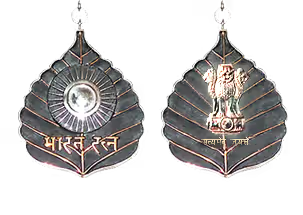
The original 1954 specifications of the award was a circle made of gold 1+3⁄8 inches (35 mm) in diameter with a centered image of the sun on the obverse side. The text "Bharat Ratna", in Devanagari Script, is inscribed on the upper edge in silver gilt with a wreath set along on the lower edge. A platinum State Emblem of India was placed in the center of the reverse side with the national motto, "Satyameva Jayate" in Devanagari Script (Sanskrit: सत्यमेव जयते; lit. "Truth alone triumphs"), inscribed in silver-gilt on the lower edge.
A year later, the design was modified. The current medal is in the shape of a sacred fig leaf, approximately 2+5⁄16 inches (59 mm) long, 1+7⁄8 inches (48 mm) wide and 1⁄8 inch (3.2 mm) thick and rimmed in platinum. The embossed sun burst design, made of platinum, on the obverse side of the medal has a diameter of 5⁄8 inch (16 mm) with rays spreading out from 5⁄6 inch (21 mm) to 1⁄2 inch (13 mm) from the center of the Sun. The words "Bharat Ratna" on the obverse side remained the same as the 1954 design as did the emblem of India and "Satyameva Jayate" on the reverse side. A 2-inch-wide (51 mm) white ribbon is attached to the medal so it can be worn around the neck. In 1957, the silver-gilt decoration was changed to burnished bronze. The medals are minted at Alipore Mint in Kolkata.
Entitlements
Bharat Ratna can not be used as a prefix or suffix, however recipients may identify themselves as "Awarded Bharat Ratna by the President" or "Recipient of Bharat Ratna Award". The award does not carry any monetary benefits, but the award includes the following entitlements:
- The medallion and miniature
- A Sanad (certificate) signed by the president of India
- Treatment as a state guest by state governments when traveling within a state
- Indian missions abroad requested to facilitate recipients when requested
- Entitlement to a diplomatic passport
- Placed seventh in the Indian order of precedence
- Exemption from airport security checks
- Concessional fare on the flag carrier Air India
Controversies and criticism
The Bharat Ratna has been mired in several controversies and award grants have been subject to multiple public interest litigations (PILs).
Subhas Chandra Bose (1992)
On 23 January 1992, a press release was published by the president's secretariat to confer the award posthumously on Subhas Chandra Bose. The decision was contested in a public interest litigation, with the petitioner objecting to the conferral of the award and its posthumous mention of Bose, saying that honouring a personality higher than the award is "ridiculous", and it was an act of "carelessness" to classify such a person with past and future recipients. It was also contested that the award cannot be conferred to Bose posthumously as the Government had not officially accepted his death on 18 August 1945. The petitioner requested the whereabouts of Bose from 18 August 1945 to date, based on the information collected by the 1956 Shah Nawaz Committee and the 1970 Khosla Commission. Bose's family also declined to accept the award.
The Supreme Court formed a special two-judge division bench to adjudicate the case. The Solicitor General noted that to confer the award per the appropriate regulations pertaining to the Bharat Ratna, the name of the recipient must be published in The Gazette of India and entered in the recipients register maintained under the direction of the president. It was noted that only an announcement had been made by press communique, but the government had not proceeded to confer the award by publishing the name in the Gazette and entering the name in the register with the president having not conferred a Sanad (certificate). On 4 August 1997, the Supreme Court delivered an order that since the award had not been officially conferred, it cannot be revoked and declared that the press communique be treated as cancelled with the court declining to pass any judgement on the posthumous mention of Bose and his death.
Awards as "titles" (1992)
In 1992, two PILs were filed in the High Courts; one in the Kerala High Court on 13 February 1992 and another in the Madhya Pradesh High Court on 24 August 1992. Both petitions questioned the civilian awards being "Titles" per an interpretation of Article 18 (1) of the Constitution. On 25 August 1992, the Madhya Pradesh High Court issued a notice temporarily suspending all civilian awards. A special five-judge division bench of the Supreme Court was formed, which restored the awards and delivered a judgement that the "Bharat Ratna and Padma awards are not titles under Article 18 of the Constitution" on 15 December 1995.
Rao and Tendulkar (2013)
Following the announcement, in November 2013, that C. N. R. Rao and Sachin Tendulkar were to be awarded the Bharat Ratna, multiple litigations were filed challenging the awards. The litigation against Tendulkar to the Election Commission indicated that the awarding him was a violation of the model code of conduct as Tendulkar was an Indian National Congress nominated member of Rajya Sabha and the decision to award him would influence the voters of five states where elections were underway at the time. On 4 December 2013, the Election Commission rejected the petition stating that conferring the award on people from non-polling states did not amount to a violation of the code.
Another litigation was filed against then-prime minister Manmohan Singh, home minister Sushilkumar Shinde and sports minister Bhanwar Jitendra Singh for conferring of the award on Tendulkar, alleging an apparent "conspiracy to ignore" the famed Indian field hockey player Dhyan Chand. The litigation filed against Rao declared that other Indian scientists, such as Homi Bhabha and Vikram Sarabhai, had contributed more than Rao, his claim of publishing 1400 research papers was "physically impossible" and Rao had proven cases of plagiarism, hence the announcement should be annulled. The High Courts rejected all the petitions raised against Rao and Tendulkar.
Criticism
In 1977, the decision by then-prime minister Indira Gandhi to posthumously honour former Chief Minister of Tamil Nadu K. Kamaraj was criticized to have been aimed at placating the voters before the Tamil Nadu assembly elections in 1977. In 1988, the decision by then-prime minister Rajiv Gandhi (1984–89) to confer the award posthumously on former chief minister of Tamil Nadu, M. G. Ramachandran was criticized to have been aimed to influence voters prior to the Tamil Nadu assembly elections in 1989. The decision was also criticized for awarding Ramachandran before prominent independence activists B. R. Ambedkar and Vallabhbhai Patel, who were bestowed the honour later in 1990 and 1991 respectively. Later, then-prime minister V.P. Singh was criticized for posthumously honouring B. R. Ambedkar, apparently in a bid to please the Dalit voters. Later, Ravi Shankar was accused of lobbying for the award.
The posthumous conferments of the award on the recipients who died before the Indian independence in 1947 or before the award was instituted in 1954, have been criticized by various authors and historians, stating that such conferments could lead to more demands to honour people like Maurya emperor Ashoka, Mughal emperor Akbar, Maratha emperor Shivaji, poet Rabindranath Tagore, Hindu spiritualist Swami Vivekananda, self-rule activist Bal Gangadhar Tilak, and father of the nation Mahatma Gandhi. In 1991, then-prime minister P. V. Narasimha Rao was criticized for bestowing the award upon Sardar Patel in 1991, 41 years after his death in 1950; and upon Subhas Chandra Bose in 1992, who purportedly died in 1945. In 2015, the prime minister Narendra Modi's decision to award Madan Mohan Malaviya, who died in 1946, close to the local body elections in Uttar Pradesh was also met with criticism.
A few of the conferments have been criticized for honouring personalities only after they received global recognition. The award for Mother Teresa was announced in 1980, a year after she was awarded the Nobel Peace Prize. Satyajit Ray received an Academy Honorary Award in 1992 followed by the Bharat Ratna the same year. In 1999, Amartya Sen was awarded the Bharat Ratna, a year after his 1998 Nobel Memorial Prize in Economic Sciences.
Popular demands
Though, as per the statutes for the Bharat Ratna, the recommendations for the award can only be made by the prime minister to the president, there have been several demands from various political parties publicly to honour their leaders. In January 2008, Bharatiya Janata Party (BJP) leader L. K. Advani wrote to then-prime minister Manmohan Singh recommending Singh's predecessor Atal Bihari Vajpayee for the award. This was immediately followed by the Communist Party of India (Marxist) lobbying for their leader, Jyoti Basu, former Chief Minister of West Bengal though Basu himself said that he would decline the honour, even if awarded. Similar demands were made by Telugu Desam Party, Bahujan Samaj Party, and Shiromani Akali Dal for their respective leaders N. T. Rama Rao, Kanshi Ram, and Parkash Singh Badal. In September 2015, regional political party Shiv Sena demanded the award for politician and ideologue Vinayak Damodar Savarkar stating that he had been "deliberately neglected by previous governments", but his family clarified that they are not making such demand and that, according to them, he did not need an award for recognition.
Per the original statutes, sports-persons were not eligible for the award; however, a revision of the rules in December 2011 made eligible "any field of human endeavour". Subsequently, several sports-persons' names were discussed; amongst them were field-hockey player Dhyan Chand and former world chess champion Viswanathan Anand. In 2011, 82 members of parliament recommended Chand's name for the award to the Prime Minister's Office. In January 2012, the Ministry of Youth Affairs and Sports forwarded his name again, this time along with 2008 Summer Olympics gold medallist shooter Abhinav Bindra and mountaineer Tenzing Norgay while Bindra had already been recommended for the award in May 2013 by the National Rifle Association of India. In July 2013, the ministry again recommended Dhyan Chand. However, in November 2013, cricketer Sachin Tendulkar became the first sports-person to receive the honour and this garnered much criticism for the government.
In 2012, a litigation was filed in the Karnataka High Court requesting the court to issue a direction to the Ministry of Home Affairs to confer the Bharat Ratna upon Mahatma Gandhi. On 27 January 2014, a counsel appearing for the petitioner noted that after multiple representations from the petitioner, they were provided with the information under RTI that the recommendations to confer the award on Gandhi have been received multiple times in the past and were forwarded to the Prime Minister's Office. A Division bench consisting of the Chief Justice and another judge, dismissed the petition stating that the subject is not amenable to any adjudication process and the nominations and conferment process is stated to be informal and in the discretion of the highest authority in the Government. The AIADMK demanded Bharat Ratna for their leader Jayalalithaa.