


Related on Lably
Through European people, Bengal and Indian subcontinent
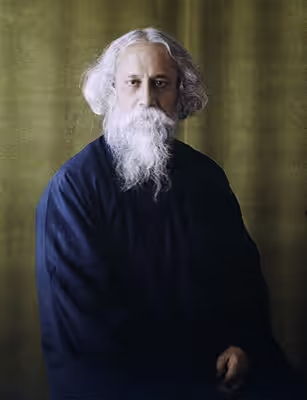
He reshaped Bengali literature and music as well as Indian art with Contextual Modernism in the late 19th and early 20th centuries. He was the author of the "profoundly sensitive, fresh and beautiful" poetry of Gitanjali. Tagore's poetic songs were viewed as spiritual and mercurial; his elegant prose and magical poetry were widely popular in the Indian subcontinent. He was a fellow of the Royal Asiatic Society. Referred to as "the Bard of Bengal", Tagore was known by the sobriquets Gurudeb, Kobiguru, and Bishwokobi.
A Bengali Brahmin from Calcutta with ancestral gentry roots in Jessore and Bardhaman districts, Tagore wrote poetry as an eight-year-old. At the age of sixteen, he released his first substantial poems under the pseudonym Bhānusiṃha ("Sun Lion"), which were seized upon by literary authorities as long-lost classics. By 1877 he graduated to his first short stories and dramas, published under his real name. As a humanist, universalist, internationalist, and ardent critic of nationalism, he denounced the British Raj and advocated independence from Britain. As an exponent of the Bengal Renaissance, he advanced a vast canon that comprised paintings, sketches and doodles, hundreds of texts, and some two thousand songs; his legacy also endures in his founding of Visva-Bharati University.
Tagore modernised Bengali art by spurning rigid classical forms and resisting linguistic strictures. His novels, stories, songs, dance dramas, and essays spoke to topics political and personal. Gitanjali (Song Offerings), Gora (Fair-Faced), and Ghare-Baire (The Home and the World) are his best-known works. His poetry, short stories, and novels were both praised and criticised for their lyricism, colloquial tone, naturalism, and philosophical introspection. His compositions were chosen by two nations as national anthems: India's "Jana Gana Mana" and Bangladesh's "Amar Sonar Bangla". The Sri Lankan national anthem was also inspired by his work. His song "Banglar Mati Banglar Jol" has been adopted as the state anthem of West Bengal.
Family background
The name Tagore is the anglicised transliteration of Thakur. The original surname of the Tagores was Kushari. They were Pirali Brahmin ('Pirali' historically carried a stigmatised and pejorative connotation; an insult that ostracised Piralis from other Brahmin sub-castes) who originally belonged to a village named Kush in the district named Burdwan in West Bengal. The biographer of Rabindranath Tagore, Prabhat Kumar Mukhopadhyaya wrote in the first volume of his book Rabindrajibani O Rabindra Sahitya Prabeshak that
The Kusharis were the descendants of Deen Kushari, the son of Bhatta Narayana; Deen was granted a village named Kush (in Burdwan zilla) by Maharaja Kshitisura, he became its chief and came to be known as Kushari.
Sign in to keep reading
8 more chapters are free with a Lably account.
Life and events
Early life: 1861–1878
The youngest of 13 surviving children, Tagore (nicknamed "Rabi") was born on 7 May 1861 in the Jorasanko mansion in Calcutta, the son of Debendranath Tagore (1817–1905) and Sarada Devi (1830–1875).
Tagore was raised mostly by servants; his mother had died in his early childhood, and his father travelled widely. The Tagore family was at the forefront of the Bengal renaissance. They hosted the publication of literary magazines; theatre and recitals of Bengali and Western classical music featured there regularly. Tagore's father invited several professional Dhrupad musicians to stay in the house and teach Indian classical music to the children. Tagore's oldest brother Dwijendranath was a philosopher and poet. Another brother, Satyendranath, was the first Indian appointed to the elite and formerly all-European Indian Civil Service. Yet another brother, Jyotirindranath, was a musician, composer, and playwright. His sister Swarnakumari became a novelist. Jyotirindranath's wife Kadambari Devi, slightly older than Tagore, was a dear friend and powerful influence. Her abrupt suicide in 1884, soon after he married, left him profoundly distraught for years.
Tagore largely avoided classroom schooling and preferred to roam the manor or nearby Bolpur and Panihati, which the family visited. His brother Hemendranath tutored and physically conditioned him by having him swim the Ganges or trek through hills, by gymnastics, and by practising judo and wrestling. He learned drawing, anatomy, geography and history, literature, mathematics, Sanskrit, and English—his least favourite subject. Tagore loathed formal education—his scholarly travails at the local Presidency College spanned a single day. Years later, he held that proper teaching does not explain things; proper teaching stokes curiosity.
After his upanayan (coming-of-age rite) at age eleven, Tagore and his father left Calcutta in February 1873 to tour India for several months, visiting his father's Shantiniketan estate and Amritsar before reaching the Himalayan hill station of Dalhousie. There Tagore read biographies, studied history, astronomy, modern science, and Sanskrit, and examined the classical poetry of Kālidāsa. During his 1-month stay at Amritsar in 1873 he was greatly influenced by melodious gurbani and Nanak bani being sung at Golden Temple, for which both father and son were regular visitors. He writes in his My Reminiscences (1912):
The golden temple of Amritsar comes back to me like a dream. Many a morning have I accompanied my father to this Gurudarbar of the Sikhs in the middle of the lake. There the sacred chanting resounds continually. My father, seated amidst the throng of worshippers, would sometimes add his voice to the hymn of praise, and finding a stranger joining in their devotions they would wax enthusiastically cordial, and we would return loaded with the sanctified offerings of sugar crystals and other sweets.
He wrote 6 poems relating to Sikhism and several articles in Bengali children's magazine about Sikhism.
- Poems on Guru Gobind Singh: নিষ্ফল উপহার Nishfal-upahaar (1888, translated as "Futile Gift"), গুরু গোবিন্দ Guru Gobinda (1899) and শেষ শিক্ষা Shesh Shiksha (1899, translated as "Last Teachings")
- Poem on Banda Bahadur: বন্দী বীর Bandi-bir (The Prisoner Warrior, written in 1888 or 1898)
- Poem on Bhai Torusingh: প্রার্থনাতীত দান (prarthonatit dan – Unsolicited gift) written in 1888 or 1898
- Poem on Nehal Singh: নীহাল সিংহ (Nihal Singh) written in 1935.
Tagore returned to Jorosanko and completed a set of major works by 1877, one of them a long poem in the Maithili style of Vidyapati. As a joke, he claimed that these were the lost works of newly discovered 17th-century Vaiṣṇava poet Bhānusiṃha. Regional experts accepted them as the lost works of the fictitious poet. He debuted in the short-story genre in Bengali with "Bhikharini" ("The Beggar Woman"). Published in the same year, Sandhya Sangit (1882) includes the poem "Nirjharer Swapnabhanga" ("The Rousing of the Waterfall").
Shilaidaha: 1878–1901
Because Debendranath wanted his son to become a barrister, Tagore enrolled at a public school in Brighton, East Sussex, England in 1878. He stayed for several months at a house that the Tagore family owned near Brighton and Hove, in Medina Villas; in 1877 his nephew and niece—Suren and Indira Devi, the children of Tagore's brother Satyendranath—were sent together with their mother, Tagore's sister-in-law, to live with him. He briefly read law at University College London, but again left, opting instead for independent study of Shakespeare's plays Coriolanus, and Antony and Cleopatra and the Religio Medici of Thomas Browne. Lively English, Irish, and Scottish folk tunes impressed Tagore, whose own tradition of Nidhubabu-authored kirtans and tappas and Brahmo hymnody was subdued. In 1880, he returned to Bengal degree-less, resolving to reconcile European novelty with Brahmo traditions, taking the best from each. After returning to Bengal, Tagore regularly published poems, stories, and novels. These had a profound influence within Bengal itself but received little national attention. In 1883, he married 9-year-old Mrinalini Devi, born Bhabatarini, 1874–1902 (this was a common practice at the time). They had five children, two of whom died in childhood.
In 1890, Tagore began managing his vast ancestral estates in Shelaidaha (today a region of Bangladesh); he was joined there by his wife and children in 1898. Tagore released his Manasi poems (1890), among his best-known work. As Zamindar Babu, Tagore criss-crossed the Padma River in command of the Padma, the luxurious family barge (also known as "budgerow"). He collected mostly token rents and blessed villagers, who in turn honoured him with banquets—occasionally of dried rice and sour milk. He met Gagan Harkara, through whom he became familiar with Baul Lalon Shah, whose folk songs greatly influenced Tagore. Tagore worked to popularise Lalon's songs. The period 1891–1895, Tagore's Sadhana period, named after one of his magazines, was his most productive; in these years he wrote more than half the stories of the three-volume, 84-story Galpaguchchha. Its ironic and grave tales examined the voluptuous poverty of an idealised rural Bengal.
Santiniketan: 1901–1932
In 1901 Tagore moved to Santiniketan to found an ashram with a marble-floored prayer hall—The Mandir—an experimental school, groves of trees, gardens, a library. There his wife and two of his children died. His father died in 1905. He received monthly payments as part of his inheritance and income from the Maharaja of Tripura, sales of his family's jewellery, his seaside bungalow in Puri, and a derisory 2,000 rupees in book royalties. He gained Bengali and foreign readers alike; he published Naivedya (1901) and Kheya (1906) and translated poems into free verse.
In 1912, Tagore translated his 1910 work Gitanjali into English. While on a trip to London, he shared these poems with admirers, including William Butler Yeats and Ezra Pound. London's India Society published the work in a limited edition, and the American magazine Poetry published a selection from Gitanjali. In November 1913, Tagore learned he had won that year's Nobel Prize in Literature: the Swedish Academy appreciated the idealistic—and for Westerners—accessible nature of a small body of his translated material focused on the 1912 Gitanjali: Song Offerings. He was awarded a knighthood by King George V in the 1915 Birthday Honours, but Tagore renounced it after the 1919 Jallianwala Bagh massacre. Renouncing the knighthood, Tagore wrote in a letter addressed to Lord Chelmsford, the then British Viceroy of India, "The disproportionate severity of the punishments inflicted upon the unfortunate people and the methods of carrying them out, we are convinced, are without parallel in the history of civilised governments...The time has come when badges of honour make our shame glaring in their incongruous context of humiliation, and I for my part wish to stand, shorn of all special distinctions, by the side of my countrymen."
In 1919, he was invited by the president and chairman of Anjuman-e-Islamia, Syed Abdul Majid to visit Sylhet for the first time. The event attracted over 5000 people.
In 1921, Tagore and agricultural economist Leonard Elmhirst set up the "Institute for Rural Reconstruction", later renamed Shriniketan or "Abode of Welfare", in Surul, a village near the ashram. With it, Tagore sought to moderate Gandhi's Swaraj protests, which he occasionally blamed for British India's perceived mental – and thus ultimately colonial – decline. He sought aid from donors, officials, and scholars worldwide to "free village[s] from the shackles of helplessness and ignorance" by "vitalis[ing] knowledge". In the early 1930s, he targeted ambient "abnormal caste consciousness" and untouchability. He lectured against these, he penned Dalit heroes for his poems and his dramas, and he campaigned—successfully—to open Guruvayoor Temple to Dalits.
Twilight years: 1932–1941
Dutta and Robinson describe this phase of Tagore's life as being one of a "peripatetic litterateur". It affirmed his opinion that human divisions were shallow. During a May 1932 visit to a Bedouin encampment in the Iraqi desert, the tribal chief told him that "Our Prophet has said that a true Muslim is he by whose words and deeds not the least of his brother-men may ever come to any harm..." Tagore confided in his diary: "I was startled into recognising in his words the voice of essential humanity." To the end, Tagore scrutinised orthodoxy—and in 1934, he struck. That year, an earthquake hit Bihar and killed thousands. Gandhi hailed it as seismic karma, as divine retribution avenging the oppression of Dalits. Tagore rebuked him for his seemingly ignominious implications. He mourned the perennial poverty of Calcutta and the socioeconomic decline of Bengal and detailed this newly plebeian aesthetics in an unrhymed hundred-line poem whose technique of searing double-vision foreshadowed Satyajit Ray's film Apur Sansar. Fifteen new volumes appeared, among them prose-poem works Punashcha (1932), Shes Saptak (1935), and Patraput (1936). Experimentation continued in his prose-songs and dance-dramas— Chitra (1914), Shyama (1939), and Chandalika (1938)— and in his novels— Dui Bon (1933), Malancha (1934), and Char Adhyay (1934).
Tagore's remit expanded to science in his last years, as hinted in Visva-Parichay, a 1937 collection of essays. His respect for scientific laws and his exploration of biology, physics, and astronomy informed his poetry, which exhibited extensive naturalism and verisimilitude. He wove the process of science, the narratives of scientists, into stories in Se (1937), Tin Sangi (1940), and Galpasalpa (1941). His last five years were marked by chronic pain and two long periods of illness. These began when Tagore lost consciousness in late 1937; he remained comatose and near death for a time. This was followed in late 1940 by a similar spell, from which he never recovered. Poetry from these valetudinary years is among his finest. A period of prolonged agony ended with Tagore's death on 7 August 1941, aged 80. He was in an upstairs room of the Jorasanko mansion in which he grew up. The date is still mourned. A. K. Sen, brother of the first chief election commissioner, received dictation from Tagore on 30 July 1941, a day before a scheduled operation: his last poem.
I'm lost in the middle of my birthday. I want my friends, their touch, with the earth's last love. I will take life's final offering, I will take the human's last blessing. Today my sack is empty. I have given completely whatever I had to give. In return, if I receive anything—some love, some forgiveness—then I will take it with me when I step on the boat that crosses to the festival of the wordless end.
Travels
Between 1878 and 1932, Tagore set foot in more than thirty countries on five continents. In 1912, he took a sheaf of his translated works to England, where they gained attention from missionary and Gandhi protégé Charles F. Andrews, Irish poet William Butler Yeats, Ezra Pound, Robert Bridges, Ernest Rhys, Thomas Sturge Moore, and others. Yeats wrote the preface to the English translation of Gitanjali; Andrews joined Tagore at Santiniketan. In November 1912 Tagore began touring the United States and the United Kingdom, staying in Butterton, Staffordshire with Andrews's clergymen friends. From May 1916 until April 1917, he lectured in Japan and the United States. He denounced nationalism. His essay "Nationalism in India" was scorned and praised; it was admired by Romain Rolland and other pacifists.
Shortly after returning home, the 63-year-old Tagore accepted an invitation from the Peruvian government. He travelled to Mexico. Each government pledged US$100,000 to his school to commemorate the visits. A week after his 6 November 1924 arrival in Buenos Aires, an ill Tagore shifted to the Villa Miralrío at the behest of Victoria Ocampo. He left for home in January 1925. In May 1926 Tagore reached Naples; the next day he met Mussolini in Rome. Their warm rapport ended when Tagore felt compelled to denounce Fascism in an article published in The Manchester Guardian. He had earlier enthused: "[w]without any doubt he is a great personality. There is such a massive vigor in that head that it reminds one of Michael Angelo's chisel." A "fire-bath" of fascism was to have educed "the immortal soul of Italy ... clothed in quenchless light".
On 1 November 1926 Tagore arrived in Hungary and spent some time on the shore of Lake Balaton in the city of Balatonfüred, recovering from heart problems at a sanitarium. He planted a tree, and a bust statue was placed there in 1956 (a gift from the Indian government, the work of Rasithan Kashar, replaced by a newly gifted statue in 2005) and the lakeside promenade still bears his name since 1957.
In 1927, Tagore travelled for four months to Southeast Asia, stopping in British Malaya, Siam and the Dutch East Indies. Tagore was accompanied by the linguist Suniti Kumar Chatterji and visited the Buddhist shrine of Borobudur. The goal of the tour was to raise funds for Visva-Bharati University and explore the legacies of ancient Indian art, culture and religion in the region. The journey had a profound influence on Tagore's view of Indian history and he became an enthusiastic supporter and promoter of the work of the Calcutta-based Greater India Society, acting as its Purodha or honorary chief advisor. He recorded his impressions in a series of letters, published as Java-Jatrir Patra (Letters from Java).
In early 1930 he left Bengal for a nearly year-long tour of Europe and the United States. Upon returning to Britain—and as his paintings were exhibited in Paris and London—he lodged at a Birmingham Quaker settlement. He wrote his Oxford Hibbert Lectures and spoke at the annual London Quaker meet. There, addressing relations between the British and the Indians – a topic he would tackle repeatedly over the next two years – Tagore spoke of a "dark chasm of aloofness". He visited Aga Khan III, stayed at Dartington Hall, toured Denmark, Switzerland, and Germany from June to mid-September 1930, then went on into the Soviet Union. In April 1932 Tagore, intrigued by the Persian mystic Hafez, was hosted by Reza Shah Pahlavi. In his other travels, Tagore interacted with Henri Bergson, Albert Einstein, Robert Frost, Thomas Mann, George Bernard Shaw, H. G. Wells, and Romain Rolland. Visits to Persia and Iraq (in 1932) and Sri Lanka (in 1933) composed Tagore's final foreign tour, and his dislike of communalism and nationalism only deepened. Vice-president of India M. Hamid Ansari has said that Rabindranath Tagore heralded the cultural rapprochement between communities, societies and nations much before it became the liberal norm of conduct. Tagore was a man ahead of his time. He wrote in 1932, while on a visit to Iran, that "each country of Asia will solve its own historical problems according to its strength, nature and needs, but the lamp they will each carry on their path to progress will converge to illuminate the common ray of knowledge."
Philosophy and religion
An early introduction to Tagore's thought for Western readers was written by Sarvepalli Radhakrishnan in 1918, who analyzed Tagore's views on philosophy, religion, art and poetry, using Tagore's works available in English up to that time. He quotes extensively from Tagore's poetry collections Gitanjali (1912), The Crescent Moon (1913), The Gardener (1913), Fruit-Gathering (1916), Stray Birds (1916), the essay collections Sadhana: The Realisation of Life (1913) and Personality (1917), as well as the drama The King of the Dark Chamber (1910) and the principal Upanishads. Radhakrishnan interprets Tagore's thought largely through the lens of Advaita Vedanta, causing differences with Tagore's more poetic, humanistic, and socially critical outlook.
Tagore later elaborated his religious and philosophical ideas in his 1922 lectures published as Creative Unity, and his 1931 Hibbert Lectures at Oxford University, published as The Religion of Man.
A contemporary analysis was done by Kalyan Sen Gupta.
Politics
Tagore opposed imperialism and supported Indian nationalists, and these views were first revealed in Manast, which was mostly composed in his twenties. Evidence produced during the Hindu–German Conspiracy Trial and latter accounts affirm his awareness of the Ghadarites and stated that he sought the support of Gensui Count Terauchi Masatake, the Prime Minister of Japan, and Marquess Ōkuma Shigenobu, the former Japanese Prime Minister. Yet he lampooned the Swadeshi movement; he rebuked it in The Cult of the Charkha, an acrid 1925 essay. According to Amartya Sen, Tagore rebelled against strongly nationalist forms of the independence movement, and he wanted to assert India's right to be independent without denying the importance of what India could learn from abroad. He urged the masses to avoid victimology and instead seek self-help and education, and he saw the presence of British administration as a "political symptom of our social disease". He maintained that, even for those at the extremes of poverty, "there can be no question of blind revolution"; preferable to it was a "steady and purposeful education".
Such views enraged many. He escaped assassination—and only narrowly—by Indian expatriates during his stay in a San Francisco hotel in late 1916; the plot failed when his would-be assassins fell into an argument. Tagore wrote songs lionising the Indian independence movement. Two of Tagore's more politically charged compositions, "Chitto Jetha Bhayshunyo" ("Where the Mind is Without Fear") and "Ekla Chalo Re" ("If They Answer Not to Thy Call, Walk Alone"), gained mass appeal, with the latter favoured by Gandhi. Though somewhat critical of Gandhian activism, Tagore was key in resolving a Gandhi–Ambedkar dispute involving separate electorates for untouchables, thereby mooting at least one of Gandhi's fasts "unto death".
Repudiation of knighthood
Tagore renounced his knighthood in response to the Jallianwala Bagh massacre in 1919. In the repudiation letter to the Viceroy, Lord Chelmsford, he wrote
The time has come when badges of honour make our shame glaring in the incongruous context of humiliation, and I for my part, wish to stand, shorn, of all special distinctions, by the side of those of my countrymen who, for their so-called insignificance, are liable to suffer degradation not fit for human beings.
Shantiniketan and Visva-Bharati
Tagore despised rote classroom schooling, as shown in his short story, "The Parrot's Training", wherein a bird is caged and force-fed textbook pages—to death. Visiting Santa Barbara in 1917, Tagore conceived a new type of university: he sought to "make Santiniketan the connecting thread between India and the world [and] a world center for the study of humanity somewhere beyond the limits of nation and geography." The school, which he named Visva-Bharati, had its foundation stone laid on 24 December 1918 and was inaugurated precisely three years later. Tagore employed a brahmacharya system: gurus gave pupils personal guidance—emotional, intellectual, and spiritual. Teaching was often done under trees. He staffed the school, he contributed his Nobel Prize monies, and his duties as steward-mentor at Shantiniketan kept him busy: mornings he taught classes; afternoons and evenings he wrote the students' textbooks. He fundraised widely for the school in Europe and the United States between 1919 and 1921.
Theft of Nobel Prize
On 25 March 2004, Tagore's Nobel Prize was stolen from the safety vault of the Visva-Bharati University, along with several other of his belongings. On 7 December 2004, the Swedish Academy decided to present two replicas of Tagore's Nobel Prize, one made of gold and the other made of bronze, to the Visva-Bharati University. It inspired the fictional film Nobel Chor. In 2016, a baul singer named Pradip Bauri, accused of sheltering the thieves, was arrested.
Influence and legacy
Every year, many events pay tribute to Tagore: Kabipranam, his birth anniversary, is celebrated by groups scattered across the globe; the annual Tagore Festival held in Urbana, Illinois (US); Rabindra Path Parikrama walking pilgrimages from Kolkata to Santiniketan; and recitals of his poetry, which are held on important anniversaries. Bengali culture is fraught with this legacy: from language and arts to history and politics. Amartya Sen deemed Tagore a "towering figure", a "deeply relevant and many-sided contemporary thinker". Tagore's Bengali originals—the 1939 Rabīndra Rachanāvalī—is canonised as one of his nation's greatest cultural treasures, and he was roped into a reasonably humble role: "the greatest poet India has produced".
Tagore was renowned throughout much of Europe, North America, and East Asia. He co-founded Dartington Hall School, a progressive coeducational institution; in Japan, he influenced such figures as Nobel laureate Yasunari Kawabata. In colonial Vietnam Tagore was a guide for the restless spirit of the radical writer and publicist Nguyen An Ninh. Tagore's works were widely translated into English, Dutch, German, Spanish, and other European languages by Czech Indologist Vincenc Lesný, French Nobel laureate André Gide, Russian poet Anna Akhmatova, former Turkish Prime Minister Bülent Ecevit, and others. In the United States, Tagore's lecturing circuits, particularly those of 1916–1917, were widely attended and wildly acclaimed. Some controversies involving Tagore, possibly fictive, trashed his popularity and sales in Japan and North America after the late 1920s, concluding with his "near total eclipse" outside Bengal. Yet a latent reverence of Tagore was discovered by an astonished Salman Rushdie during a trip to Nicaragua.
By way of translations, Tagore influenced Chileans Pablo Neruda and Gabriela Mistral; Mexican writer Octavio Paz; and Spaniards José Ortega y Gasset, Zenobia Camprubí, and Juan Ramón Jiménez. In the period 1914–1922, the Jiménez-Camprubí pair produced twenty-two Spanish translations of Tagore's English corpus; they heavily revised The Crescent Moon and other key titles. In these years, Jiménez developed "naked poetry". Ortega y Gasset wrote that "Tagore's wide appeal [owes to how] he speaks of longings for perfection that we all have [...] Tagore awakens a dormant sense of childish wonder, and he saturates the air with all kinds of enchanting promises for the reader, who [...] pays little attention to the deeper import of Oriental mysticism". Tagore's works circulated in free editions around 1920—alongside those of Plato, Dante, Cervantes, Goethe, and Tolstoy.
Tagore was deemed over-rated by some. Graham Greene doubted that "anyone but Mr. Yeats can still take his poems very seriously." Several prominent Western admirers—including Pound and, to a lesser extent, even Yeats—criticised Tagore's work. Yeats, unimpressed with his English translations, railed against that "Damn Tagore [...] We got out three good books, Sturge Moore and I, and then, because he thought it more important to see and know English than to be a great poet, he brought out sentimental rubbish and wrecked his reputation. Tagore does not know English, no Indian knows English." William Radice, who "English[ed]" his poems, asked: "What is their place in world literature?" He saw him as "kind of counter-cultur[al]", bearing "a new kind of classicism" that would heal the "collapsed romantic confusion and chaos of the 20th century." The translated Tagore was "almost nonsensical", and subpar English offerings reduced his trans-national appeal:
Anyone who knows Tagore's poems in their original Bengali cannot feel satisfied with any of the translations (made with or without Yeats's help). Even the translations of his prose works suffer, to some extent, from distortion. E.M. Forster noted [of] The Home and the World [that] '[t]he theme is so beautiful,' but the charms have 'vanished in translation,' or perhaps 'in an experiment that has not quite come off.'
— Amartya Sen, "Tagore and His India".
In October 1961 a blue plaque to Tagore was unveiled at Number 3, Villas on the Heath in Hampstead, to mark Tagore's visit in 1912 and to mark the centenary of Tagore's birth. The address was Tagore's home for a few months in the summer of 1912, during his third visit to England. The lodgings were found for him by the artist and writer Sir William Rothenstein, who lived nearby at 11 Oak Hill Park.
In July 2025, a bronze bust of Tagore, sculpted by Ram V. Sutar, was unveiled in Trunk's Close, Edinburgh, opposite a bust of Patrick Geddes who was a friend and collaborator of Tagore.
Museums
There are eight Tagore museums, three in India and five in Bangladesh:
- Rabindra Bharati Museum, at Jorasanko Thakur Bari, Kolkata, India
- Tagore Memorial Museum, at Shilaidaha Kuthibadi, Shilaidaha, Bangladesh
- Rabindra Memorial Museum at Shahzadpur Kachharibari, Shahzadpur, Bangladesh
- Rabindra Bhavan Museum, in Santiniketan, India
- Rabindra Museum, in Mungpoo, near Kalimpong, India
- Patisar Rabindra Kacharibari, Patisar, Atrai, Naogaon, Bangladesh
- Pithavoge Rabindra Memorial Complex, Pithavoge, Rupsha, Khulna, Bangladesh
- Rabindra Complex, Dakkhindihi village, Phultala Upazila, Khulna, Bangladesh
Jorasanko Thakur Bari (Bengali: House of the Thakurs; anglicised to Tagore) in Jorasanko, north of Kolkata, is the ancestral home of the Tagore family. It is currently located on the Rabindra Bharati University campus at 6/4 Dwarakanath Tagore Lane Jorasanko, Kolkata 700007. It is the house in which Tagore was born, and also the place where he spent most of his childhood and where he died on 7 August 1941.
In popular culture
- Rabindranath Tagore is a 1961 Indian documentary film written and directed by Satyajit Ray, released during the birth centenary of Tagore. It was produced by the Government of India's Films Division.
- Serbian composer Darinka Simic-Mitrovic used Tagore's text for her song cycle Gradinar in 1962.
- In 1969, American composer E. Anne Schwerdtfeger was commissioned to compose Two Pieces, a work for women's chorus based on text by Tagore.
- In Sukanta Roy's Bengali film Chhelebela (2002) Jisshu Sengupta portrayed Tagore.
- In Bandana Mukhopadhyay's Bengali film Chirosakha He (2007) Sayandip Bhattacharya played Tagore.
- In Rituparno Ghosh's Bengali documentary film Jeevan Smriti (2011) Samadarshi Dutta played Tagore.
- In Suman Ghosh's Bengali film Kadambari (2015) Parambrata Chatterjee portrayed Tagore.