

Butcher
Craftsperson responsible for the preparation and sale of meat
- 8 min read
- 9 chapters

Related on Lably
Through Domestication, Contamination and Renaissance
History
Butchery is an ancient trade, whose duties may date back to the domestication of livestock; butchering guilds were first formed in England as far back as 1272. In England during the Middle Ages, butchering was heavily regulated and structured. Butchers operated in a broad network of urban trade systems, some of these were food provision, textiles, clothing, etc. These trades overlapped and allowed for interconnected systems to form in medieval towns. The different trade regulations maintained the quality of meat and ostensibly protected the public. The butchering was regulated by appointed officials, specifically when it came to the sale and preparation of the meat. These regulations were used to make sure they met the standards to be sold to the public. These regulations represent earlier efforts to maintain quality standards in public spaces and markets.
Despite earlier attempts and regulations, butchers were still associated with air contamination and ‘putrid’ meat. Historical accounts commonly show a similar complaint of butchers disposing of the waste of their butchering into public spaces. These complaints linked the disposal of the waste to diseases and bad smells. Authorities took these disposals as serious offences and were punished accordingly. These punishments were to deter such practices, and contributed to restricting instances of improper disposal. When they would occur, they were sometimes associated to widespread animal diseases when it became difficult to ensure the quality of meat.
Through medieval England to the Renaissance, the butchering trade became closely tied to guilds systems in urban communities. Guilds played a big role in regulations and market organization and economic activity. They often played bigger roles in bigger urban settings such as cities or large towns. During this period, efforts were made to regulate and standardize the butchering trade.Authorities also became more involved in the regulation of guilds and butchering to ensure they continued to perform with quality in mind. The authorities would be very involved in making sure that underweighting of the meat would not occur, so the price of the meat would be fair to the public. This caused tension between the butchers and regulators, especially in times of changing market conditions.
By the nineteenth century, industrialisation brought major changes to the meat industry and the butchering profession. Slaughterhouses increasingly located to designated industrial facilities away from public spaces. Prior to this shift butchering was typical to see in public. This caused a bigger rift between butchering and the public, as it was starting to no longer be popular to go to butcher shops nor see the process of the butchering. Industrial facilities were often seen as more sanitary, as they were seen to have more regulations. This led to the foundation of what we now know today of the relationships between the meat industry, butchers, and the public.
Since the 20th century, many countries and local jurisdictions offer trade certifications for butchers to ensure quality, safety, and health standards but not all butchers have formal certification or training. Trade qualification in English-speaking countries is often earned through an apprenticeship although some training organisations also certify their students. In Canada, once a butcher is trade qualified, they can learn to become a master butcher (Fleishmaster).
Standards and practices of butchery differ between countries, regions and ethnic groups. Variation with respect to the types of animals that are butchered as well as the cuts and parts of the animal that are sold depends on the types of foods that are prepared by the butcher's customers.
Sign in to keep reading
8 more chapters are free with a Lably account.
Duties
Butchery is a traditional line of work. In the industrialized world, slaughterhouses use butchers to slaughter the animals, performing one or a few of the steps repeatedly as specialists on a semi-automated disassembly line. The steps include stunning (rendering the animal incapacitated), exsanguination (severing the carotid or brachial arteries to facilitate blood removal), skinning (removing the hide or pelt) or scalding and dehairing (pork), evisceration (removing the viscera) and splitting (dividing the carcass in half longitudinally).
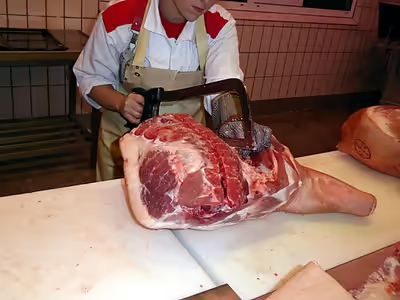
After the carcasses are chilled (unless "hot-boned"), primary butchery consists of selecting carcasses, sides, or quarters from which primal cuts can be produced with the minimum of wastage; separating the primal cuts from the carcass; trimming primal cuts and preparing them for secondary butchery or sale; and storing cut meats. Secondary butchery involves boning, trimming and value-adding of primal cuts in preparation for sale. Historically, primary and secondary butchery were performed in the same establishment, but the advent of methods of preservation (vacuum packing) and low cost transportation has largely separated them.
In parts of the world, it is common for butchers to perform many or all of the butcher's duties. Where refrigeration is less common, these skills are required to sell the meat of slaughtered animals.
Butcher shop
Butchers sell their goods in specialized stores, commonly termed a butcher shop (American English), butchery (South African English) or butchers (British English). Butchers at a butcher shop may perform primary butchery, but will typically perform secondary butchery to prepare fresh cuts of meat for sale. These shops may also sell related products, such as Charcuterie, hot food (using their own meat products), food preparation supplies, baked goods and grocery items. Butcher shops can have a wider variety of animal types, meat cuts and quality of cuts. Additionally, butcher shops may focus on a particular culture, or nationality, of meat production. Some butcher shops, termed "meat delis", may also include a delicatessen.
In the United States and Canada, butcher shops have become less common because of the increasing popularity of supermarkets and warehouse clubs. Many remaining ones are aimed at Hispanic and other immigrants or, more recently, those looking for organic offerings. Supermarkets employ butchers for secondary butchery, but in the United States even that role is diminished with the advent of "case-ready" meat, where the product is packaged for retail sale at the packinghouse or specialized central processing plants.
Hot boning
Hot boning is a process used by butchers to remove the meat from the carcass almost instantly after the animal is slaughtered. This is done to prevent rigor mortis (Chemical changes causing stiffening of the limbs and corpse). Warm meat is often softer and easier to remove from the bone, and hot boning can save refrigeration costs. Cattle, Lamb, and Pigs are the animals most frequently hot boned.
Relevance
Popularity and relevance of the art of butchering have shifted over the years both geographically and historically. Meat demand has risen dramatically over the centuries, but in many Western countries, like the United States, Butcher shops are less prevalent. Meat markets have grown by an average 5.1% per year since 1970, and this is largely due to urbanization and demand. In the United States, meat is mass-produced and then shipped to stores that can sell large amounts quickly and keep the meat frozen. Individual butcher shops with contracts to small farms struggle to keep their prices low enough to match large industries.
Butcher shops are still common in many European and South American countries. In countries like Argentina meat consumption was as high as 97 kilograms per person in 2002, with the vast majority of it being beef.
In asian countries, butchering consists of more "nose to tail" butchering practices, which involves using every part of the animal, including common parts that are typically thrown away in the West, like pig blood, chicken feet, rabbit head, tripe, and tendon. Often these meats are harvested with specialty knives like the Caidao, hankatsu, and honesuki.
Meat departments
In the United States and in other western countries, many customers have become familiar with meat departments in grocery stores and supermarkets rather than butcher shops. Meat departments are used to sell and take in more product faster and more efficiently. Butchers who work in meat departments have tasks like small scale cutting and cleaning, as well as marinating, packaging and ordering shipments of meat. Butchers in meat departments almost never assist in the slaughtering process.
Most meat departments sell fresh (never frozen) cuts of meat. Many butchers are able to manipulate the "bloom" aspect of meat (the bright red color of steaks that looks fresh). When meat is first cut, it will appear purple. This is due to a surplus of myoglobin on the surface; once the meat has first warmed up to room temperature, oxygen is added to the meat to oxidize myoglobin, which produces oxymyoglobin, giving the meat the scarlet red color that consumers indicate as fresh. Through this process, supermarkets and meat departments are able to make meat appear fresh for longer periods of time. This process is referred to as "blooming".
Primal cut
A primal cut is a piece of meat initially separated from the carcass during butchering. Different countries and cultures make these cuts in different ways, and primal cuts also differ between type of carcass. The British, American and French primal cuts all differ in some respects. One notable example with pork is fatback, which in Europe is an important primal cut of pork, but in North America is regarded as trimmings to be used in sausage or rendered into lard. The primal cuts may be sold complete or cut further.
Metaphorical use
- See also Butcher (disambiguation)
In various periods and cultures, the term "butcher" has been applied to people who act cruelly to other human beings or slaughter them. For example, Pompey, a prominent Roman general and politician of the first century BC, got the Latin nickname adulescentulus carnifex, translated as "The Teenage Butcher" or "The Butcher Boy", due to brutal treatment of political opponents in the early part of his career. More recently, the Bosslot Serb war criminal Ratko Mladić was nicknamed "the Butcher of the Balkans".
The term can also be used in a semi-humorous or metaphorical way to describe someone whose actions resemble the various skills and methods of a butcher (chopping, cutting, slicing, stabbing etc.) Spanish footballer Andoni Goikoetxea was popularly ascribed the epithet "The Butcher of Bilbao" in recognition of his perceived aggressive style of play and frequent, sometimes injurious, challenges on opposing players.
Notable butchers and butcher shops
- Dario Cecchini
- Lobel's of New York
- Tom Mylan
- Omaha Steaks
- Arthur Orton
- Pat LaFrieda Meat Purveyors