

Chaitanya Mahaprabhu
Indian Vaishnavite Hindu saint (1486–1534)
- 9 min read
- 9 chapters

Related on Lably
He is considered the chief proponent of the Vedantic philosophy of Achintya Bheda Abheda. The concept of inconceivable difference in non-difference, known as achintya-bhedabheda, was explained later by Jiva Goswami in his book Bhagavat Sandharbha, and in his Sarva-samvadini.
Mahaprabhu founded Gaudiya Vaishnavism. He expounded Bhakti yoga and popularised the chanting of the Hare Krishna Maha-mantra. He composed the Shikshashtakam (eight devotional prayers).
Chaitanya is sometimes called Gauranga (IAST: Gaurāṅga) or Gaura due to his molten gold–like complexion. His birthday is celebrated as Gaura-purnima. He is also called Nimai because he was born underneath a Neem tree.
Life
The religious hagiographies of Gauḍīya sampradāya are the only sources available for the reconstruction of Chaitanya's life. These texts (in Sanskrit and Bengali), consider Chaitanya to be an avatāra of Kṛṣṇa, Svayaṁ Bhagavān, Rādhā-Kr̥ṣṇa (joint and separate), Nārāyaṇa, Viṣṇu, and Jagannātha. A canonical narrative was established in early 1600s through the Caitanya Caritāmṛta of Kṛṣṇadāsa Kavirāja, which is regarded within the tradition as the "final word" on Gauḍīya history and theology.
Sign in to keep reading
8 more chapters are free with a Lably account.
Birth
Chaitanya was born in Nabadwip, in the Nadia district of present-day West Bengal, on the evening of Friday, 18 February 1486, although some accounts give the date as 27 February. His birth occurred on the full moon during a lunar eclipse in the Hindu month of Phālguna. He was the tenth child of Jagannātha Miśra, a Brahmin originally from Sylhet, and his wife, Śacidevī. Traditional accounts state that eight of the couple's previous children, all daughters, died in infancy. Chaitanya's only surviving elder sibling was his brother, Viśvarūpa. At birth, he was given the name Viśvambhara, but he became widely known by the nickname Nīmai. Neighbors also called him Gauraṅga or Gaura, meaning "fair-complexioned", because of his bright complexion. Hagiographies portray his birth as a divine event that foretold his future mission of propagating harināma saṃkīrtana in Kali Yuga.
Family and paternal ancestry
Chaitanya's father, Jagannātha Miśra, also known as Purandhara Miśra, left his ancestral home in Dhakadakshin, Sylhet, in present-day Bangladesh, and settled in Nabadwip. He reportedly moved there to pursue higher education and to live on the banks of the Ganges. His mother, Śacidevī, was the daughter of Nīlāmbara Chakravartī, a scholar and astrologer. Nīlāmbara was reportedly a fellow student of prominent scholars such as Bishārada, the father of Sārvabhauma Bhaṭṭācārya. According to the biographer Jayānanda in the Caitanya Maṅgala, the family's earlier roots lay in Jajpur, Odisha. Chaitanya's paternal grandfather, generally identified in historical records and hagiographies as Upendra Miśra, is said to have migrated from Jajpur to Sylhet during the reign of Kapilendra Deva, around 1451 CE. Some genealogical traditions trace the paternal line further back through Madhukar Miśra and Viśuddha Miśra.
Childhood
In his infancy, he would reportedly not stop crying unless the women of the neighborhood chanted the names of God. His parents reportedly discovered the symbols of a banner, thunderbolt, conch, and discus on his feet. This led his maternal grandfather Nīlāmbara Chakravartī to predict that the child would be an extraordinary figure.
There are several legends associated with his childhood. He was reportedly found playing with a venomous snake in his yard. On another occasion he sat on a pile of discarded cooking pots to teach his mother that nothing is impure if it is used in the service of God. He was once kidnapped by two thieves to steal his gold jewelry. However, the thieves reportedly became disoriented and "bewitched" by the child so that they inadvertently carried him back to his own doorstep, thinking that they were at their own destination. A visiting Brahmin once prepared an offering for his deity, and Chaitanya ate it. This occurred three times, after which the Brahmin reportedly had a vision that the child was himself the deity to which he was worshipping and offering the prepared food. He was also known to be mischievous, teasing the local girls at the riverbanks, hiding their clothes, putting seeds in their hair, and jokingly asking them to marry him. He would also steal milk and rice from his neighbors, often evading capture.
Education
Chaitanya began his formal education at the age of five in a local ṭol (seminary). He proved to be a child prodigy, mastering Sanskrit grammar and Navya-nyāya (neo-logic) with remarkable speed. During the early educational years, when he was roughly six to ten years old, his older brother Viśvarūpa took saṃnyāsa and left home. For a period of time Chaitanya consoled his grieving parents. Later, around the age of eleven or twelve, his father died, making him assume the responsibilities of the house.
He continued his education under scholars such as Gaṅgādāsa Paṇḍita, Sudarśana, and Viṣṇupāda. One legend states that he wrote an exceptionally brilliant commentary on logic. However, when he realized his work was so superior that it would eclipse the reputation of his friend Raghunātha Śiromaṇi, he threw the manuscript into the Ganges. At age sixteen Chaitanya established his own ṭol (seminary) at the home of Mukunda Sañjaya. He quickly became a sought-after teacher in Navadvipa, becoming known as "Nīmai Paṇḍita". Shortly after beginning his teaching career Caitanya fell in love with Lakṣmīpriyā, daughter of a Navadvīpa brāhmaṇa named Vallabhācārya (not to be confused with Vallabhācārya the founder of the Puṣṭimārga), at first sight, subsequently marrying her.
As time went on, his intellectual confidence turned into scholarly pride. Chaitanya then embarked on a tour of East Bengal to earn wealth through teaching and debate. He was known to be talkative and flippant, defeating senior scholars in debates and picking flaws in their logic. He is said to have once defeated Keśava Bhaṭṭa of the Nimbārka school in a debate on Sanskrit prosody, an example of his "superhuman erudition". While he was away from home, his wife Lakṣmīpriyā died from a snakebite. Upon his return he was deeply affected by the loss. On his mother's request, he married again to Viṣṇupriyā, daughter and only child of the court scholar Sanātana Miśra.
The Sankirtan movement
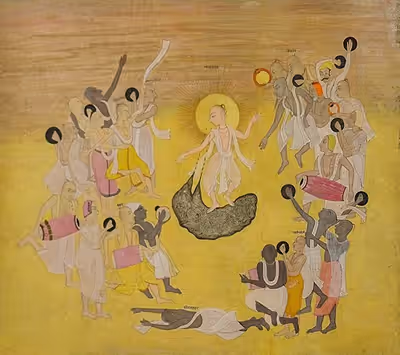
Around 1508-1509 he travelled to Gaya to perform śrāddha (funeral rites) for his father. There he met the ascetic Īśvara Purī, and requested to get initiated by him. He was given the ten-syllable Gopāla Mantra and experienced a spiritual awakening. He then returned to Navadvipa. He is said to have abandoned his scholarly pride for "rapturous devotion to Krishna". He would frequently fall into trances, crying out for God, and losing external consciousness. He closed his school and dedicated himself to saṃkīrtana (congregational chanting). Along with his associates Nityānanda and Advaita Ācārya, he engaged in ecstatic public worship/chanting. This movement faced opposition from the local Muslim ruler, the Chand Kazi. The ruler banned the congregational chanting. Chaitanya responded by leading a peaceful protest of thousands to the ruler's house, leading to the ruler converting to his cause.
At the age of twenty-four, Chaitanya decided to enter the renounced order of life (saṃnyāsa) to spread his message. He felt this would allow him to overcome the opposition of those who viewed him merely as a local scholar. In 1510 he received the monastic vows of renunciation from his guru Keśava Bhāratī at Katwa. He was given the name "Śrī Kṛṣṇa Caitanya". At his mother's request he decided to make Jagannatha Puri in Odisha his headquarters. He traveled there with a few companions, stopping at the home of Advaita Ācārya in Shantipur along the way. Shortly after arriving in Puri, Chaitanya converted the famous monistic scholar Sārvabhauma Bhaṭṭācārya to his devotional philosophy. He then spent approximately two years traveling extensively through the southern part of India. There he met Rāmānanda Rāya and discussed the highest stages of Rādhā-bhāva. Upon returning from the South in 1512, Chaitanya was met at Alalnath by his companions including Nityānanda and Sārvabhauma Bhaṭṭācārya. Then, in Puri, King Pratāparudra arranged for Chaitanya to reside in a secluded room within the house of Kāśī Miśra, known as the Gambhīra, where he would spend most of his remaining years.
Although Chaitanya initially refused to meet the king because he was a "worldling", he was eventually moved by the king's devotion. During the Rathayātrā festival, the king performed the lowly service of sweeping the road before the deity's car. This pleased Chaitanya so much that he finally granted the king a personal interview. Chaitanya established a tradition of personally sweeping and washing the Gundicha temple with pitchers of water before the Rathayātrā festival. In 1514 Chaitanya set out for Vrindavan, travelling first through Bengal. At the village of Ramakeli, he met two brothers who were high-ranking ministers for the Muslim Sultan Husain Shah. He accepted them as his disciples and renamed them Rūpa and Sanātana. After his renunciation, Chaitanya spent his time teaching Kr̥ṣṇa bhakti and engaging in communal saṁkīrtana. Hagiographies describe debates with followers of Advaita Vedānta and other theological opponents in form of digvijaya (conquest through debate). He spent two months in Vrindavan in c. 1515, where he instructed Sanātana Gosvāmī and Rūpa Gosvāmī. He spent the last two decades of his life in Puri, where his ecstatic seizures yearning for Kr̥ṣṇa and his consorts, mainly Rādhā, intensified. He died in c. 1528-1534.
Teachings
The Śikṣāṣṭaka is the only work accepted to be composed by Caitanya. The poem expounds upon the subjects of harināmajapa, saṁkīrtana, the relationship between individual souls and Kr̥ṣṇa, devotional submission to Kr̥ṣṇa, and Caitanya's personal virahabhakti. Sri Caitanya founded the great Gauḍīya Vaiṣṇava sect.
According to Murari Gupta, one of Caitanya's close associates, Caitanya taught that kirtana (chanting God's name) is the most effective spiritual practice in the Kali Age. He first gathered the community for kirtana in Srivasa's courtyard. Caitanya revealed bhakti as the primary means to approach Krishna, and he appointed the Goswamis, such as Srinivasa Acarya and Narottama Dasa, to gather and compose texts explaining this devotion.
According to Dinesh Chandra Sen's analysis, Caitanya's teaching is centered on prema (divine love), described in Vaishnava texts as progressing through different spiritual phases. Sen also states that Caitanya integrated compassionate service and taught that devotion to God is higher than social distinctions, quoting Caitanya's words "The moment that you say you love God, all human beings will be your brethren; there will be no Brahmin, no Sudra".
Biographies
Chaitanya Mahaprabhu's life and teachings are described in numerous biographical, devotional, and scholarly works composed in several languages over the centuries.
Works on Chaitanya:
- Śrī Kṛṣṇa Caitanya Caritāmṛtam by Murari Gupta.
- Chaitanya Bhagavata by Vrindavana Dasa Thakura.
- Krsna-Caitanya-caritra-mahakavya by Kavi Karnapura (Paramanand Sen).
- Caitanya-caritāmṛta-kavya by Kavi Karnapura (Paramanand Sen).
- Caitanya-caritāmṛta by Krishnadasa Kaviraja.
- Caitanya-Mangala by Jayananda.
- Chaitanya Mangala by Lochana Dasa (Trilocan Dasa).
- Chaitanya-chandrodaya-kaumudi by Premadas (Purushottam Mishra).
- Gaura-ganoddesha-dipika by Kavi Karnapura (Paramanand Sen).
- Chaitanya-samhita by Bhagirath Bandhu.
- Chaitanya-vilasa by Madhava Dasa.
- Gauranga-vijay by Chundamani Dasa.
- Sriman-mahaprabhor-asta-kaliya-lila-smarana-mangala-stotram by Visvanatha Chakravarti.
- Sri Gauranga-Lilamrta by Krishna Dasa.
- Caitanya-upanisad.
- Sri Caitanya-caranamrta Bhasva by Bhaktivinoda Thakur.
- Amrita-pravaha-bhashya by Bhaktivinoda Thakur.
- Anubhāsya by Bhaktisiddhanta Sarasvati.
- Śrī Caitanya-caritāmṛta by A. C. Bhaktivedanta Swami.
- Krishna-Caitanya, His Life and His Teachings by Walther Eidlitz.
Cultural legacy
The cultural legacy of Chaitanya is defined by a socio-religious revival that reshaped the literary theological, and social landscape of Eastern India and beyond. Though he left only eight verses in writing, the movement he inspired produced an array of philosophical and aesthetic literature.
Noted Bengali biographical film on Chaitanya, Nilachaley Mahaprabhu (1957), was directed by Kartik Chattopadhyay (1912–1989). A Bengali film based on Chaitanya's demise, Lawho Gouranger Naam Rey (2025), is directed by Srijit Mukherji.