

Chera dynasty
Dynasty in ancient South India
- 16 min read
- 7 chapters

Learn it on Lably
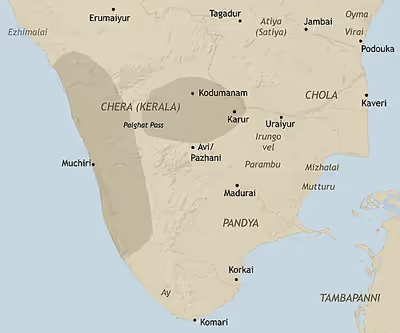
The Cheras of the early historical period (c. second century BCE – c. third/fifth century CE) had their capital in interior Tamil country (Vanchi-Karuvur or Karur, the Kongu country), and ports/capitals at Muchiri-Vanchi (Muziris) and Thondi (Tyndis) on the Indian Ocean coast of Kerala. They also controlled Palakkad Gap and the Noyyal River valley, the principal trade route between the Malabar Coast and eastern Tamil Nadu. The bow and arrow, or just the bow, was the traditional dynastic emblem of the Chera family.
The major pre-Pallava polities of southern India — ruled by the Cheras, Pandyas, and Cholas — appear to have displayed a rudimentary state structure. Early Tamil literature, known as the Sangam texts, and extensive classical Graeco-Roman accounts are the major sources of information about the early historic Cheras. Other corroborative sources for the Cheras include Tamil-Brahmi inscriptions, silver portrait coins with Tamil-Brahmi legends, and copper coins depicting the Chera symbols of the bow and the arrow on the reverse. With the close of the early historical period, between the third and fifth centuries CE, the Cheras witnessed a substantial decline in power.
"Kadal Pirakottiya" Chenkuttuvan, the most celebrated Chera ruler of early Tamil literature, is famous for the traditions surrounding Kannaki, the principal character of the Tamil epic poem Chilappathikaram. Several medieval dynasties, such as the Cheras of Karur (Kongu country), Satiyaputra Cheras of Thagadur, and the Chera "Perumals" of Mahodayapuram (Kerala) claimed descent from the early historic Chera rulers. The ruling lineage of the kingdom of Venad, the Kulasekharas, was also known as the "Chera dynasty".
Etymology
The Tamil title "Chera", along with its variants such as "Cheraman" and "Cheralar/Cheral", and its various Indo-Aryan equivalents like "Kedalaputho" or "Kerala", refers to the ruling dynasty or family, the people, and the geographical region(s) associated with them. The title "Cheraman" is generally believed to be a shortened form of the phrase "Cheramakan", which is also considered the original root of the phrase "Keralaputras".
The etymology of the term "Chera" remains a subject of debate among historians.
- The ancient Tamil term "Cheralam" likely means "mountain range", suggesting a connection to the mountainous geography of Kerala or the Malabar Coast.
- It has also been suggested that the word "Chera" derives from the Tamil term "cherppu", meaning "seashore" (the Malabar Coast).
A number of additional theories have also been proposed in historical studies.
It may seem that the title Chera is derived from the Malayalam word "keram" (meaning "coconut palm"). However, the term "keram" itself is believed to have originated from the name Kerala. Alternatively, some suggest that "keram" is simply a shortened form of the Sanskrit word "narikela", meaning "coconut tree".
Variations of the term Chera
The Cheras are cited in ancient non-Tamil sources under different forms of the names "Chera" or "Cheraman". For the first time, they are mentioned as "Kedalaputo" in the edicts of the Maurya emperor Asoka (third century BCE).
Pliny the Elder (1st century CE), author of Natural History, and Claudius Ptolemy (2nd century CE), the astronomer and mathematician, referred to the Cheras of southern India as "Kaelobotros" and "Kerobottros", respectively. The Periplus Maris Erythraei, an early Greek manual of sailing directions written in the 1st century CE, refers to the Cheras as "Keprobotras". These Graeco-Roman names are probably corruptions of the Indo-Aryan term "Kedala Puto/Kerala Putra".
Sign in to keep reading
6 more chapters are free with a Lably account.
Political history from Tamil sources
A large body of Tamil works from the c. second century BCE to third century CE, collectively known as the Sangam (Academy) Literature, describes a number of Chera, Chola, and Pandya rulers. These praise-filled poetic eulogies often glorify the rulers' accomplishments and virtues, perhaps serving to legitimize their political power.
Among these, the most important sources for the Cheras are the Pathitrupathu, the Agananuru and the Purananuru. The Pathitrupattu, the fourth book in the Ettuthokai Anthology, mentions several rulers (and possible heirs-apparents) of the Chera family. Each Chera is praised in ten songs sung by a court poet. The title Pathitrupathu indicates that there were ten texts, each consisting of a decad of lyrics; however, two of these have not yet been discovered. Additionally, the collection has not yet been worked into a connected history and settled chronology.
Gajabahu-Chenguttuvan synchronism
The events described in the early Tamil texts, or the Sangam Literature, are dated to around the first or second centuries CE based on the Gajabahu-Chenguttuvan synchronism, which is derived from certain verses in the Tamil epic poem Silappathikaram. Despite its reliance on a number of conjectures, this method is considered a sheet anchor for dating early historic south India. Complementary archaeological (and epigraphical) evidence broadly seems to support the Gajabahu chronology.
Ilango Adigal, the author of Silappathikaram, describes the renowned Chera ruler Chenguttuvan, a central figure in the epic, as his elder brother. He also mentions Chenguttuvan's consecration of a temple for the goddess Pattini (Kannaki) at Vanchi (the Chera capital on the Malabar Coast). According to the poem, a king named Gajabahu—identified with Gajabahu, a second-century ruler of Sri Lanka—was among those present at the Pattini temple consecration at Vanchi. Based on this context, Chenguttuvan and the other Chera rulers can be dated to either the first or the last quarter of the second century CE.
Apart from the Chera rulers known from the Pathitrupattu, many more are mentioned in other early Tamil collections, such as the Purananuru. However, some of these names are re-duplications.
"Karuvur Eriya" Ol-val Ko Perum Cheral Irumporai is recorded as ruling from the city of Karuvur (present-day Karur, Tamil Nadu). He was praised by the poet Nariveruttalaiyar. Another ruler is "Kadungo" Valia Athan, while certain "Palai Padiya" Perum Kadungo is also mentioned. Anthuvan Cheral Irumporai (c. 140 CE), the father of Chelva Kadumko Vali Athan (of the seventh decade), is another figure of importance. He was a contemporary of the Chola ruler "Mudittalai" Ko Perunar Killi, whose royal elephant famously wandered into the city of Karuvur.
"Yanaikatchai" Mantharam Cheral Irumporai (c. 215 CE) ruled a vast territory, stretching from the Kolli Hills (near Karur Vanchi) in the east to the ports of Thondi and Mantai on the western coast (central Kerala). He defeated his enemies in a battle at Vilamkil. However, he was later captured by the famous Pandya ruler "Thalaiyalanganam" Nedum Chezhian II (early 3rd century CE), though he managed to escape captivity and successfully regain his lost territories.
Other rulers mentioned include Ko "Kothai Marpa", "Thagdur Erinta" Perum Cheral Irumporai, and Kuttuvan Kodai. "Kudakko" Nedum Cheral Athan and Perum Cheral Athan are also listed. Another notable figure is Kanaikkal Irumporai, who is said to have defeated a chief named "Muvan" and imprisoned him. In an act of brutality, Kanaikkal pulled out the teeth of his prisoner and planted them on the gates of the city of Thondi (on the Malabar Coast). Later, when captured by the Chola ruler Chengannan, Kanaikkal committed suicide by starvation. "Kudakko" Cheral Irumporai is also recorded, along with "Kottambalattu Tunchiya" Makkodai, who is probably identical with the "Kottambalattu Tunchiya" Cheraman mentioned in Akananuru (168). Vanchan and "Kadalottiya" Vel Kelu Kuttuvan are further notable names in the tradition. Finally, Man Venko is remembered as a friend of both the Pandya ruler Ugra Peruvaluti and the Chola ruler "Rajasuyam Vetta" Perunar Killi.
Geographical extent
Recent studies on early historic south Indian history suggest that the three major Tamil rulers – the Pandya, the Chera and the Chola – were customarily based in Madurai, Vanchi-Karuvur (Karur) and Uraiyur (Tiruchirappalli), respectively, in present-day Tamil Nadu. Although these early kingdoms may have emerged in river plains with abundant agricultural resources — such as those of the Tamraparni, Vaigai, and Kaveri rivers — they also established major ports/capitals on the Indian Ocean at Korkai, Muchiri-Vanchi (Muziris), and Puhar (Kaveripumpattinam) respectively.
The Chera country of the early historical (pre-Pallava) period consisted of present-day central Kerala and western Tamil Nadu (the Kongu country). Multiple branches of the Chera family ruled simultaneously in central Kerala, with Muchiri-Vanchi and Thondi as their two regional headquarters—both also being important ports on the Indian Ocean—and in the Kongu country (the Irumporai/Porai branch), with Vanchi-Karur as their capital, an important political and economic center. These collateral branches likely competed for the leadership of the Chera country. The southern tip of Kerala was controlled by the minor Ay dynasty, while the Ezhimala rulers controlled the northern Kerala.
State formation
The nature of political organization in pre-Pallava (early historic) southern India remains a subject of active debate among scholars and historians. A major point of contention is the interpretation of early Tamil poems (or the Sangam Literature) alongside archaeological (and numismatic) evidence. A balanced perspective indicates that the existence of at least a rudimentary state structure in early historic south India cannot be denied.
A school of academics/scholars argues that developments in early historic south India occurred within the framework of a state polity. Supporting this perspective is the presence of Tamil-Brahmi inscriptions, dynastic coin issues (numismatic evidence), refined old Tamil poems (the Sangam Literature), urban centers such as Madurai and Vanchi-Karur (urbanization), specialized crafts, and long-distance trade, particularly maritime commerce. Evidence of differential access to and control over resources can be found in poetic references to rulers bestowing expensive gifts, such as gold coins and precious stones. The traditional rulers were major consumers of luxury goods acquired through Indian Ocean spice trade. They also developed key trading ports, such as Muchiri and Korkai, and imposed rudimentary tolls and customs duties. The Pugalur inscriptions notably refer to the Chera king as "Ko", while princes carried the suffixes "Ko" or "Kon" in their names. Additionally, references to an "investiture ceremony" for the Chera heir apparent perhaps highlight the structured nature of succession.
At the top of the political hierarchy of early historic south India were the three "Crowned Kings", or the Vendars (the Chera, Chola, and Pandya), each distinguished by their royal insignias and emblems of power. Lesser rulers, known as "Velir" chieftains, were likely required to pay tribute to the Vendars. Violent conflicts were a common feature of early historic south Indian politics, as kings and chieftains frequently formed alliances and waged battles against one another.
However, this view is sometimes questioned by scholars such as R. Champakalakshmi. They argue that urbanization in early historic south India did not occur within the framework of a state polity. Instead, this period was characterized by tribal chiefdoms (or, at most, "potential monarchies"). The Vendar rulers exercised only limited control over the rice cultivating agricultural plains and relied primarily on tribute and plunder for their sustenance. There was no regular or extensive system of taxation, nor was there a centralized coercive authority. Political organization was based on communal resource ownership, with production structured around kinship ties. Authority was maintained through various redistributive social relationships, supported by the "predatory accumulation of resources". Here, kinship-based chiefdoms operating on a redistributive system formed the economic structure of ancient south India. Subsistence was largely agro-pastoral, and politics was driven by competition and conflict.
This school of scholars deliberately applies the terms "chiefs" and "chiefdoms" to denote the early historic or pre-Pallava Tamil rulers (the Chera, Chola, and Pandya) and the Tamil polities of south India, respectively.
Society and culture
The early Tamil texts, or Sangam literature, reflect a society with unique cultural traditions. The surviving Sangam poems often celebrate themes of war and love. The Puram poems praise the valor and generosity of rulers, while the Akam poems express human emotions through associations with specific geographical landscapes.
In general, the literature reflect the southern Indian cultural tradition and some elements of the northern Indian cultural tradition, which by then was coming into contact with the south. Most of the Chera population, like the rest of the Tamil country, probably followed native Dravidian belief systems. Notable was the belief in Ananku, the sacred forces inhabiting various objects, including humans. It was controlled through the performance of specific rites and rituals. Ananku was also believed to manifest in women, with the notion that in chaste women, it remained controlled and possessed auspicious potential. Certain communities were tasked with performing the rites and rituals needed to regulate the ananku. The worship of departed heroes was common in the Tamil country, along with tree worship and different kinds of ancestor worship. The war goddess Korravai was perhaps propitiated with elaborate offerings of meat and toddy. Korravai was later assimilated into the present-day goddess Durga.
Early migrations from northern India brought Jain and Buddhist influences to the southern regions around the 3rd century BCE. While indigenous practices remained the primary tradition for the majority of the population, a smaller segment consisting primarily of migrant communities adhered to Jainism, Buddhism, and Brahmanism.
The varna classification had limited relevance in early Tamil society. The jati system was also not characteristic of this society, especially as reflected in the restrictions on inter-dining and social interaction. However, early Tamil texts refer to a "kudi"-based social classification in early historic south Indian society. The kudis were clan-based descent groups, linked to production and associated with lineage and hereditary occupations.
In the early historic southern India, women were probably accorded high status (in comparison to the medieval period, in southern India), and poets, bards and musicians were held in high regard in society. Early Tamil texts include several references about the lavish patronage of court poets. Professional poets of all genders composed texts praising their patron rulers, for which they were generously rewarded. It is assumed the institution of "sabha" in south-Indian villages for local administration began during the early historic period.
Economy
The Sangam poems indicate that agriculture, fishing, and cattle rearing were widespread in ancient Tamil society. They also highlight the significance of Indian Ocean maritime trade and the practice of iron forging. The initial phase of urbanization in southern India, and the Chera country, is typically linked to the period from the 3rd century BCE to the 3rd century CE.
Some scholars argue that this urbanization was not driven by socio-economic changes but was instead stimulated by external trade. However, historians sometimes find this view difficult to accept, as trade cannot be regarded as an independent factor, separate from socio-economic processes.
Spice trade
Trading relations with merchants from Graeco-Roman world, or the Yavanas, and with northern India provided considerable economic momentum for southern India; the main economic activity was trade across the Indian Ocean. The earliest Graeco-Roman accounts referring to the Cheras are by Pliny the Elder in the first century, in the first-century text Periplus Maris Erythraei, and by Claudius Ptolemy in the second century. The Periplus Maris Erythraei portrays the trade in the territory of Cheras or "Keprobotras" in detail. The port of Muziris, or Muchiri in Tamil, located in the Chera country, was the most-important centre in the Malabar Coast, which according to the Periplus "abounded with large ships of Romans, Arabs and Greeks". Bulk spices, ivory, timber, pearls and gems were exported from Chera country, and southern India, to the Middle East/Mediterranean regions.
Geographical advantages, such as favorable monsoon winds that carried ships directly from Arabia to south India, the abundance of exotic spices in the interior Ghat Mountains and the many rivers connecting the Ghats with the Arabian Sea allowed the Cheras to become a major power in ancient southern India. Trading in spices and other commodities with Middle Eastern/Mediterranean Graeco-Roman navigators was perhaps extant before beginning of the Common Era and was consolidated in the first century CE. In the first century, the Romans conquered Egypt, which probably helped them gain dominance in the Indian Ocean spice trade.
The Graeco-Romans brought vast amounts of gold in exchange for commodities such as black pepper. The Roman coin hoards that have been found in Kerala and Tamil Nadu provide evidence of this trade. The first-century writer Pliny the Elder lamented "the drain of Roman gold into India and China" for luxuries such as spices, silk and muslin. The Indian Ocean spice trade dwindled with the decline of the Roman empire in the third and fourth centuries, and they were replaced by Chinese and Arab/Middle Eastern navigators.
The nature of the spice trade between the ancient Chera country, and southern India, and the Middle East/Mediterranean regions is disputed. It remains uncertain whether this trade with the Mediterranean world was conducted on equal terms by local rulers and merchants, such as the Cheras and Pandyas. However, early Tamil poems record that these rulers were consumers of luxury goods associated with the Indian Ocean spice trade. They were also involved in long-distance maritime trade, likely by developing ports and imposing rudimentary tolls and customs duties.
Iron technology
There are several ancient Tamil, Greek and Roman literary references to high-carbon steel from South Asia. The crucible steel production process probably started in the sixth century BCE in southern India (as evidenced from Kodumanal in Tamil Nadu, Golconda in Telangana, and Karnataka) and Sri Lanka. The Romans called this steel "the finest steel in the world" and referred to it as "Seric". It was perhaps exported to the Middle East/Mediterranean world by c. early 5th century BC.
The steel was exported as cakes of steely iron that were known as "wootz". Wootz steel was produced by heating black magnetite ore in the presence of carbon in a sealed clay crucible inside a charcoal furnace to completely remove slag. An alternative was to smelt the ore to give wrought iron, then heat and hammer it to remove slag. The carbon source was probably bamboo trees and leaves from plants such as avārai (Senna auriculata). The Chinese and Sri Lankans perhaps adopted the production methods of wootz steel from the south Indians by the fifth century BCE.
In Sri Lanka, this early steel-making method employed a unique wind furnace that was driven by the monsoon winds. Production sites from early historic period have been found at Anuradhapura, Tissamaharama and Samanalawewa, as well as imported iron and steel artefacts from Kodumanal in southern India. A c. 2nd century BC Tamil trade guild in Tissamaharama, in the south-east of Sri Lanka, transported some of the oldest iron and steel artefacts and production processes to the island from early historic southern India.
Legacy
After about the fifth century, the influence of the Cheras appears to have declined significantly compared to the early historic period. Comparatively little is known about the Cheras during this time. The Cheras ruling at Vanchi-Karur (present-day Karur) in the Kongu country (western Tamil Nadu), also called the "Keralas", seems to have dominated the former Chera territories, including present-day Kerala, in this period.
The region subsequently experienced the rise of the Kalabhras, followed by Chalukya or Pallava-Pandya domination, and later the ascendancy of the Rashtrakutas and the Cholas. By around the ninth century CE, central Kerala appears to have separated from the larger "Chera/Kerala kingdom" to form the "medieval Chera kingdom of Kerala" (Mahodayapuram). The medieval Cheras maintained a fluctuating relationship with the neighbouring Cholas and Pandyas, alternating between alliance and conflict. In the early eleventh century CE, the Cholas attacked and eventually forced the Chera kingdom into submission, primarily to break its monopoly on the Indian Ocean spice trade (especially pepper) with the Middle East. When the Chera kingdom in Kerala was dissolved in the early 12th century, most of its constituent chiefdoms became independent.
Scholars often identify the Alvar saint Kulasekhara and the Nayanar saint Cherman Perumal (literally "the Chera king") with some of the earliest medieval Chera rulers of Kerala. During this period, the port of Kollam (later Quilon) emerged as a major hub of Indian Ocean trade with the Middle East and Southeast Asia. The Cheras, along with the Pandyas, also made extensive use of the Vattezhuthu script.
It is also recorded that in the late 12th century AD, the Satiyaputra Kerala or Adigaman Chera rulers governed Thagadur (Dharmapuri) in northern Tamil Nadu under the Chola authority. In southern Kerala, the ruling lineage of Venad — the Kulasekharas — was likewise known as the "Chera dynasty" from the 12th century onwards.