


Related on Lably
Taxonomy
The genus Centropus was introduced in 1811 by the German zoologist Johann Karl Wilhelm Illiger. The type species was subsequently designated as the Senegal coucal by George Robert Gray in 1840. The genus name combines the Ancient Greek kentron meaning "spur" or "spike" with pous meaning "foot".
Sign in to keep reading
2 more chapters are free with a Lably account.
Description
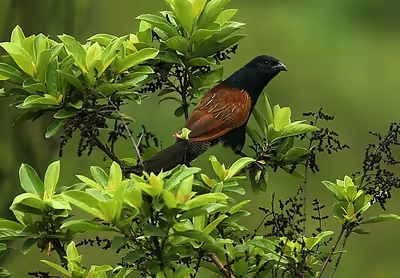
Many coucals have a long claw on their hind toe (hallux). The feet have minute spurs and this is responsible for the German term for coucals Sporenkuckucke. The common name is perhaps derived from the French coucou and alouette (for the long lark like claw). (Cuvier, in Newton 1896) The length of the claw can be about 68-76% of the tarsus length in the African black coucal C. grillii and lesser coucal C. bengalensis. Only the short-toed coucal C. rectunguis is an exception with the hallux claw of only 23% of the tarsus length. Thread like feather structures (elongated sheaths of the growing feathers that are sometimes termed trichoptiles) are found on the head and neck of hatchlings and can be as long as 20mm. Nestlings can look spiny. Many are opportunistic predators, Centropus phasianus is known to attack birds caught in mist nets while white-browed coucals Centropus superciliosus are attracted to smoke from grass fires where they forage for insects and small mammals escaping from the fire.
Coucals generally make nests inside dense vegetation and they usually have the top covered but some species have the top open. Pheasant coucal Centropus phasianinus, greater coucal C. sinensis and Madagascar coucal C. toulou sometimes build an open nest while some species always build open nests (the bay coucal C. celebensis)
Some coucal species have been seen to fly while carrying their young.
Species
The genus contains 29 species: