


Related on Lably
Through Light, Extinction (astronomy) and Radio wave
Dark clouds appear so because of sub-micrometre-sized dust particles, coated with frozen carbon monoxide and nitrogen, which effectively block the passage of light at visible wavelengths. Also present are molecular hydrogen, atomic helium, C18O (CO with oxygen as the 18O isotope), CS, NH3 (ammonia), H2CO (formaldehyde), c-C3H2 (cyclopropenylidene) and a molecular ion N2H+ (diazenylium), all of which are relatively transparent.
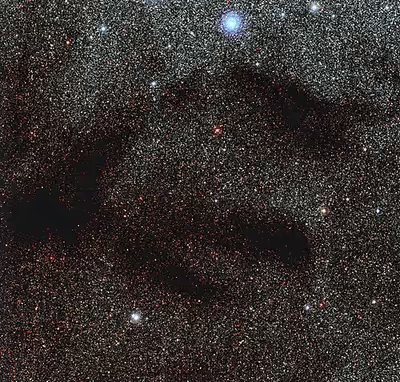
The form of such dark clouds is very irregular: they have no clearly defined outer boundaries and sometimes take on convoluted serpentine shapes. The closest and largest dark nebulae are visible to the naked eye, since they are the least obscured by stars in between Earth and the nebula, and because they have the largest angular size, appearing as dark patches against the brighter background of the Milky Way like the Coalsack Nebula and the Great Rift. These naked-eye objects are sometimes known as dark cloud constellations and take on a variety of names.
In the central regions of dark nebulae and molecular clouds, events such as the formation of stars and maser emission take place.
Complexes and constellations
Along with molecular clouds, dark nebulae make up molecular cloud complexes.
Dark nebulae form part of dark cloud constellations, recognisable in the night sky with the naked eye.
- Great Rift (astronomy)
- Cygnus Rift
- Serpens–Aquila Rift
- Dark Horse (astronomy)
- Rho Ophiuchi cloud complex
- Emu in the sky